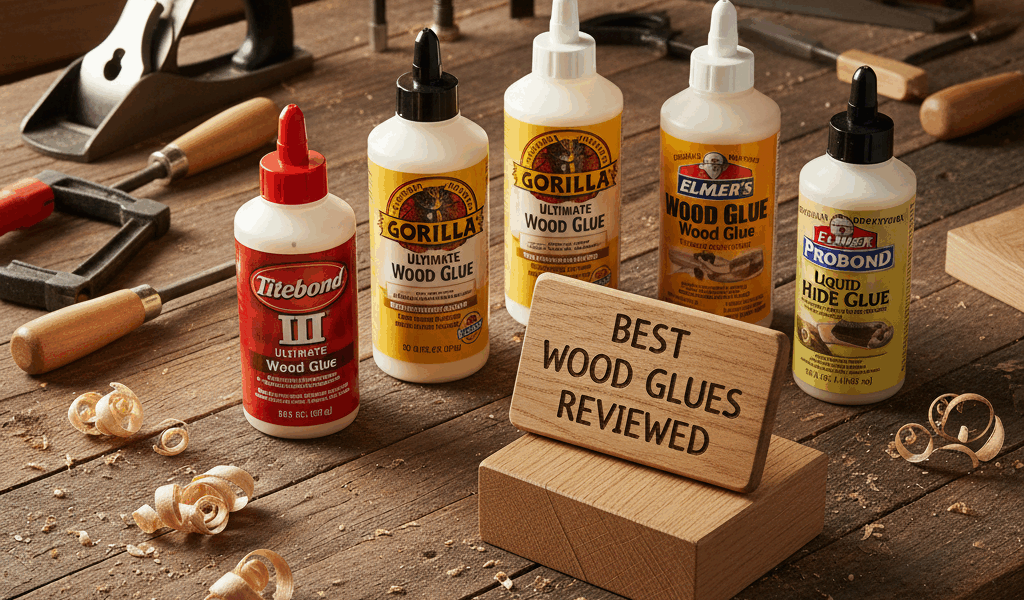
The best wood glue depends on the joint and exposure. For tight-fitting indoor furniture joints, use a woodworking PVA such as Titebond Original. Choose Titebond II when you need Type II water resistance and a shorter working time, or Titebond III when an exterior wood-to-wood project needs Type I water resistance and a longer open time. Use a moisture-cured polyurethane adhesive for dissimilar porous materials, and a properly thickened two-part epoxy when the repair genuinely needs gap bridging.
There is no honest universal winner. A waterproof label does not make an adhesive suitable for constant immersion, a foaming glue does not become structurally stronger by filling empty space, and a high laboratory strength number cannot compensate for a loose, dirty, or poorly clamped joint. The recommendations below use current manufacturer specifications checked August 2, 2026.
Best wood glue by project
| Project | Practical choice | Why | Main caution |
|---|---|---|---|
| Indoor furniture and cabinets | Titebond Original or another woodworking PVA | Fast tack, water cleanup while wet, sandable, designed for interior wood joints | Not intended for exterior exposure |
| Kitchen projects and occasional moisture | Titebond II Premium | Passes ANSI/HPVA Type II water-resistance testing; short working time | Type II is not the same as continuous waterproof immersion |
| Exterior wood-to-wood projects | Titebond III Ultimate | Passes the more demanding Type I water-resistance test and provides longer open time | Follow the product’s temperature, fit, and exposure limitations |
| Wood joined to stone, metal, ceramic, foam, or another material | Original Gorilla Glue or another compatible polyurethane adhesive | Moisture-activated and designed for multiple materials | It expands, requires gloves, and the manufacturer explicitly says it is not gap filling |
| Loose repair or irregular gap | Correctly mixed and thickened structural epoxy | Fillers can bridge uneven surfaces while the epoxy wets the wood | Ratio, surface preparation, filler, cure, and clamping matter |
| Antique repair requiring future reversibility | Appropriate hide glue | Traditional repair compatibility and reversibility can matter more than water resistance | Confirm compatibility with the existing adhesive and conservation goal |
| Temporary positioning or tiny non-structural repair | Cyanoacrylate (CA) | Very fast set and useful for small, close-fitting work | Brittle behavior and short working time make it a poor default for furniture joinery |
For the chemistry and tradeoffs behind these categories, see our separate wood-glue types comparison.
Best for indoor furniture: woodworking PVA
A close-fitting long-grain furniture joint generally does not need an exotic adhesive. Titebond identifies Original as its interior formula for furniture, cabinets, trim, molding, picture frames, stairs, and veneering. It lists an average open time of roughly 4–6 minutes and a 30-minute clamp time under its stated conditions.
PVA works well when the mating surfaces fit, the wood is clean and unfinished at the bond line, and clamping creates contact without starving the joint. Do a dry assembly first. Spread a continuous film, assemble within the product’s working time, and use enough pressure to close the joint—not enough to bow the work or squeeze the bond dry.
Best for water resistance: choose Type II or Type I deliberately
Titebond’s comparison says Original is for interior work, Titebond II passes ANSI/HPVA Type II water resistance, and Titebond III passes Type I. Type I is the more demanding laboratory test. That makes Titebond III a sensible default for many outdoor furniture, planter, mailbox, and birdhouse joints when the design and finish also manage water.
Titebond II offers a shorter working time and may be preferable for quick assemblies that need water resistance but not the Type I classification. Both II and III are described by the manufacturer as compliant for indirect food contact. That claim should not be expanded into a promise that every cured joint, finish, project design, or use condition is suitable for direct food preparation.
Water-resistant adhesive does not make a project weatherproof by itself. End grain, trapped water, wood movement, fasteners, drainage, finish maintenance, and joint design still determine service life.
Best for mixed materials: polyurethane—when compatible
Original Gorilla Glue is a moisture-activated polyurethane adhesive that bonds wood and several non-wood materials. The manufacturer directs users to dampen one surface, apply a thin layer to the other, clamp, and wear gloves. It expands as it cures.
Expansion is not proof of a strong gap. Gorilla’s own technical information says “gap filling: no.” Foam can occupy space without creating the same structural bond as a close-fitting joint. Use polyurethane because the substrates, moisture exposure, temperature range, and directions fit—not because it grows out of the joint.
Best for an irregular repair: thickened epoxy
Epoxy can be the right answer when a sound repair cannot be made perfectly close fitting. WEST SYSTEM’s bonding guidance recommends a two-step process for many structural bonds: wet the wood with neat resin/hardener, then apply epoxy thickened enough to bridge gaps and prevent an epoxy-starved joint.
Epoxy is not simply “mix equal parts and fill anything.” Use the specified resin-to-hardener ratio, prepare the surface, select the right filler, mix thoroughly, observe temperature and working time, and apply only enough clamping pressure to hold alignment and produce modest squeeze-out. Large masses can generate dangerous heat, so follow the product’s limits.
What about Gorilla Wood Glue?
Gorilla Wood Glue is a PVA—not the same chemistry as Original Gorilla Glue. The manufacturer says its wood glue passes ANSI/HPVA Type II water resistance, requires 20–30 minutes of clamp time under stated conditions, fully cures in 24 hours, and dries a natural color. It is a reasonable alternative for indoor or weather-resistant wood-to-wood work when its specific instructions match the project.
This naming distinction matters: “Gorilla Glue” can refer to several different formulas. Read the product name and technical sheet rather than applying one product’s directions to another.
How to choose without relying on brand rankings
- Identify the substrates. Wood-to-wood, oily wood, end grain, finished surfaces, and mixed materials behave differently.
- Evaluate fit. PVA is not a structural filler. Repair or remake a badly fitting joint, or use an engineered repair method.
- Define exposure. Interior, occasional moisture, exterior weather, heat, and immersion are different requirements.
- Check working time. A complex assembly may need more open time than a small joint.
- Check application temperature and moisture. Cold or wet stock can prevent a proper cure.
- Plan cleanup and finish. Glue left on the surface can block stain and remain visible.
- Read the current label and technical sheet. Formula instructions outrank generic woodworking advice.
Common wood-glue mistakes
- Gluing over finish, wax, oil, dust, or a burnished surface.
- Skipping the dry fit and exceeding the adhesive’s assembly time.
- Assuming more glue or more clamp pressure creates a stronger joint.
- Using PVA to bridge a visible gap.
- Calling polyurethane foam “gap-filling strength.”
- Ignoring minimum application temperature or wood moisture.
- Removing clamps early because the squeeze-out feels dry.
- Confusing water resistance with suitability for submersion.
Our wood-glue drying-time guide explains why temperature and humidity change the schedule.
Bottom line
Use interior PVA for ordinary furniture, Type II or Type I PVA when the exposure requires it, polyurethane for compatible mixed materials, thickened epoxy for a properly engineered irregular repair, and hide glue when restoration compatibility matters. The winning adhesive is the one whose technical limits match the joint—not the bottle with the strongest marketing claim.

Stay in the loop
Get the latest crafted wood creations updates delivered to your inbox.