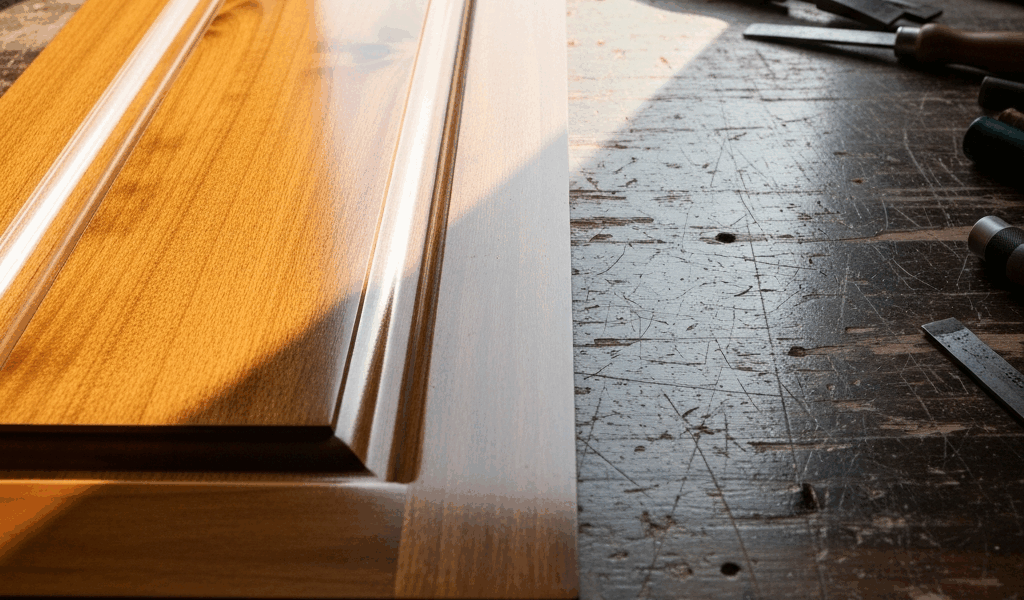
Lacquer and polyurethane are not interchangeable names for the same clear finish. Lacquer is usually chosen when fast recoating, spraying, and repairability matter. Polyurethane is commonly chosen when a brushable film and resistance to abrasion, water, and household use matter. But neither category has one universal dry time or durability rating: nitrocellulose lacquer, pre-catalyzed lacquer, water-based lacquer, oil-based polyurethane, and water-based polyurethane behave differently.
The safest decision is therefore project-first and product-specific. Choose a finish approved for the substrate and use, then follow that exact label for preparation, film build, recoat time, ventilation, and cure. The comparison below is for interior wood unless a product explicitly says otherwise.
Lacquer vs polyurethane at a glance
| Decision factor | Lacquer | Polyurethane |
|---|---|---|
| Typical reason to choose it | Fast production, spray application, thin coats, easier blending or repair | Brush or wipe application and a durable film for furniture, trim, or a product-approved floor |
| Application | Many products are designed for spray; a few are formulated for brushing | Brush, wipe, or spray depending on the exact product |
| Recoat time | Often shorter, but may range from minutes to hours | Often several hours, but water-based and specialty products vary |
| How coats join | Traditional solvent lacquer can partially redissolve into prior lacquer coats | Later coats depend on chemical bonding within the recoat window or mechanical adhesion after sanding |
| Color | Depends on resin; some remain clear while nitrocellulose systems can amber with age | Oil-based products commonly add warmth; many water-based products remain clearer |
| Repair | Often easier to blend when the repair product is compatible with the original finish | Usually requires cleaning and abrasion; spot repairs may show |
| Important limitation | Solvent-rich spray products can create serious fire, vapor, and exposure hazards | Full cure takes longer than “dry to touch,” and compatibility between old and new coatings must be tested |
What “lacquer” means
Lacquer describes more than one coating chemistry. Traditional nitrocellulose lacquer dries mainly as solvent evaporates and is valued for rapid build and the way a compatible fresh coat can soften the previous one. Pre-catalyzed and post-catalyzed lacquers include additional chemistry for better resistance. Water-based products sold as lacquer may apply and cure differently from solvent lacquer.
That distinction matters. A blanket statement such as “lacquer can be recoated in 30 minutes” is not reliable. General Finishes, for example, lists a one-hour-or-longer recoat and a 21-day cure for its water-based Enduro Pre-Cat Lacquer, while other lacquer labels specify different intervals. Temperature, humidity, airflow, coat thickness, and colorants also change drying. Read the Enduro Pre-Cat Lacquer instructions as an example of product-specific guidance.
What “polyurethane” means
Polyurethane also covers several products. Oil-based polyurethane generally adds amber warmth and dries more slowly. Water-based polyurethane usually stays clearer, has lower odor, and may recoat sooner. Water-based oil-modified products combine characteristics of both. Wiping polyurethane is thinned for easier application and normally needs more coats to reach the same film build.
Do not treat “dry,” “ready to recoat,” “ready for light use,” and “fully cured” as synonyms. Minwax Fast-Drying Polyurethane currently specifies recoating after 4–6 hours, 24 hours before light use, and longer restrictions for floors. Those times belong to that product under its stated conditions—not every polyurethane. Consult the Minwax product instructions and the label on your container.
Which finish lasts longer?
“Lasts longer” depends on what damages the surface. A finish can resist abrasion but perform poorly outdoors, tolerate water but be vulnerable to alcohol, or remain intact while its color changes. Substrate preparation and film thickness can matter as much as the resin name.
- Cabinetry, trim, and lightly used furniture: a compatible lacquer system can provide an efficient, attractive finish and easier repair.
- Dining tables and desks: a polyurethane labeled for furniture is often the practical choice, but coasters and prompt spill cleanup still matter. No clear film makes wood maintenance-free.
- Floors: use only a coating specifically labeled for floors. Do not infer floor suitability from “polyurethane” alone.
- Exterior wood: use a product explicitly labeled for exterior exposure and the wood species. Interior lacquer or interior polyurethane is not a substitute for an exterior system.
- Metal: use only a coating whose technical data lists that metal and required primer. A wood-finish comparison cannot determine adhesion or corrosion protection on metal.
For a furniture project exposed to frequent water and abrasion, a suitable polyurethane commonly wins. For sprayed cabinetry where turnaround and future touch-up matter, a suitable lacquer often wins. The exact product data sheet decides the edge cases.
Application: spray, brush, or wipe?
Choose lacquer when the product and workspace support spraying
Many professional lacquers are formulated for spray application. Spraying can create a smooth film and rapid production schedule, but it also atomizes coating and solvent. A dust mask and open window are not an adequate substitute for a compliant spray area, ventilation, ignition control, and the respirator specified by the safety data sheet.
OSHA’s spray-finishing standard requires mechanical ventilation adequate to remove flammable vapors and keep ventilation operating during spraying and afterward. Home woodworkers should avoid improvising with a household fan, whose motor and switches may be ignition sources. Review OSHA 1910.107, the coating’s safety data sheet, and local fire rules. If the workspace cannot meet the product’s requirements, choose a safer application system or have the piece professionally finished.
Choose polyurethane for accessible brush or wipe application
Many consumer polyurethanes are designed for a high-quality natural-bristle or synthetic brush, depending on whether the product is oil- or water-based. Wipe-on formulas trade film thickness per coat for easier control. Do not thin unless the manufacturer permits it; modern coatings can be harmed by a generic “thin the first coat 10 percent” rule.
Apply within the listed temperature and humidity range, keep coats within the recommended thickness, and respect the recoat window. If the label requires sanding between coats, remove dust without contaminating the surface. Our wood-finishing schedule explains how to plan sanding, coating, and cure time.
Can lacquer go over polyurethane?
Do not assume it can. A new coating may attack, wrinkle, soften, or fail to adhere to the old film. The answer depends on the exact lacquer, the exact polyurethane, whether the old coating is fully cured, surface contamination, sanding, and whether the manufacturer approves the combination.
- Identify the existing finish if possible. If it is unknown, treat that uncertainty as a compatibility risk.
- Clean off wax, silicone polish, grease, and other contamination with a method approved for the finish.
- Read both manufacturers’ technical sheets. Look for an approved sealer or barrier coat rather than inventing a stack.
- Test the complete schedule on scrap or a hidden area and allow it to cure—not merely dry to the touch.
- Check for wrinkling, lifting, poor adhesion, cloudiness, color change, and imprinting before coating the whole piece.
The same caution applies to polyurethane over lacquer. A universal claim that one direction always works or always fails is misleading. When the original finish is unknown or valuable, stripping or consulting the coating manufacturer may be safer than experimenting on the piece.
Can you repair lacquer or polyurethane?
A compatible traditional lacquer is often easier to blend because a repair coat can interact with the existing film. That advantage disappears if the original chemistry is unknown or the surface is contaminated. Catalyzed and water-based lacquers may require a different repair schedule.
Polyurethane repairs commonly require thorough cleaning, abrasion for adhesion, and recoating a larger boundary such as an entire tabletop. A deep failure or peeling film may require removal, but not every scratch requires stripping to bare wood. Follow the manufacturer’s maintenance and recoating instructions.
If the project starts with bare wood, choose and test the color layer before the clear finish; our wood stain comparison covers stain types, species, preparation, and project fit.
Color, clarity, and appearance
Oil-based polyurethane usually warms light woods and can continue ambering. Many water-based polyurethanes stay clearer. Nitrocellulose lacquer can also amber, while acrylic and some water-based lacquer products are designed for better color retention. Always make a complete sample on the actual wood, stain, and sealer because the finish changes grain contrast and color.
Sheen does not determine durability. Gloss, satin, and flat versions may use different flattening-agent amounts, so stir as directed and maintain a consistent film. Do not shake a product if its label warns that shaking introduces bubbles.
A practical decision checklist
- Name the substrate: bare wood, stained wood, existing finish, engineered panel, or metal.
- Name the exposure: interior display, daily tabletop use, floor traffic, water, alcohol, sunlight, or weather.
- Choose the application method: brush, wipe, or a properly equipped spray environment.
- Find a labeled product: confirm that its data sheet approves the substrate and use.
- Make a sample: reproduce every layer, sanding step, and drying interval.
- Plan for cure: do not package, stack, install hardware, place rugs, or put the piece into service before the label permits it.
Bottom line: choose lacquer for a product-approved spray system where speed and repairability are priorities. Choose polyurethane for a product-approved brush, wipe, or floor system where a durable household-use film is the priority. Then let the exact label—not a generic category comparison—set the schedule.
Frequently asked questions
Is lacquer the same as polyurethane?
No. They are different coating families, and each family contains several chemistries. Their application, recoat, cure, repair, and compatibility requirements vary by product.
Is lacquer or polyurethane better for a tabletop?
For a frequently used household table, an interior polyurethane labeled for furniture is often the practical choice. Lacquer can be appropriate for lower-wear furniture or professional systems. Make a sample and confirm resistance claims in the product data sheet.
Can I apply lacquer over polyurethane?
Only when the coating manufacturer approves the system or a fully cured test proves compatibility and adhesion. Clean and abrade as directed; never rely on a blanket yes.
Which dries faster?
Many lacquers recoat faster than oil-based polyurethane, but the only valid time is the one on the exact product label under the stated conditions. Full cure is longer than recoat time for both categories.


Stay in the loop
Get the latest crafted wood creations updates delivered to your inbox.