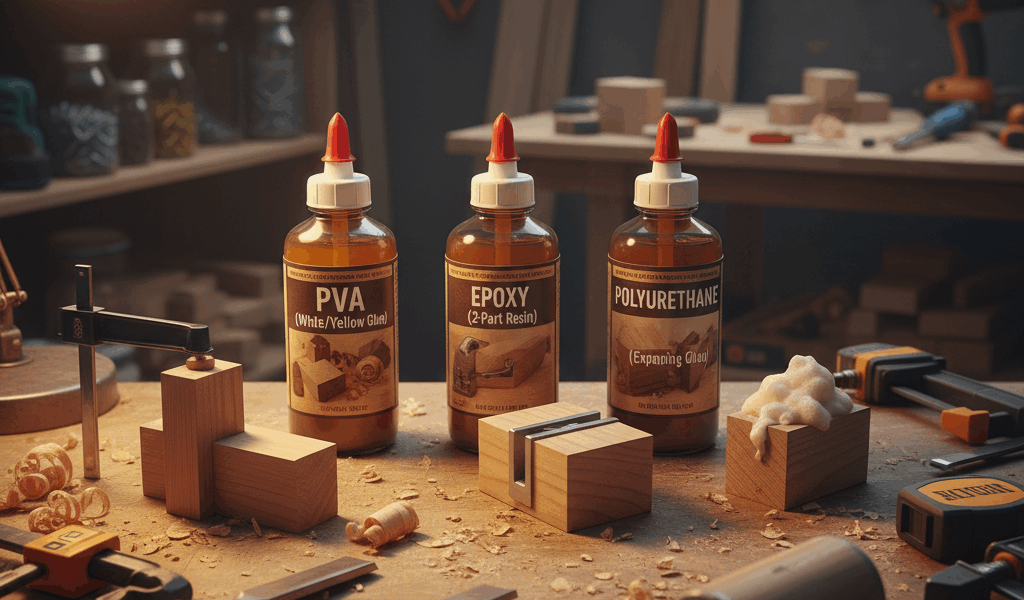
Wood adhesives fall into several useful families: PVA, polyurethane, epoxy, hide glue, cyanoacrylate, and specialized resin adhesives. They cure differently, handle moisture and gaps differently, and are not interchangeable. For most close-fitting furniture joints, PVA is the starting point. Polyurethane helps with compatible mixed materials, thickened epoxy can bridge irregular gaps, hide glue suits certain restoration work, and CA glue is best reserved for small or temporary tasks.
Wood glue types at a glance
| Type | Best use | Water/exposure behavior | Gap behavior | Key limitation |
|---|---|---|---|---|
| PVA/aliphatic resin | Close-fitting wood-to-wood joinery | Varies by formula: interior, Type II, or Type I | Poor structural gap filling | Needs contact and suitable temperature/moisture |
| Polyurethane | Compatible wood-to-dissimilar-material bonds | Many formulas offer strong water resistance | Expands, but foam is not structural gap filling | Moisture activation, gloves, messy squeeze-out |
| Two-part epoxy | Repairs, mixed materials, irregular joints | Depends on system and service conditions | Can bridge gaps when properly thickened | Exact mixing, surface prep, filler, and cure are critical |
| Hot or liquid hide glue | Furniture restoration, instruments, traditional joinery | Generally poor moisture resistance | Not a substitute for sound joinery | Temperature, freshness, and technique matter |
| Cyanoacrylate (CA) | Small repairs, jigs, temporary positioning | Formula dependent | Best in thin, close-fitting bonds unless using a filled repair system | Short working time and brittle behavior |
| Specialized resin adhesives | Veneering, laminating, production pressing | Formula dependent | Designed for controlled bond lines | Mixing, pressure, temperature, and safety requirements |
PVA wood glue
Polyvinyl acetate and related woodworking emulsions are the everyday choice for furniture, cabinetry, trim, frames, and many laminations. They spread easily, clean with water while wet, and develop strong bonds in properly prepared wood joints.
The formula matters. Titebond’s current comparison describes Original as an interior adhesive, Titebond II as passing ANSI/HPVA Type II water-resistance testing, and Titebond III as passing the more demanding Type I test. These classifications concern water resistance under defined tests; they are not a universal rating of joint strength or permission for continuous immersion.
PVA does not turn a loose joint into a sound joint. The adhesive depends on close contact and adequate wood surface. Glue-starved end grain, oily wood, finished surfaces, cold stock, high moisture, or assembly after the open time can all undermine the bond.
Polyurethane wood adhesive
One-part polyurethane adhesives cure with moisture and can bond wood to materials such as stone, metal, ceramic, and some foams. Original Gorilla Glue instructs users to dampen one surface, apply a thin film to the other, clamp, and wear gloves. It expands during cure.
Do not confuse expansion with structural gap filling. Gorilla’s technical page explicitly lists the product as “gap filling: no.” The foamed material can look substantial but has less density than a properly designed bond line. Confirm compatibility with every substrate and test an unfamiliar combination.
Epoxy adhesive
Epoxy combines resin and hardener in a specified ratio. It can bond wood, metals, composites, and other prepared surfaces, and fillers can change its viscosity and gap-bridging behavior. The correct method is system-specific.
WEST SYSTEM recommends wetting porous bonding surfaces with neat epoxy and then applying a thickened mixture for many structural bonds. This reduces the risk of the wood absorbing resin and leaving a starved joint. Clamp only enough to maintain contact and alignment; excessive pressure can squeeze the adhesive out.
Epoxy generates heat as it cures. Do not improvise ratios or cast deep masses with a laminating/bonding system. Follow the manufacturer’s batch-size, thickness, ventilation, protective-equipment, and cure instructions.
Hide glue
Traditional hot hide glue is made from animal collagen and is valued for restoration, musical instruments, and joinery that may need to be reversed later. Liquid hide glue provides a longer room-temperature workflow but has its own shelf-life and cure requirements.
Hide glue is not the default for exterior or wet service. Its strengths are repair compatibility, a hard glue line, and reversibility under appropriate heat and moisture. Before repairing an antique, identify the existing adhesive; adding a modern glue over contaminated old adhesive can make future conservation harder.
Cyanoacrylate glue
CA glue cures quickly and comes in thin, medium, and thick viscosities. Woodworkers use it for small repairs, stabilizing tiny cracks with an appropriate system, attaching templates, and temporary positioning with tape. It is convenient, but short open time, brittleness, blooming, and limited bond area make it a poor general replacement for PVA furniture joinery.
Avoid skin and eye contact, use ventilation, and follow the label. CA can react rapidly with some fibers and materials, generating heat.
Specialized veneer and laminating adhesives
Large veneer, bent-lamination, and production panels may use urea-formaldehyde, plastic-resin, contact, or other purpose-built adhesives. These systems can offer long open times, rigid glue lines, or compatibility with presses, but they also introduce precise mixing, pressure, temperature, ventilation, and safety requirements.
Contact adhesive is useful for some laminates but is not a structural wood-joinery glue. Construction adhesive can bridge irregular building-material joints but is not a substitute for furniture adhesive when a thin, rigid, finishable bond line is required.
How water-resistance ratings work
Titebond explains that Type II testing repeatedly soaks and heats specimens, while Type I testing is more rigorous and includes boiling-water cycles. Passing one of these standards is useful evidence for that adhesive formula, but the finished project still depends on wood species, joint design, drainage, fasteners, finish, movement, and maintenance.
“Waterproof” also does not automatically mean approved for below-waterline use or continuous submersion. Check the exact product limitations.
Which wood glue type should you use?
- Indoor table, chair, cabinet, or frame: close-fitting PVA joinery.
- Outdoor planter or furniture: a Type I or suitable Type II formula, plus weather-conscious design and finish.
- Wood to another compatible material: polyurethane or epoxy selected from the manufacturer’s substrate chart.
- Irregular structural repair: an engineered epoxy repair with the correct filler and surface preparation.
- Antique furniture: identify the old glue and consider hide glue or a conservator’s recommendation.
- Small jig or quick tack: CA glue where the bond’s limitations are acceptable.
For product-level recommendations by project, use our best wood glue guide. For scheduling and clamp removal, see how temperature and humidity affect wood-glue drying time.
Bottom line
PVA is the default for close-fitting wood joinery, but exposure determines which PVA formula fits. Polyurethane is useful for compatible mixed materials, epoxy is the versatile repair and gap-bridging system when properly formulated, hide glue serves restoration, and CA handles small or temporary tasks. Choose chemistry from the joint requirements and current technical sheet—not from a generic strength ranking.

Stay in the loop
Get the latest crafted wood creations updates delivered to your inbox.