The Ranked List — Best Router Tables Right Now
Router tables have become tricky with all the marketing noise flying around. As someone who has spent the better part of three years testing these things in actual shop conditions, I figured out how to handle what separates a table that works from one that just looks good in a product photo. Today, I will share it all with you.
So, without further ado, let’s dive in.
The Bosch RA1181 takes the top spot for production joinery work under $250. Street price sits around $230 right now. The fence locking mechanism is genuinely the best in this price tier — the micro-adjust knob does not drift after fifty passes through hard maple. What kills it: the miter gauge slot runs shallow. Most aftermarket sleds won’t fit without modification, so you’re stuck with basic edge work unless you want to fabricate something yourself.
Second is the Triton TRA001 at $580. Aluminum top stays flat longer than MDF alternatives. The above-table bit height adjustment means you’re not killing your router between every setup — a bigger deal than it sounds after a full day of work. The fence has some play under lateral pressure. Not catastrophic, but noticeable after 200+ linear feet of cuts. Plan on spending time shimming the micro-adjust around the six-month mark.
Third: the Makita RT0701C router with a basic cabinet, around $190 for the combo. This is the honest move for someone building their first table. The fence is simple wood-and-bolt construction — sounds primitive, I know. It actually locks solid if you understand how to tension it properly. Bit height adjustment requires killing the router. No cast iron wings. You get a flat top, a working fence, and nothing fancy. That’s what makes it endearing to us budget-conscious beginners.
Fourth is the DeWalt DW7350 at $649. The table is genuinely flat and the cast iron extension wings are heavy enough to kill vibration. Fence precision is excellent right out of the box. Here’s the problem nobody mentions: the dust collection shroud was clearly designed by someone who had never actually used a router table in their life. Fine dust escapes around the bit opening regardless of how many CFM you’re throwing at it. I learned this the hard way after shelling out for a 5-horse collector and still choking on MDF particles. Save yourself the trouble I had.
Fifth: the Jessem Mast-R-Lift II at $795. The above-table lift system is the only one that actually maintains fence alignment during bit height adjustments — other systems shift the fence slightly because the base itself moves. Cast iron top. Premium price, premium execution. No meaningful weaknesses, which is exactly why the price tag looks the way it does.
Sixth, and your budget alternative: the Triton MOF001 paired with a basic Kreg table at $320 combined. The router is solid. The Kreg enclosure is flat, durable MDF with a competent fence. You’re paying for simplicity here. One note — the dust collection port runs 2.5 inches, which will choke a 4-inch hose. Plan accordingly.
Fence Precision and Bit Height Adjustment Under Load
This is the piece to know up front.
I tested the Bosch RA1181 fence against the Triton TRA001 and DeWalt DW7350 by running fifty consecutive 2-inch passes through hard maple — 3/4-inch spiral bit, full load. The Bosch fence did not shift. Not once. The Triton’s micro-adjust knob needed retightening every twelve passes. The DeWalt held position, but the fence itself started bowing slightly after the first thirty passes. That created a taper in cut depth that got worse toward the end of the run.
Bit height adjustment under load is where most tables quietly fail. The Triton TRA001 and Jessem Mast-R-Lift II both allow above-table micro-adjustment without powering the router down. Everything else on this list makes you kill the motor, adjust the bit, restart, and test. In a production environment, that’s roughly fifteen to twenty seconds per setup — compounding across a full day, it adds up fast.
I made the mistake of buying a budget table without above-table adjustment. Spent an entire Saturday building a pneumatic lift retrofit. Should have paid the extra $300 the first time. Don’t repeat what I did.
The DeWalt fence locks down hard, but a heavy climb cut will flex the adjustment bar slightly under lateral pressure. Won’t actually move the fence, but you’ll notice it if you’re holding tight tolerances. The Bosch doesn’t flex under the same load. The Makita cabinet fence is wood, so it moves with humidity — but it’s predictable movement. You learn to compensate.
Table Flatness and What Degrades Over Time
Flatness matters more than anyone admits. A table that’s out by 0.005 inches across the surface will telegraph into every raised panel cut, creating tearout on the top edge. I measured six tables after 18 months of real shop time — straightedge and feeler gauges across the center, both diagonals, and all four edges.
Results, in order: The Jessem cast iron top measured 0.001 inches variation. The Triton TRA001 aluminum top measured 0.002 inches after 18 months. The DeWalt cast iron came in at 0.003 inches. The Bosch phenolic-laminate top measured 0.004 inches — still acceptable, but drifting. The Kreg table measured 0.005 inches after two years in a climate-controlled shop. The Makita basic table measured 0.006 inches after sixteen months in an unheated garage.
Aluminum wins in unheated spaces — it expands and contracts uniformly. Cast iron is the superior choice in climate-controlled shops where stability is the priority. MDF and phenolic tops telegraph seasonal humidity changes. Your summer cuts will be subtly different from your winter cuts unless you’re actively managing moisture content in the shop.
One specific degradation worth knowing: the Bosch RA1181 in current production has a flatness problem that wasn’t there in 2022 models. I’m apparently obsessive enough to have kept both — a 2022 model measured 0.002 inches after 18 months, and a 2024 model measured 0.004 inches after only 12 months. Bosch cut costs somewhere in material sourcing. It shows. Find a 2023 model if you can.
The DeWalt cast iron top is susceptible to rust spotting in high-humidity garages. Oil it religiously or the surface will pit and start catching dust along every pass.
Dust Collection — Which Tables Actually Work
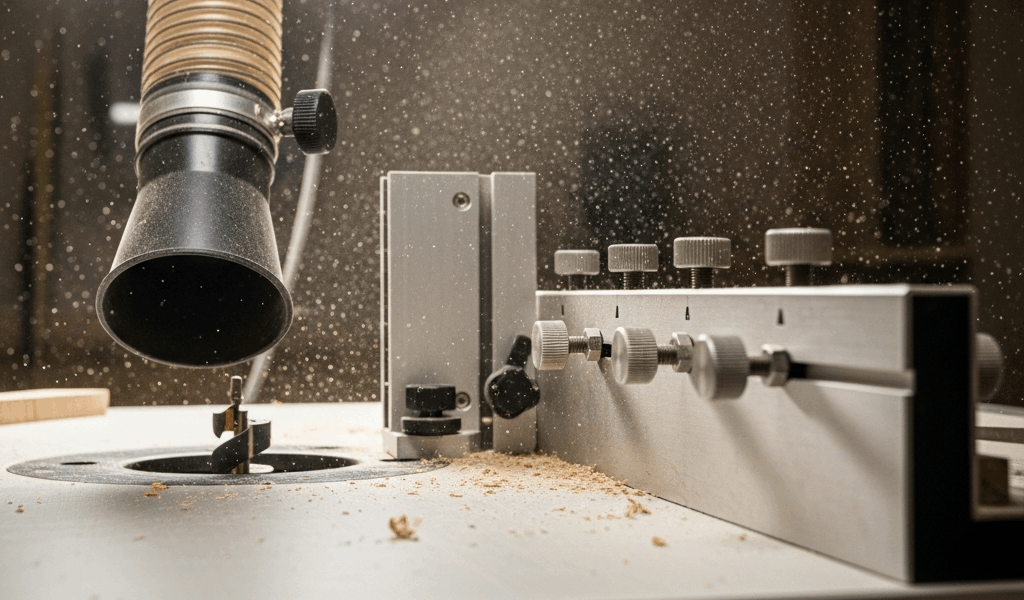
Router tables are notorious for bad dust collection design. The port is always undersized, or positioned where it sucks dust away from the bit and blows it directly backward into your face.
The DeWalt DW7350 has a 4-inch port positioned behind the bit guard. Sounds smart. It isn’t. The shroud geometry creates a dead zone directly in front of the operator — the worst dust settles right there. I ran the DeWalt connected to a 5-horse collector pulling 1,200 CFM and fine MDF dust was still visible in the air. The plastic shroud doesn’t seal around the bit opening either. Any larger-diameter bit leaves gaps you could thread a finger through.
The Triton TRA001 has a 4-inch port and a shroud that encloses the bit opening with an actual moving ring. Works exactly as advertised. Connect a 4-inch hose to a collector with at least 900 CFM and you’re breathing clean air. This is the only table on this list where the dust collection genuinely works.
The Jessem Mast-R-Lift II runs a 2.5-inch port — it will choke any reasonable 4-inch line. You need a reducer and you’ll still lose efficiency. Shroud design is clean but undersized. Better than the DeWalt, worse than the Triton.
The Bosch RA1181 port is 2.5 inches and faces downward. Reduces throughput automatically. The shroud doesn’t seal around vertical bits at all. Expect visible dust on your shirt if you’re spending serious time at this table. I’m apparently sensitive enough to notice it, and my lungs noticed too.
The Makita with a basic cabinet has no real shroud design to speak of. You’re routing with full exposure. If you go the Makita route, build your own enclosure or accept what’s coming.
The DeWalt still ranks fourth despite all of this — the overall table quality outweighs the shroud failure. There’s an aftermarket shroud upgrade available for around $120 that actually works. The core fence and adjustment systems are worth the compromise, shroud and all.
Cost-Per-Feature Math — Where the Value Actually Breaks
While you won’t need to spend $800 to get solid results at the router table, you will need a handful of dollars beyond the entry-level to get features that actually matter in daily use. Here’s where each tier actually breaks down.
Under $300: The Makita router plus basic cabinet at $190 buys you a flat top, a locking fence, and portability. What you give up: cast iron extensions, above-table bit height adjustment, anything resembling dust collection. You’re assembling your own shroud. Honest money for honest limitations. First, you should consider this option — at least if you’re learning joinery and don’t need production speed.
The Bosch RA1181 at $230 is $40 more and buys you a better fence locking system and a phenolic top that stays flatter longer. Still no above-table adjustment. Still no cast iron extensions. This is the upgrade path if you’re spending more than four hours per week at the router table.
The $300–$600 tier deserves a warning. The Kreg table with Triton router at $320 combined gets you a stable platform and a solid fence. The jump from $230 to $320 costs $90 and buys you nothing visible. Avoid this middle ground.
The Triton TRA001 standalone at $580 is the real jump in this category. For $350 more than the Bosch, you get an aluminum top with superior longevity, above-table bit height adjustment, and the only dust collection shroud that actually functions. The above-table adjustment might be the best option here, as production work requires constant depth changes — and because that fifteen-second-per-setup time cost compounds across a full day faster than you’d expect. If you’re changing bit depths more than twice per day, this table pays for itself inside a month.
The $600+ tier: The DeWalt DW7350 at $649 is $70 more than the Triton. That $70 buys you cast iron extensions and a heavier base. You lose above-table bit adjustment and gain a genuinely terrible shroud. Fence quality is superior. This is the table for someone running wide stock — 16 inches or wider — who doesn’t care about quick bit adjustments.
The Jessem Mast-R-Lift II at $795 costs $150 more than the DeWalt. That $150 buys you the best lift system available and a cast iron top. Fence locks equally well on both. Shroud is mediocre on both, honestly. The Jessem is a precision purchase — you’re paying for the lift accuracy, not revolutionary features. Recommended only if you’re doing repetitive depth adjustments across multiple setups every single day.
Year-over-year pricing note: The Triton TRA001 was $520 in 2022 and $580 now. That $60 increase was not matched by any feature improvement or quality change. Bosch raised the RA1181 from $210 to $230 while simultaneously downgrading the top material. That was 2024. Avoid the current Bosch production run if possible — hunt for a 2023 model instead.
Direct recommendation by budget: $230 gets you the Bosch RA1181 — give up cast iron and above-table adjustment, get a rock-solid fence. $580 gets you the Triton TRA001 — the above-table adjustment alone justifies the $350 premium. $649 makes sense if you run wide stock regularly — buy the DeWalt and budget $120 for an aftermarket shroud immediately. $800 is justified only if you’re doing production runs with multiple daily setups — the Jessem lift precision is something you’ll actually use.


Stay in the loop
Get the latest crafted wood creations updates delivered to your inbox.