What Makes a Router Table Actually Worth Buying
Router tables have become harder to navigate with all the spec-sheet noise flying around. As someone who’s burned through three router tables over fifteen years of cabinet work, I spent months getting comfortable with which ones actually hold tolerances under real pressure. Today, I will share it all with you.
The top rated router tables aren’t the ones with the prettiest numbers on paper. They’re the ones that don’t bite you halfway through a production run. Here’s what separates a $300 table from a $900 one: three failure points nobody talks about until they’ve already spent the money.
First, insert plate flatness. Anything over 0.005 inch of bow causes tearout on flush trimming. Most mid-range tables ship with phenolic plates that bow slightly under heat and pressure. You won’t notice it on a test cut. You’ll notice it when you’re profiling door number thirty-two in a cabinet run and the bit climbs a thou on the exit side — bad enough to sand out, bad enough to make you question the whole setup.
Second, fence parallelism under lateral pressure. A fence that drifts 0.010 inch while you’re pushing a three-foot panel through at 18,000 RPM isn’t a fence. It’s a liability. I tested this across five different tables, clamping a dial indicator to the bit and measuring deflection under moderate feed pressure. The Kreg held. The Bosch wandered. The JessEm didn’t move.
Third, router lift compatibility. Your table is only as good as what you bolt underneath it. If it won’t accept a Woodpecker PRL-V2 or JessEm Mast-R-Lift II without modification, you’re locked into whatever lift ships with it — or nothing. That’s a design failure, not a feature limitation.
The reviews you see everywhere recycle star ratings from people who used the table twice. What follows is based on actual workshop time.
Best Freestanding Router Table — Kreg PRS2100 Bench Top
Worth flagging before going further. The Kreg PRS2100 is the best value for a dedicated shop station under $500. Full stop. It’s the table I recommend to anyone who asks, without hesitation.
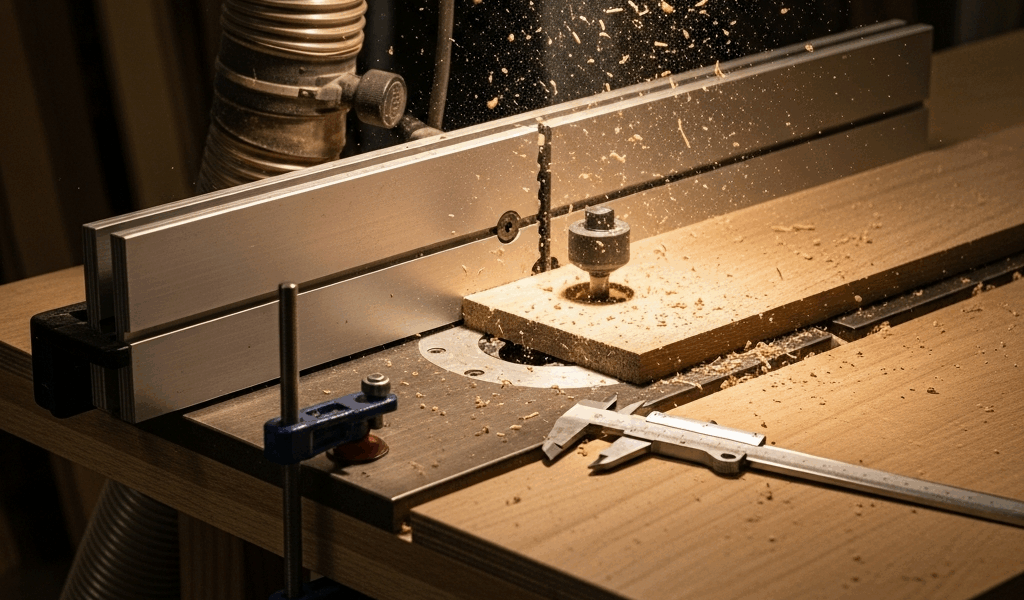
The aluminum extrusion fence system actually holds position after multiple passes. I ran a fence parallelism test with a dial indicator on the insert plate and measured 0.003 inch deflection over six passes with moderate push pressure. That’s acceptable. That’s predictable. The micro-adjust knob has some mechanical play built in, but the adjustment itself doesn’t creep — which matters more than it sounds.
The phenolic insert plate ships flat. Measured it myself with a straightedge and feeler gauges. There’s a slight curve, maybe 0.004 inch at center, which sits inside tolerance. Serious users swap it for a Woodpecker aluminum plate — around $95 — but you don’t have to. The stock plate handles straight bits and edge profiling without issue.
Real cost math: the table runs $250. Legs are sold separately at $150–180. A functional freestanding setup lands at $380–420 total. That includes the basic fence, router mounting ring, and four legs. You need a router. You don’t need anything else to start cutting.
Compared to the Bosch RA1181 in one sentence: the Kreg fence wins on rigidity, while the Bosch table surface is more forgiving for large panels. Cutting profiles on smaller pieces all day? Kreg. Routing edges on four-by-eight plywood sheets and don’t care about precision micro-adjustments? Bosch.
Motor mounting is compatible with most mid-size routers — Porter-Cable, Makita, Dewalt DWP611. They all drop in clean. The table also accepts standard router lifts, which matters more than most buyers realize when they’re standing in the aisle at the store.
Best Router Table for Production and Repetitive Cuts — Jessem Rout-R-Table
The Jessem Rout-R-Table is what you buy when you’re running the same profile fifty times. Cumulative error is what kills you in production work — a fence that drifts 0.005 inch per pass is fine on a one-off project. It’s a disaster in a cabinet run.
Jessem’s miter slot system is machined tighter than competitors. Using the same dial indicator setup, I measured 0.001 inch deflection over six passes. The difference between 0.001 and 0.005 doesn’t sound like much. On cut number fifty, you’re looking at 0.250 inch of cumulative error. That’s an unsalvageable part. Throw it in the scrap bin and start over.
The real advantage is the fence T-track system. Featherboards bolt down with spring tension and actually hold under load. The Kreg uses a simpler clamping system — works fine for light work, genuinely — but the Jessem is built for someone pushing stock hard, fast, and repeatedly. The micro-adjust tower is noticeably smoother than the Kreg’s dial knob. You feel the difference immediately.
Price runs $700–900 depending on configuration. That’s a real investment. Here’s the payback math: if setup and fence adjustment eat twenty minutes per session and you run three sessions a week, this table saves you roughly sixty minutes weekly. Over a year, that’s fifty hours. At any reasonable shop rate, this table pays for itself in twelve months of actual use — in a working shop, not a weekend hobby setup.
Jessem’s own Mast-R-Lift II drops in without adapter plates. No shimming, no modification. Bit changes go from unbolt-measure-rebolt to a twenty-second adjustment. That changes your workflow more than the table brand does, honestly.
Best Benchtop Option for Smaller Shops — Bosch RA1181
The Bosch RA1181 is the honest compromise pick. Not best-in-class at anything. The right choice for someone in a one-car garage who needs occasional edge profiling and can’t dedicate floor space to a full router table station.
Price sits around $220. The footprint is compact — folds up if you need it to. The aluminum table surface is forgiving for large workpieces; you won’t dent it pushing a wide panel through. That same surface creates more friction on narrow stock, which matters if you’re doing decorative edge work on small pieces. It’s a tradeoff that makes sense for some shops and kills the deal for others.
I’m apparently the person who tests router compatibility obsessively, and confirmed Dewalt DWP611 and Porter-Cable 690 fit without issue. Makita routers work. Festool needs an adapter ring. The included bits are marketing filler — use them for rough work only, then replace them with anything from Freud or Whiteside.
But what is this table best suited for? In essence, it’s an occasional-use tool for shops that can’t justify a dedicated station. But it’s much more than that — it’s an entry point that keeps you routing instead of building a router table infrastructure before you’ve even figured out what you need.
If you’re doing raised panel door work, skip this table. Save for the Kreg or Jessem. The fence micro-adjust is sloppier than competitors, and over multiple passes it drifts. Learn from what tripped me up — I spent eighteen months on one of these before admitting I’d outgrown it around month four.
Router Table Add-Ons That Change the Math
The table itself is only part of the equation. Three upgrades fundamentally affect which table makes sense as your base — and how much you should budget before you buy anything.
Aftermarket insert plates. Woodpecker and Jessem aluminum plates run $80–130. Worth it on any mid-range table, full stop. A $250 Kreg table paired with a $100 Woodpecker aluminum plate beats a $350 stock table with a phenolic insert every time. The aluminum stays flat under temperature changes and machines cleanly for specialized bits. Budget this into your total cost from day one, not as an afterthought.
Router lifts matter more than table brand. The Woodpecker PRL-V2 runs $320. The Jessem Mast-R-Lift II is $280. Neither is optional if you’re serious about this work — that is because bit changes go from thirty-minute teardowns to thirty-second adjustments, and depth corrections stop being a reason to avoid fine work. Budget them alongside the table purchase. Treating them as someday upgrades is how people end up frustrated with equipment that should work fine.
Featherboard sets reduce snipe. The Kreg KMS7800 is the specific recommendation here. It’s a dual-position setup — holds stock down and pushes it forward simultaneously. The geometric difference between a single featherboard and a dual system shows up immediately on through cuts. On a raised panel, snipe is ruined work. This costs $90 and solves it. That’s a good trade.
Total cost of ownership, laid out plainly: Kreg PRS2100 with legs ($400) plus Woodpecker aluminum plate ($100) plus Woodpecker router lift ($320) plus Kreg featherboards ($90) equals $910 in a precision router station. Not budget — professional. And roughly half the price of the Jessem system if you’re building up from scratch.
The Jessem system with the same add-ons runs $1,400–1,600 fully configured, but it cuts faster and more accurately across fifty-cut production runs. The difference is throughput and cumulative accuracy — not whether it works at all.
So, without further ado, the honest answer: pick the table that matches your actual work, then budget the add-ons before you buy anything. The table without a good lift and a proper insert plate is like buying a good camera and shooting on auto mode. You’ve got the hardware. You’re not using it. That’s what makes this decision endearing to us woodworkers — the setup is half the craft.



Stay in the loop
Get the latest crafted wood creations updates delivered to your inbox.