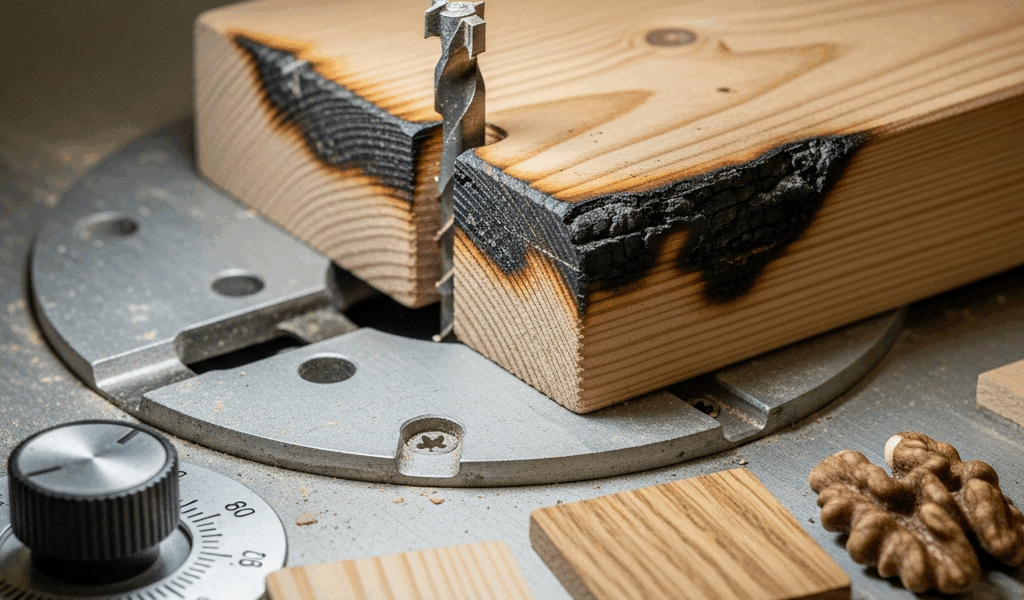
Why Router Bits Burn Wood in the First Place
Router bit burning has shifted noticeably with all the conflicting advice flying around. Slow down. Speed up. Buy better bits. Change your wood. Everyone has a theory. Here’s what’s actually happening: friction converts motion into heat faster than wood can push it away. Simple as that. The cutting edge is supposed to slice through fibers cleanly — ejecting chips, clearing heat, moving on. When it dwells instead of cutting, friction takes over. The edge rubs. Resin chars. Black marks appear.
Most woodworkers assume they already know the cause. Usually they’re wrong. I spent three years blaming my feed rate for every single burn mark I produced. Three years. Then I actually tested my router’s RPM against the bit diameter I was using and discovered my machine was screaming at 24,000 RPM with a 2-inch panel bit installed. That was the real culprit — not my hands, not my feed rate, not the wood. Burning has multiple root causes. Fix the wrong variable and you waste time, material, and patience. The diagnostic approach works better every time.
Feed Rate Too Slow Is the Most Common Culprit
Slow feed rate makes the bit dwell. The cutting edge contacts the same wood fiber for too long, generating friction instead of clearing chips. The result is concentrated heat, char marks, and sometimes scorching deep enough that 80-grit sandpaper won’t touch it.
What does a correct feed rate feel like? Not a formula — a sensation. The bit pulls the workpiece forward with steady, consistent resistance. You’re not forcing it. You’re not stalling it. The motor hums evenly rather than laboring. With freehand routing, your hands push forward with light, controlled pressure — almost like you’re guiding rather than shoving. If you’re leaning hard into it, gripping the handles white-knuckle tight, or moving hesitantly across the surface, you’re feeding too slowly.
Table routing feels different. The workpiece feeds past a stationary bit, and the resistance lives in the material itself as it crosses the table. Rush it and you’ll get kickback or torn grain. Creep and you’ll burn. That’s what makes finding the right speed so frustrating — the penalty exists on both ends. The correct pace feels almost automatic. No pause. No hesitation. No strain.
Stopping mid-cut burns wood. Every time. Never pause while the bit is spinning against material — not even for half a second. If you need to reposition, lift the router completely clear, kill the motor, wait for full stop, then restart. A momentary pause concentrates enough heat in one spot to leave a visible scorch mark that takes serious sanding to remove. Steer clear of where I went wrong on that one.
RPM Too High for the Bit Diameter
This was my mistake. Larger bits need lower RPM — it’s straightforward physics. A bigger diameter spins faster at the cutting edge for any given RPM setting, which generates excessive friction and heat almost immediately. A small 1/4-inch straight bit runs comfortably at 24,000 RPM. A 2-inch panel bit at that same speed generates enough heat to scorch hard maple in roughly three seconds.
Here’s the working rule: small bits up to 1/2 inch run between 18,000 and 24,000 RPM. Medium bits from 3/4 to 1-1/4 inch drop to 12,000–18,000 RPM. Large bits at 1-1/2 inches and up need 8,000–12,000 RPM. These aren’t rigid figures — they’re practical ranges that keep edge speed reasonable and heat manageable across most wood species.
Many woodworkers leave their router maxed out for every single operation. That habit burns wood. If your router has a dial or digital readout, use it intentionally. If it doesn’t — and plenty of older or budget models skip variable speed entirely — consider upgrading. A Triton MOF001 or a DeWalt DWP611 lets you dial in RPM deliberately rather than guessing. Yes, that’s a $150 to $250 investment depending on where you buy. But if you’re already ruining expensive hardwood, it pays for itself faster than you’d think.
Test this yourself. Run a 1-1/2-inch edge profile bit at your router’s maximum speed on a scrap piece. Then reduce RPM by 30 percent and feed at the same rate. The second pass burns less — sometimes dramatically less. Keep reducing speed until the burn marks disappear entirely. Write that RPM down. You now have an actual baseline for that specific bit.
Dull Bits and Dirty Cutting Edges
Here’s the part worth saying first. A dull edge generates friction instead of cutting. It rubs across wood fibers rather than slicing through them, and rubbing creates heat. Sharp carbide clears chips and dissipates heat simultaneously. Dull carbide does neither.
Spotting a dull bit takes some practice. Look for pitch buildup caked around the flutes — that dark, sticky resin coating means the edge is glazed and no longer cutting cleanly. Run your fingernail gently across the edge under a bright light. A sharp carbide edge catches your nail immediately. A dull one lets it slide right past. It sounds backwards, but a dull bit actually demands more push pressure, not less. If you’re pushing harder than you used to, the edge is wearing out.
Before replacing anything, try cleaning the bit first. Pitch and resin buildup mimics dullness but isn’t the same thing at all. I’m apparently a Boeshield T-9 person — spray the bit, let it sit for a full minute, scrub the flutes with an old toothbrush, wipe clean. CMT Formula 2050 works for some people while Boeshield never disappoints me. That simple process sometimes restores cutting performance completely. Saves money. Solves burn problems instantly. Worth doing every time before you assume the bit is finished.
When cleaning doesn’t help, the edge is past recovery. Carbide rounds over with use and can’t be sharpened at home with any reliability. Replace it. A quality 1/4-inch straight bit runs $15 to $30. A large panel bit costs $40 to $80. That stings. But running a worn bit across expensive figured maple or quartersawn white oak is a much worse deal in the end.
Wood Species and Grain Direction Add to the Problem
Cherry, maple, and ash burn faster than oak or poplar. That’s not subjective — it’s wood chemistry and cellular structure doing exactly what physics predicts. Route the same profile through cherry and poplar at identical speed and feed rate, and the cherry shows burn marks while the poplar comes out clean. Same router. Same bit. Same hands. Different wood.
Grain direction multiplies everything. Routing against the grain — pushing the bit backward relative to fiber orientation — creates both tearout and friction simultaneously. The bit’s forward motion conflicts with the grain’s direction, building resistance. Routing with the grain lets fibers separate cleanly and eject as chips. On a single four-square board, two edges route smoothly and two burn easily. That’s what makes grain direction worth understanding before you touch the router to the wood.
End grain burns almost without exception. Those exposed fiber ends char quickly because heat penetrates rather than disperses. A light pass on end grain — roughly half your normal depth of cut — is standard practice. Feed faster than feels comfortable. Reduce depth further if needed. If you’re dealing with end grain on hard maple specifically, expect burn marks unless you commit to multiple shallow passes at a deliberate pace.
The practical adjustment on difficult wood: reduce depth of cut and increase feed rate together. That sounds backwards — “slower and shallower” feels instinctively safer. It isn’t. Shallow passes mean less dwell time per pass. Faster feed means the bit spends less time in contact with any given spot. Together, they reduce heat buildup more effectively than slowing down alone ever will. This new approach takes some getting used to several cuts in, but eventually it becomes the method experienced woodworkers know and rely on today.



Stay in the loop
Get the latest crafted wood creations updates delivered to your inbox.