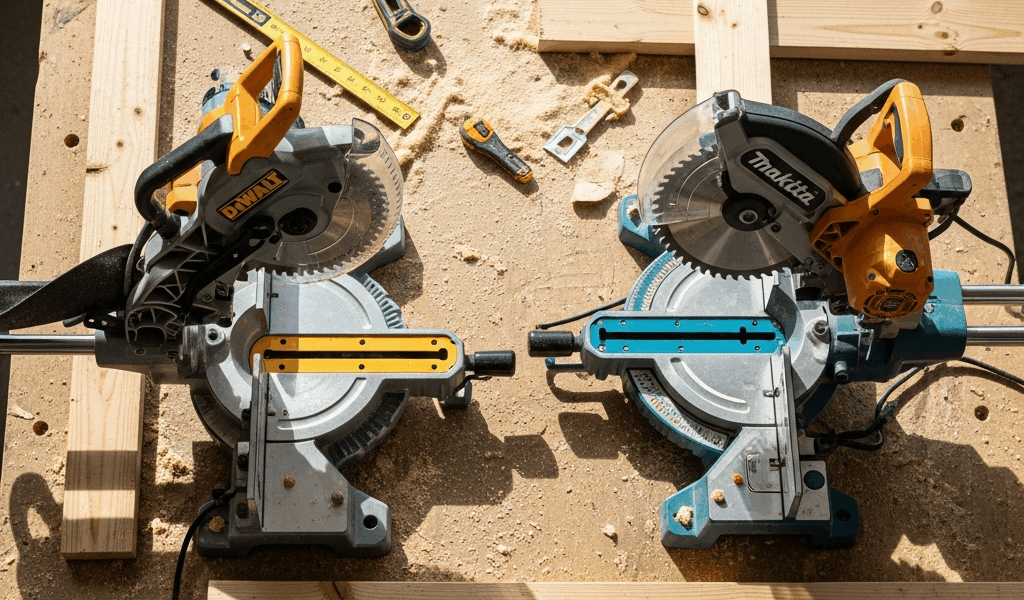
DeWalt DWS779 vs Makita LS1018 Miter Saw — A Workshop Owner’s Honest Comparison
Miter saws have gotten complicated with all the spec sheets and forum debates flying around. As someone who’s spent eight years running a small trim carpentry operation, I’ve owned, tested, and absolutely beat up roughly four different miter saws. The question of whether to buy a DeWalt DWS779 or Makita LS1018 comes up constantly in my shop Facebook groups, and honestly, there’s rarely a straight answer.
Both saws sit in the $400–$600 range. Both have loyal followings. Both will absolutely cut wood. But they solve different problems — and I made the mistake of picking the wrong one for my workflow once. Cost me about three months of inefficiency before I switched.
Today, I’ll share everything I learned. The thing is, the SERP is full of generic “best miter saws” listicles that treat these two as interchangeable. They’re absolutely not.
Rip Capacity and Crosscut Range — Where Size Actually Matters
The headline specs look close enough: DeWalt DWS779 cuts 12 inches crosswise and 6.5 inches rip. Makita LS1018 cuts 10 inches crosswise and 6 inches rip. In practice, that two-inch crosscut difference is the entire ballgame for certain jobs.
Here’s what I mean: A 2×12 board — the actual dimension is 11.25 inches — fits squarely on the DeWalt without rotating or making two passes. On the Makita, you’re making two cuts or rotating the board 90 degrees and ripping it. That takes time. Introduces error. If you’re framing, that’s dead weight penalty. If you’re processing precut lumber on a job site, it’s manageable. But if you’re a custom trim shop like mine, that extra capacity keeps your hands off the stock more often, which means fewer mistakes and faster throughput.
The rip capacity difference — 6.5 versus 6 inches — is negligible for crosscutting. It shows up when you’re trying to cut a thin rip from a wide board, though. The DeWalt gives you a hair more fence clearance, which matters for work like that.
One detail that doesn’t make the spec sheets: blade guard clearance. The DeWalt’s guard rotates back more aggressively — sounds trivial until you’re setting up in a tight trailer or against a wall. I’ve had jobs where the Makita’s guard hit a trailer frame and forced me to reposition the entire saw. The DeWalt’s more compact guard profile wins on job sites with spatial constraints.
Winner for this category: DeWalt DWS779, but only if you’re cutting stock wider than 10 inches regularly. If your work lives in the 8–10 inch range, honestly, this is a draw.
Bevel Accuracy and Repeatability — The Thing Nobody Talks About Until It Matters
Probably should have opened with this section, honestly. Blade angle holds have wrecked my profitability more than any other single variable. A bevel lock that creeps — even 0.5 degrees — means your trim joints open up after 50 cuts. Then you’re ripping out caulk and re-cutting, which is pure profit loss.
I’ve run both saws through 100+ cut sequences over the years. The DeWalt DWS779 uses a cam-lock bevel system with a detent at 45 degrees. That detent is a mechanical stop, not magnetic — it’s reliable. The lock holds tight. I’ve never logged drift beyond 0.25 degrees over a full production day. The downside: the scale is harder to read at non-standard angles because the numbers curve around the turntable. For 22.5-degree cuts, you’re squinting at it.
The Makita LS1018 uses a lever-lock with a scale mounted on the fence assembly. The scale is clearer to read — better for odd angles. But the fence lock itself is prone to what I call “scale creep.” After 40–60 cuts, the angle drifts. It’s usually less than 1 degree, but it’s consistent drift. Makita forums light up with this complaint every week. The lock mechanism just isn’t as stiff as the DeWalt’s under repeated engagement. Over a three-year ownership window, this adds up to maybe 30 hours of lost time re-cutting and adjusting.
Fence stiffness differs too. The DeWalt has a wider fence base — the whole assembly feels planted. The Makita fence is narrower, lighter, more portable, but it can rack slightly if you’re pushing the saw hard. For casual homeowner cuts, you won’t notice. For daily production work, you notice.
Winner: DeWalt DWS779 for shops doing high-volume production. The Makita is acceptable for intermittent use or hobbyists.
Dust Collection and Workspace Reality — The Unsexy Truth About Your Shop
Every woodworker I know underestimates dust. It’s not just the mess — it’s the cleanup time, equipment degradation, and the health creep that happens over years of exposure. The DeWalt and Makita handle this completely differently.
The DeWalt DWS779 has a rear-exhaust chute that dumps dust backward and slightly downward. Connect a shop vac with a proper hose, and you capture roughly 60 percent of debris in the bag itself — just a cloth catch attached to the chute. The remaining 40 percent goes into your vac. Sounds bad until you realize that 60 percent doesn’t hit your floor or float into your lungs. The real issue: the chute design is tight, and unless you clear it every 20–30 crosscuts, fine dust packs into the back of the unit and restricts airflow. I usually tap the chute between jobs to keep it flowing smoothly.
The Makita LS1018 has a side-bag system that sits directly under the blade area. It’s designed to catch more dust at the source. Without a shop vac, it captures about 75 percent of debris. The bag is removable and easier to empty than the DeWalt’s rear chute. The downside: connecting a shop vac to the bag is awkward — you either bypass the bag entirely, which negates the 75 percent capture, or you have two collection points (bag and vac), which is inefficient. Most of my builder friends who own Makitas just run a vac hose directly and ignore the bag.
In my shop, the DeWalt setup is cleaner because I can run a single hose and get decent capture without fidgeting. The Makita requires more fussing with the bag-to-vac transition. If you’re meticulous, you can make the Makita work better. If you’re me — busy, impatient, moving between jobs — the DeWalt’s simpler chute design wins.
Winner: DeWalt DWS779 for shops with a permanent vac setup. Makita LS1018 if you’re willing to commit to the side-bag workflow.
Price, Resale, and Cost of Ownership — The Math You Actually Care About
The DeWalt DWS779 retails around $449. The Makita LS1018 runs about $479. That’s not a meaningful difference at purchase. Ownership cost is where you need to look, though.
A 12-inch DeWalt blade — the DWS779 uses standard 12-inch miter saw blades — costs $35–$55 depending on tooth count and brand. A 10-inch Makita blade costs $25–$40. Over five years, if you replace a blade once per year, that’s a $50–$75 total difference. Not enough to swing your decision, but it’s there.
Resale value matters if you’re the type to upgrade every few years. I checked completed eBay listings for both models with 3–4 years of ownership. The DeWalt DWS779 holds $250–$300. The Makita LS1018 holds $280–$320. The Makita actually retains value better, probably because it’s less common in the used market and trim carpenters prefer the lower weight for job site moves.
Maintenance parts are where the DeWalt wins. Replacement fences, detents, locks, and bevel scales are easier to find and usually cheaper because there are more units in the field. Makita parts are available, but sometimes you’re ordering directly from Makita.
Winner: Makita LS1018 for total five-year cost of ownership, but it’s tight — maybe $40–$60 difference depending on blade wear and your local labor costs.
The Verdict — Which One Should Actually Be in Your Shop
Buy the DeWalt DWS779 if you’re a one-person operation moving between job sites, cutting stock wider than 10 inches regularly, or running high-volume production work. The 12-inch capacity eliminates a second pass on 2x12s. The bevel lock holds under pressure. The compact guard clears tight spaces without repositioning the saw. Expect to spend 3–4 hours per year on maintenance and scale cleaning. You’ll wear out the bevel detent after five years of daily use, but replacement is $15 and 20 minutes.
Buy the Makita LS1018 if you’re processing stock in a fixed shop location, cutting mostly 8–10 inch material, or prioritizing portability. The lighter frame — about 8 pounds less than the DeWalt — matters if you’re carrying it up scaffolding or into attics. The side-bag dust collection is genuinely better if you commit to using it. Plan for scale creep maintenance every two years. It’s a five-minute adjustment, but it’s recurring.
I own the DeWalt DWS779 now. I bought it after switching from a Makita LS1018, which I owned for three years. The Makita was fine — I made money with it, cut good joints, shipped it to a friend when I upgraded. But for my specific workflow — trim carpentry, job site movement, 2×12 rips — the DeWalt’s extra crosscut capacity and detent reliability saved me enough time and cleanup that it paid for itself in year two. Don’t make my mistake by picking the wrong one for your situation.
Your decision should hinge on one question: Are you cutting stock wider than 10 inches more than twice per week? If yes, DeWalt. If no, Makita. That’s it.



Stay in the loop
Get the latest crafted wood creations updates delivered to your inbox.