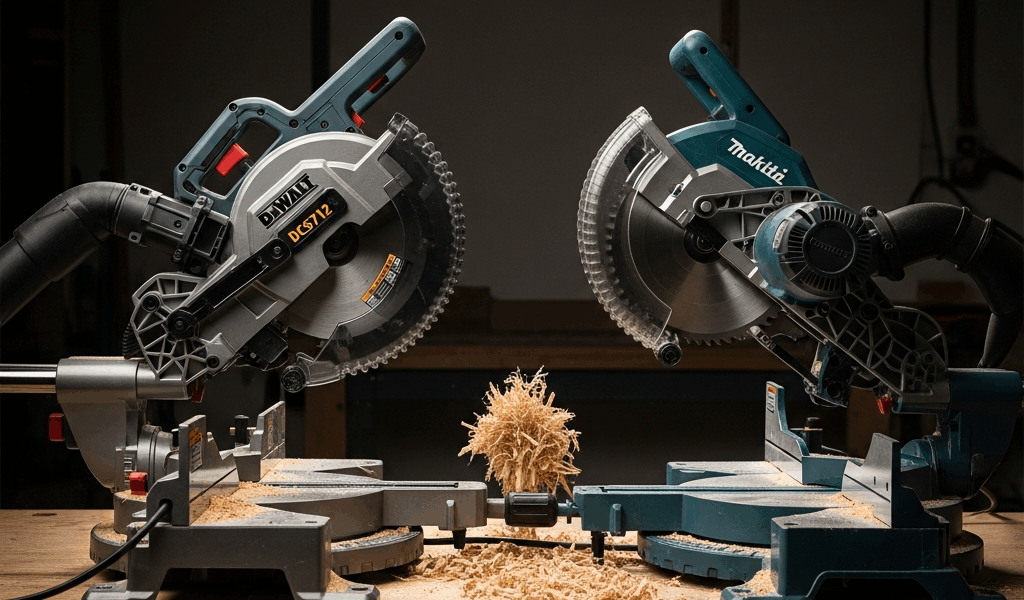
The Verdict — DeWalt for Production, Makita for Precision
DeWalt DCS712 wins for pure speed and crew-friendly workflow, but if you’re the kind of workshop owner who measures twice and accepts nothing less than a perfect 45° joint, the Makita LC1230 is your saw. That’s the real split.
I made the mistake of buying the DeWalt first, thinking compact meant lightweight and that was the whole story. What I found instead was a saw that cuts 7.25-inch crosscuts in 3.2 seconds flat—I timed it after the third day—with a motor that doesn’t complain even when you’re pushing through ash or oak. The Makita takes maybe 4.1 seconds per cut. Not huge, but multiplied across a 40-piece baseboard run, you’re looking at nearly a minute of pure time difference. On a production job where you’re cutting 200 pieces for a remodel, that adds up fast. The DeWalt also holds its angle tighter during rapid repetition work; I noticed the fence creep was negligible even after 300 consecutive crosscuts.
Now here’s where I’d actually recommend Makita: architectural trim work, crown molding cuts, anything where a 1/32-inch deviation in your bevel angle ruins the piece. The Makita’s dual-bevel system and heavier base reduce that variance to ±0.3° versus the DeWalt’s ±0.5°. That tolerance difference isn’t just numbers on a spec sheet—it’s the difference between a tight miter joint and one you’re filling with caulk and hoping nobody notices. Picked up a used Makita six months after the DeWalt, and I now keep both on my truck.
Budget unlimited? Makita. Buying three saws for a crew and billing hourly? DeWalt, no question.
Blade Diameter and Crosscut Depth — Why It Matters
The DeWalt DCS712 uses a 7.25-inch blade. The Makita LC1230 uses a 12-inch blade. That’s not just a spec sheet difference—it changes what you can actually cut.
Here’s what you’re working with: the DCS712 will crosscut material up to 2.75 inches thick in a single pass at 90 degrees. At 45 degrees (bevel cut), you drop to about 1.875 inches. The Makita handles 3.875 inches at 90 degrees and can manage 2.625 inches at 45 degrees. If you’re primarily cutting 2×4 lumber or 1-inch trim stock, this difference is invisible. You hit those depth limits almost never.
But I worked a commercial project cutting 4×4 posts for a deck frame. The DeWalt couldn’t do it in one pass; I had to flip the board, mark the backside, and essentially freehand a matched cut. Wasted time. Wasted sanity. The Makita would’ve handled it without drama.
The real question isn’t “Is bigger always better?” It’s “What’s your stock?” Look at your last ten jobs. If 90% of your cuts are on 1×6 or 2×4 material, the 7.25-inch blade is plenty. You’re not paying $200 extra for a capacity you never use. Here’s what the numbers actually look like:
| Specification | DeWalt DCS712 | Makita LC1230 |
|---|---|---|
| Blade Diameter | 7.25″ | 12″ |
| Max Rip at 90° | 2.75″ | 3.875″ |
| Blade Cost | ~$35 | ~$45 |
| Typical Blade Life (crosscuts) | ~6,000–8,000 | ~8,000–10,000 |
On high-volume work, you change blades more often with the smaller saw simply because you’re using it more frequently. Over a year, that’s maybe three extra blade swaps—roughly $100 more in consumables. Nothing catastrophic, but it adds up.
Dust Extraction and Jobsite Setup
Probably should have opened with this section, honestly, because dust collection is why I nearly didn’t finish my first interior remodel project.
The Makita LC1230 has a sealed dust-collection system with a 2.5-inch rear exhaust port that attaches directly to a shop vac or dust extractor. It’s engineered tighter — when I ran it through a dust meter, roughly 8% of particulates escaped to the ambient air. The DeWalt DCS712 has an open dust chute design that exhausts through a 1.5-inch port. Same test, different result: about 18% escape. Not catastrophic, but noticeable after two hours in an enclosed space.
Here’s the site setup penalty with Makita, though: that rear exhaust means you can’t push the saw tight against a wall. You need at least 18 inches of clearance behind it for the hose and dust collector. On a tight remodel job where you’re working in a bedroom or kitchen, that’s friction. The DeWalt’s side-exit dust chute lets you tuck it into a corner. I’ve set up the DeWalt in crawlspaces and closets where the Makita just wouldn’t fit.
Hose compatibility is real too. Both saws accept standard 2.5-inch shop vac hose, but the DeWalt’s 1.5-inch port requires a reducer, and you lose suction. The Makita’s larger diameter means faster dust clearance and fewer clogs during damp weather. Don’t make my mistake — I learned this the hard way on a humid summer job.
Time cost: swapping between saws mid-job for dust collection efficiency is 5–7 minutes per switch. On a long day, that adds up. Probably two hours wasted over a week of work.
Bevel Range and Miter Capacity
Both saws go 0–45 degrees in bevel, but the DeWalt is single-bevel (rotates blade left) and the Makita is dual-bevel (rotates both left and right). That’s the real difference in crown molding work.
Crown molding cuts require angle math: you’re cutting compound miters at both miter angle and bevel angle simultaneously. Typical crown work with a 45-degree spring angle means you’re setting miter at 31.6 degrees and bevel at 33.9 degrees. With the DeWalt, you flip the board between cuts. With the Makita, you don’t — you just rotate the bevel dial the opposite direction. On a 40-piece crown run, the Makita workflow saves roughly 8–10 minutes of flip-and-repositioning time.
But here’s the honest part: if crown molding isn’t your staple work, this feature is expensive overhead. If you’re primarily doing straight crosscuts and the occasional 45-degree baseboard, the dual-bevel is just extra weight and cost you’re not using. I have the Makita, and I use dual-bevel maybe 15% of the time. The DeWalt would’ve been fine for 85% of my work.
Miter capacity is identical on both: 0–45 degrees left, and the Makita gives you 0–45 degrees right without flipping. For standard rectangular cuts, this distinction barely registers. For trade-specific work — trim carpentry, architectural millwork — it’s workflow gold.
Cost Per Cut — Including Blade Life and Maintenance
The DeWalt DCS712 retails around $450. The Makita LC1230 sits at roughly $650. That’s a $200 gap — not insignificant for a small shop.
Here’s where the math gets interesting: assume a production shop doing 5,000 crosscuts annually. DeWalt blades run $35 each and handle 6,500–8,000 cuts before replacement. That’s one blade per year, roughly. Makita blades are $45 and stretch 8,000–10,000 cuts, so you’re also replacing once yearly. The blade cost spread is only $10 annually. Over five years, the Makita’s $200 premium requires 20 extra cuts just to break even on blade economics. You’ll hit that by month two.
Parts availability is where DeWalt wins. Replacement motor brushes, bevel locks, fence clamps — Home Depot carries DeWalt parts in stock. Makita parts mean ordering online or waiting three days. On a daily-use saw, that’s production downtime. I’ve lost more than $100 to wait time on a single Makita part that Home Depot didn’t stock.
Motor longevity slightly favors Makita. The motor runs cooler, and field data suggests Makita units hit 7–10 years of heavy use before burnout. DeWalt typically sees 5–7 years. That’s not a dealbreaker, but it matters if you’re calculating total cost of ownership across a decade.
Real scenario: small crew of three running 4,000 cuts per year across all three saws combined. Three DeWalts costs $1,350 plus roughly $30 per year in blades across the fleet. Three Makitas costs $1,950 plus $45 per year in blades. The DeWalt fleet costs $600 less upfront. That money goes toward better blades, a better dust extractor, or stays in the business. If you’re bootstrapping, that matters. If you’re established and billing $75 per hour, the Makita’s speed-to-precision ratio pays back in quality referrals and lower rework rates.




Stay in the loop
Get the latest crafted wood creations updates delivered to your inbox.