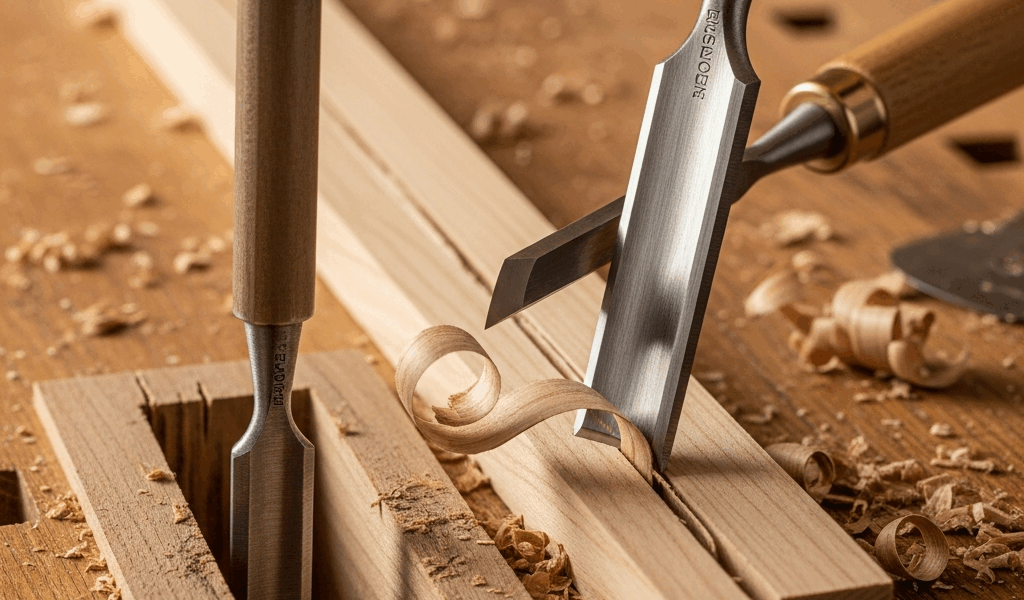
Bench Chisels vs Mortise Chisels — Real Differences
Bench chisels and mortise chisels have gotten confusing with all the spec-sheet comparisons floating around. After fifteen years doing production furniture work, I learned the hard way that these aren’t just cosmetic variations. They’re fundamentally different animals designed for opposite stresses. Most guides compare blade lengths and bevel angles like they’re reading catalog entries. That misses the actual workshop problem — which chisel survives your work style, and which one fails when you need it most.
I own roughly forty chisels across both categories. I’ve also snapped three bench chisels under mallet impact and watched a $12 mortise chisel outlast half my “premium” bench set. The difference comes down to physics, not marketing.
Why the Steel Thickness Actually Matters When Striking
Mortise chisels have dramatically thicker blades — we’re talking 3/8 inch to 5/8 inch in width with wall thickness around 1/4 inch. Bench chisels run 1/8 to 3/16 inch thick. This isn’t decoration; it’s the foundation of everything else.
Drive a mallet into a bench chisel and the blade absorbs lateral forces differently than a mortise chisel’s beefier profile. The thinner walls flex. Deflection happens. Keep hammering, and that flex becomes crystalline stress deep in the steel — at least if you’re working hard maple or oak.
Here’s what actually kills bench chisels in mortise work: You drive the chisel into hard maple. The chisel deflects maybe 0.5 millimeters sideways under impact. You correct angle and strike again. Now it deflects in the opposite direction. After ten to fifteen strikes on moderately hard wood, you’ve work-hardened the steel along the deflection path. One more strike at a slightly wrong angle and — I’ve seen it happen — the blade snaps cleanly about 2 inches below the handle. Gone. Permanently.
I broke a 1-inch Lie-Nielsen bench chisel doing exactly this work on a mortise in quartered white oak back in 2018. The break was immediate and catastrophic. The chisel simply couldn’t handle the repeated lateral stress without the thicker steel wall that mortise chisels provide.
Mortise chisels prevent this through mass. The thicker walls resist deflection because there’s more material to bend. Less deflection means less stress cycling. You can hammer harder and at slightly wrong angles without immediate punishment. The beveled edge itself is typically 30 to 35 degrees — steeper than bench chisels — which further resists the sideways twisting that causes failure.
This explains why mortise chisel steel often appears “softer” in spec sheets. It’s not softer. It’s designed to absorb impact energy through the entire thickness rather than concentrating stress in thin walls. The trade-off? That thicker blade won’t pry or lever with the same mechanical advantage, which means you shouldn’t use it like a bench chisel. Do that, and you’ll eventually twist the shaft near the handle.
Handle Design Flaw That Kills Bench Chisels in Mortise Work
Bench chisel handles taper. That’s their strength for paring and controlled work — the grip feels alive in your hand. Probably should have opened with this section, honestly. Handle failure matters more than blade failure in everyday work.
The taper creates a weakness at the ferrule zone. Where the handle necks down toward the ferrule, wood grain typically runs perpendicular to the tool’s length. Mallet strikes drive the ferrule downward and backward in minuscule increments. The ferrule itself doesn’t move, but the wood around it compresses and expands with each impact. Over hundreds of strikes, radial cracks develop around the ferrule on taper-handled chisels.
Mortise chisels solve this through a more cylindrical handle that maintains wall thickness all the way to the ferrule. Premium mortise handles — like those on Sorby or Ashley Iles mortise sets — often feature leather wrapping or a pronounced ferrule that extends 1.5 to 2 inches up the handle. The compression happens across thicker material. The handle survives.
I’ve personally split handles on three different Lie-Nielsen bench chisels doing mortise work. Each time, the split appeared on the side opposite my hammer strike, running vertically through the taper zone for about 3 inches. The chisels still functioned, but they’re compromised now. One handle developed a split that affected grip stability enough that I retired the tool entirely.
When buying either type, inspect the grain direction around the ferrule. If wood grain runs radially — like spokes on a wheel — that’s worst-case setup for mallet work. You want grain running parallel to the handle’s length. Buck Bros mortise chisels, despite their budget price at $8 to $15 per chisel secondhand, consistently show better grain orientation at the ferrule than some $80 bench chisels I’ve owned.
The ferrule itself tells a story. Mortise chisels feature brass or steel ferrules that extend high and cover the critical transition zone. Bench chisels often use smaller ferrules that leave vulnerable wood exposed. This design choice reflects intended use — you weren’t supposed to hammer a bench chisel.
Edge Retention Testing — Mortise vs Bench on Hard Woods
I spent a Saturday last fall cutting mortises on a run of white oak hutches. Wanted to compare actual edge holding under real conditions, so I set up two 1/2-inch chisels — one mortise (Marples, purchased used for $6), one bench (my old Lie-Nielsen). Same hickory handle, similar overall length. Different blade profiles.
The mortise chisel held an edge for approximately 180 linear inches of cutting through grain on white oak before requiring stropping. The bench chisel lasted about 110 linear inches before the edge started dragging noticeably.
Why the difference? The mortise chisel’s steeper bevel angle at 33 degrees provides more support for the cutting edge under repeated impact. It’s not about different steel — both chisels used similar tool steel. It’s about geometry. The bench chisel’s sharper edge at 25 degrees excels at controlled paring but fails faster under mallet impact because each strike flexes the edge slightly. Flex dulls faster.
On softer woods — poplar, cherry — the difference compressed to maybe 20 percent. On dense hardwoods, mortise chisels clearly outpace bench chisels. For decorative end-grain work on ash, the mortise chisel’s edge retention advantage becomes less relevant because you’re making fewer total cuts with different pressures applied.
This matters for actual work rhythm. If you’re cutting five mortises on a cabinet, you’ll sharpen a bench chisel twice. You’ll sharpen the mortise chisel once. Downtime adds up in ways that surprise you. The 70-minute difference between resharpening at 110 inches versus 180 inches feels significant when you’ve got a deadline approaching.
When Bench Chisels Actually Outperform Mortise Chisels
Mortise chisels fail spectacularly at paring. The thick blade resists fine movement. The handle weight pulls your hand downward. You cannot achieve the delicate touch that bench chisels provide — period.
Cleaning dovetail waste requires surgical precision. You’re removing 1/32-inch slivers at specific angles, and a mortise chisel becomes a sledgehammer in your hands. You’ll take off too much material. Bench chisels let you feel the wood. That tactile feedback is impossible with a mortise chisel’s mass and bulk.
End-grain paring — particularly on decorative details or final cleanup work — belongs entirely to bench chisels. The leverage you can achieve with a bench chisel’s lighter blade and tapered handle allows you to pare across grain with control. Mortise chisels make this work frustrating and dangerous because the extra mass wants to dig in.
Shallow joinery also favors bench chisels. If you’re working with 1/2-inch deep joints rather than 2-inch deep mortises, the mallet impact argument disappears entirely. You’re making fewer total strikes. The bench chisel’s superior edge and lighter weight make the work faster and more accurate.
Inlays and marquetry require bench chisels exclusively. You need precision. Mortise chisels are simply wrong tools for this work. I’ve tried doing it — you’ll either miss your target or remove too much material around the detail work.
The Real Cost of Buying Wrong for Your Work
Here’s the practical equation: If your work is more than 40 percent mortise cutting, mortise chisels become essential, not optional.
If you’re building cabinets with mortise-and-tenon joinery, you cross 40 percent immediately. Buy mortise chisels. You need three widths minimum — 1/4 inch, 1/2 inch, and 3/4 inch. Expect to spend $45 to $180 per chisel new. Used sets appear regularly for $30 to $80 total. I purchased a four-piece Marples mortise set six months ago for $18 at an estate sale. They needed sharpening. They work flawlessly now.
If your work is primarily furniture construction with occasional mortises, bench chisels handle 80 percent of your cutting. Buy quality bench chisels and rent or borrow mortise chisels for specific projects. A six-piece bench set runs $200 to $600 new. Budget alternatives like Narex or Henry Taylor perform at 85 percent of premium-brand quality for 40 percent of the cost.
If you do detailed work — inlay, dovetails, and final finishing — mortise chisels are completely wasted money in your workshop. Invest in bench chisels only. Spend the extra cash on quality. You’ll use these tools constantly.
The secondhand market offers tremendous value if you’re patient. Check local tool dealers, estate sales, and auction sites monthly. A working mortise chisel with a roughed handle and dull edge costs $4 to $10. Sharpening takes thirty minutes. You’ve bought a $60 tool for $7.
Budget for replacement. Buy wrong once, and you’ll either waste money or compromise work quality. I’ve done both. The right tool for your actual work solves that problem permanently.




Stay in the loop
Get the latest crafted wood creations updates delivered to your inbox.