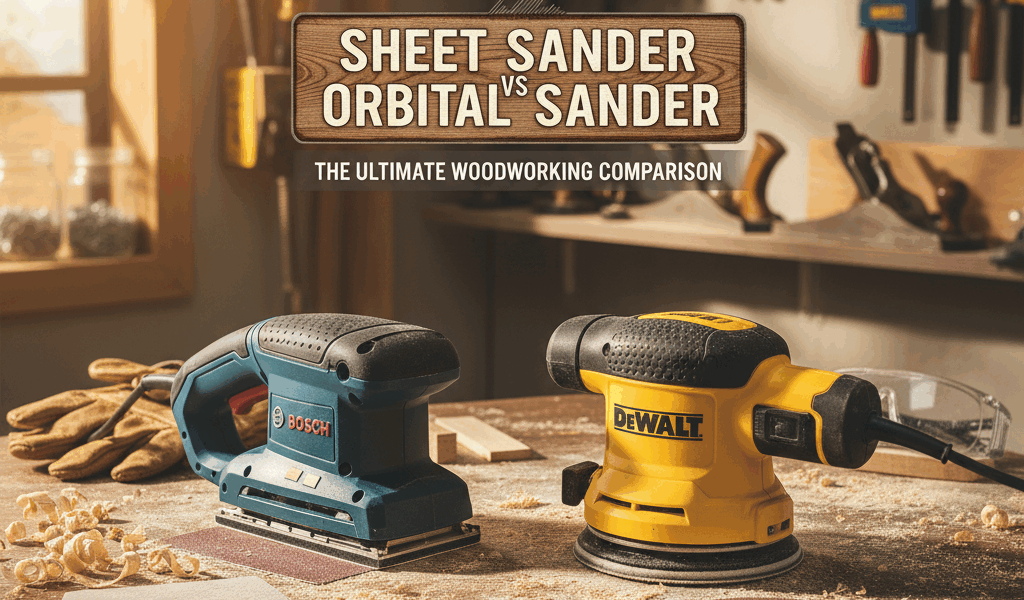
Sanding tools have gotten confusing with all the random orbit vs. sheet sander debates and overlap in marketing copy flying around. As a woodworker who uses both regularly and has strong opinions about when each belongs in my hand, I’ve learned that the choice usually comes down to the work at hand. Today, I’ll share everything I know about sheet sanders vs. orbital sanders.

The Sheet Sander
A sheet sander — sometimes called a palm sander — is square or rectangular and uses standard sandpaper cut or torn to fit. It moves the paper in a straight back-and-forth motion, similar to hand sanding. That predictable motion is both its strength and its limitation: excellent on flat, wide surfaces and less aggressive than orbital sanders, but prone to leaving with-grain scratches visible after finish if you’re not careful.
Where Sheet Sanders Work Best
- Flat panel surfaces — doors, tabletops, wide boards
- Preparation for painting where the final surface needs to be perfectly flat
- Finish sanding between coats
- Smoothing out previous sanding marks on flat faces
The Orbital (Random Orbit) Sander
The random orbital sander is round and moves the abrasive disc in small elliptical orbits rather than a straight line. That random pattern means no two scratch paths are parallel — the result is a scratch-free finish that’s ready for stain or topcoat without the swirl marks you get from cheaper rotary sanders.
Where Orbital Sanders Excel
- Removing stock quickly on flat or curved surfaces
- Refinishing cabinets where speed matters
- Stripping old paint or finish
- Sanding between finish coats
- Complex shapes and curved surfaces where a sheet sander won’t follow the contour
The Key Differences
Sheet sanders are gentler and better at final finishing on flat surfaces. Orbital sanders are more aggressive and more versatile for stock removal and curved work. I’m apparently a “orbital for everything except flat finish work” person and that habit always works better for me while defaulting to a sheet sander on curved or complex surfaces never does — the sheet sander just can’t follow the geometry the way a round disc can.
Choosing Between Them
For flat, wide surfaces where the final finish quality is the priority, a sheet sander is the right tool. For aggressive material removal, curved surfaces, and versatile shop use, a random orbital sander is the better choice. If you’re equipping a shop for the first time, the random orbital sander covers more situations. If you’re adding to an existing setup, a sheet sander fills the niche the orbital doesn’t cover as well on large flat panels.
One Final Thought
Neither sander is universally superior — they solve different problems, and having both is the practical answer for any woodworker who works across a variety of project types. Let the sander do the work regardless of which you’re using; excessive downward pressure creates heat, loading, and uneven stock removal that none of these tools are designed to work through. Light pressure, consistent movement, and the right grit progression will get you where you need to go.