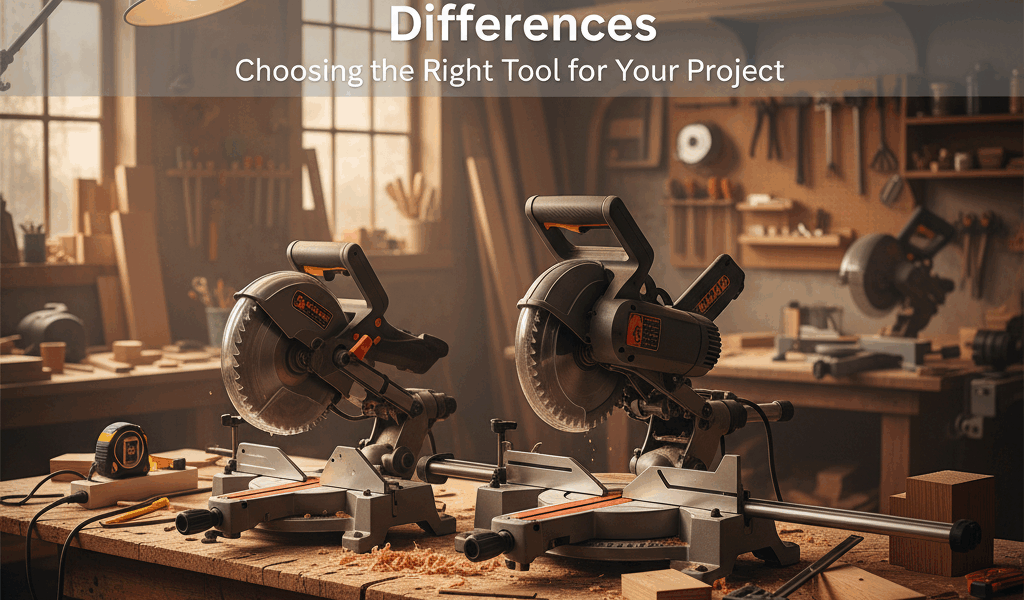
“Chop saw” is an ambiguous name. In woodworking, people sometimes use it for a basic non-sliding miter saw that crosscuts wood. In metalworking and many retail listings, it means a stationary cut-off saw built for an abrasive wheel or a low-speed carbide metal-cutting blade. A miter saw is normally a wood or wood-like-material saw with a rotating table for angled crosscuts.
The safe answer is therefore not “a chop saw always cuts metal.” Read the machine’s nameplate and manual. The approved material, blade or wheel, arbor, diameter, maximum speed, guard, vise, and fence determine what the tool can cut. Never identify a saw only by its pivoting-arm shape.
Chop saw vs miter saw: quick comparison
| Feature | Wood miter saw | Abrasive metal cut-off saw | Carbide metal-cutting saw |
|---|---|---|---|
| Primary material | Wood and wood-like products; only other materials specifically approved by the manual | Approved ferrous metal profiles and stock | Approved metal profiles and stock |
| Cutting accessory | Toothed circular saw blade | Bonded abrasive cut-off wheel | Purpose-built carbide-tipped metal blade |
| Typical speed | Relatively high blade RPM | Matched to the rated abrasive wheel | Often substantially lower than a wood miter saw |
| Work holding | Fence plus clamp or correctly positioned hand, as the manual allows | Built-in vise or clamp | Built-in vise or clamp |
| Angles | Miter adjustment; compound models also bevel | Some have adjustable fences, others are limited | Some metal saws provide 0–45° fence adjustment |
| Waste and hazard | Sawdust, chips, kickback and blade contact | Sparks, hot workpiece, abrasive dust and possible wheel breakage | Hot metal chips, sharp cut edges and blade contact |
Why the names cause confusion
All three machines bring a rotating cutter down through stationary stock. That visual similarity is why “chop saw” became a loose shop term. OSHA’s woodworking guidance even describes a chop saw as a pivoting circular saw for square cuts and explains that compound miter saws add miter and bevel capability. Metal-tool manufacturers, however, also sell products explicitly named “chop saws” that use abrasive wheels.
Use more precise language when buying accessories or discussing safety:
- Non-sliding miter saw: a wood-cutting saw whose table rotates for miter angles.
- Compound miter saw: adds a tilting head for bevel and compound cuts.
- Sliding compound miter saw: adds rails or an articulated mechanism for wider crosscuts.
- Abrasive cut-off saw: a guarded machine designed around a bonded abrasive wheel, commonly for metal.
- Dry-cut metal saw: a purpose-built, generally lower-speed machine using an approved carbide metal blade.
- Masonry saw: a separate machine designed for approved masonry-cutting equipment and dust or water controls.
What a wood miter saw does
A miter saw makes crosscuts across a board. Rotating the table produces a miter; tilting the head produces a bevel. Combining the two produces a compound cut, useful for crown molding and other trim. A sliding model increases crosscut capacity but also takes more space and may introduce more moving parts.
The blade, guard, throat plate, dust collection, and motor are designed around the materials named in the manual. For example, DeWalt’s DWS779 instructions state that the miter saw is intended for wood or wood-like products and cannot use abrasive cut-off wheels for ferrous material. The manual warns that abrasive dust can jam the lower guard and sparks can damage plastic parts.
Some miter-saw manuals allow particular non-ferrous metals with a manufacturer-approved blade and procedure; others do not. “A carbide blade fits the arbor” is not permission. Check the exact saw manual, blade application, diameter, kerf, arbor, tooth geometry, and RPM rating.
What an abrasive metal cut-off saw does
An abrasive cut-off saw removes material with a bonded wheel. It is commonly used on approved steel bar, pipe, angle, channel, and similar stock. The process produces heat, sparks, abrasive dust, and a cut that may need deburring. As the wheel wears, its diameter and cutting capacity decrease.
These machines normally secure work in a vise. Contrary to the old version of this article, not every metal “chop saw” has a fence fixed permanently at 90 degrees. Some allow angled setup. The machine’s manual defines its capacity and procedure.
Abrasive-wheel integrity is a distinct safety issue. OSHA requires appropriate guarding for abrasive-wheel machinery and says the machine spindle speed must not exceed the wheel’s marked maximum operating speed. Use the correct flanges and mounting hardware, inspect the wheel as directed, and never grind on the side of a cut-off wheel unless the manufacturer explicitly designed it for that operation.
DeWalt’s D28715 abrasive chop-saw manual is a useful example of machine-specific instructions. It does not authorize applying those instructions to another model.
What a carbide metal-cutting saw does
A dry-cut metal saw uses a blade, speed, guard, vise, and chip-control system designed together for metal. It is not simply a high-speed wood miter saw wearing a different blade. As one concrete example, Makita specifies its LC1230 at 1,700 RPM with a 12-inch carbide-tipped metal blade and a quick-release vise. Its guide plate adjusts from 0 to 45 degrees, proving that metal cut-off saws are not universally limited to square cuts.
Check the current Makita LC1230 documentation for that model’s exact capacity. Other metal saws can have different approved materials, speeds, blades, and work-holding requirements.
Can you put an abrasive wheel on a miter saw?
Do not do this unless the miter-saw manufacturer explicitly approves the exact wheel and operation. Common wood miter saws are not designed for abrasive ferrous-metal or masonry cutting. A wheel fitting physically does not make its speed rating, flange system, guard, dust path, or spark exposure safe.
DeWalt’s current DWS779 manual explicitly prohibits abrasive cut-off wheels for ferrous material. Bosch likewise warns in a current miter-saw manual that ferrous-metal or masonry dust can disable the lower guard and that the tool is not intended for metal or masonry cut-off wheels. Use a purpose-built machine instead.
Can a miter saw cut aluminum or plastic?
Sometimes—but only when the saw manual and blade manufacturer approve the exact material and method. Non-ferrous metal can catch, and many plastics can chip, melt, or create hazardous dust. Clamp and support the work as instructed, use the approved blade, and keep hands outside the manual’s exclusion zone. Round stock needs a fixture that prevents rolling.
Do not extrapolate permission for thin aluminum trim to steel, rebar, masonry, or an abrasive wheel. Material compatibility is model-specific.
Which saw should you choose?
- Trim, framing, furniture parts, and repeated wood crosscuts: choose a miter saw. A compound model handles bevels; a sliding model adds width capacity.
- Frequent steel cut-off work where finish is secondary: compare purpose-built abrasive cut-off saws.
- Frequent metal work where speed and a cleaner cut matter: compare purpose-built carbide metal-cutting saws and their material limits.
- Concrete, brick, block, or tile: use equipment specifically designed and approved for the masonry operation and its dust or water controls.
- Occasional site work across multiple materials: renting the correct saw can be safer and less expensive than forcing one machine into an unapproved task.
If your real choice is between two woodworking tools, read our miter saw versus table saw comparison. A table saw serves ripping and sheet-goods work that neither style of cut-off saw replaces.
Safety checklist before any cut
- Read the exact machine manual and inspect current safety notices or recalls.
- Match the blade or wheel’s material, diameter, arbor, kerf, and maximum RPM to the machine.
- Disconnect power or remove the battery before changing accessories or making service adjustments.
- Confirm that guards move freely and return correctly. Never defeat or remove them.
- Clamp or support stock as the manual requires; do not cut freehand.
- Keep the work area clear of flammable material, especially when metal cutting produces sparks.
- Wear the eye, face, hearing, respiratory, and other protection required by the tool, material, and workplace rules.
- Keep hands outside the marked exclusion zone and out of the blade or wheel path.
- Let the cutter reach full speed before contact, do not force the cut, and wait for it to stop before reaching near the cut-off piece.
- Remember that metal stock and cut edges may remain hot and sharp.
OSHA’s chop-saw guidance emphasizes working guards, correctly rated blades, and eye and face protection. Its separate abrasive-wheel standard covers guarding, flanges, inspection, and operating-speed requirements in covered workplaces. Home users should still treat the manufacturer manual as the minimum operating reference.
Frequently asked questions
Is a chop saw the same as a miter saw?
Sometimes the words are used interchangeably for a basic wood crosscut saw, but many modern listings use “chop saw” for a metal cut-off machine. Identify the machine from its manual and approved cutter, not the nickname.
Can a chop saw make angled cuts?
Some can. Wood miter saws rotate specifically for angled cuts, and some purpose-built metal saw fences also adjust to 45 degrees. Other cut-off machines have more limited adjustment. Check the model’s documented capacity.
Is an abrasive chop saw more powerful than a miter saw?
Amp ratings alone do not answer that question. The machines convert power through different speeds, cutters, guards, and intended materials. “More powerful” does not make one suitable for the other’s job.
Can one blade cut both wood and steel?
Do not assume so. Blade tooth geometry, construction, speed rating, and the machine itself must be approved for the material. Use the exact blade and procedure specified by both the saw and blade manufacturers.
Bottom line
For ordinary woodworking, choose a miter saw sized for the crosscuts and angles you need. For metal, choose a purpose-built abrasive or carbide metal-cutting saw based on finish, speed, and approved stock. Because “chop saw” can describe different machines, the manual—not the nickname—is the deciding source. Never convert a wood miter saw into an abrasive metal or masonry saw merely because a wheel appears to fit.
Need wider crosscut capacity after choosing the correct tool category? Compare our current sliding compound miter saw guide, including capacity, footprint, recall, dust, and safety checks.



Stay in the loop
Get the latest crafted wood creations updates delivered to your inbox.