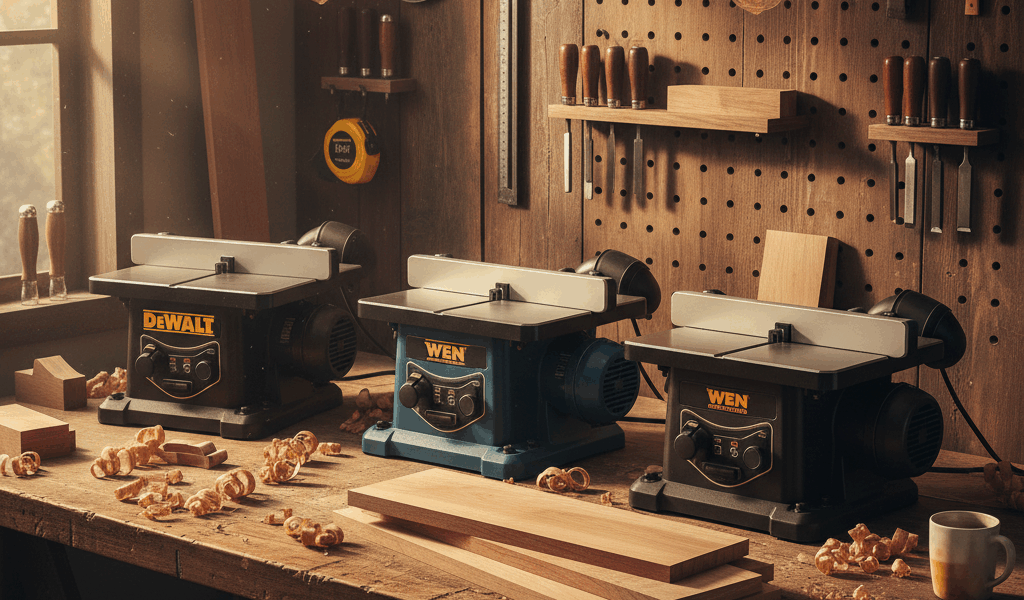
The DeWalt DW735X is the best benchtop planer for most furniture-focused home shops. Its 13-inch capacity, two feed speeds, three-knife cutterhead, automatic carriage lock, strong chip ejection, included extension tables, and extra knife set make it the most complete conventional-knife package in this group. Choose the Makita 2012NB when lower weight and quieter published operation matter more than 13-inch capacity, the RIDGID R4331 for a simpler 13-inch three-knife alternative, the WEN PL1326 for a lower-cost spiral-style cutterhead, or the Grizzly G0940 when you specifically want indexable carbide inserts.
This guide compares current manufacturer specifications and manuals; it is not presented as a hands-on test of five machines. Prices and availability change, so the picks are organized around cutterhead, capacity, feed system, weight, dust handling, warranty, and parts—not a temporary sale.
Best benchtop planers compared
| Model | Best fit | Width / height capacity | Cutterhead | Published weight |
|---|---|---|---|---|
| DeWalt DW735X | Best overall conventional-knife planer | 13 in. / 6 in. | Three reversible knives; 10,000 RPM; 96 or 179 cuts per inch | About 92 lb for the planer |
| Makita 2012NB | Best for transport and lower published noise | 12 in. / 6-3/32 in. | Two double-edge knives; 8,500 RPM | 61.9 lb |
| RIDGID R4331 | 13-inch three-knife alternative | 13 in. / 6-1/8 in. | Three dual-edge knives; 9,000 RPM; 96 CPI | 73 lb |
| WEN PL1326 | Value spiral-style cutterhead | 13 in. / 6 in. | 26 staggered, rotatable HSS inserts; 10,000 RPM | Check current manual/listing |
| Grizzly G0940 | Carbide helical upgrade | 13 in. / 6 in. | 30 indexable carbide inserts in two helical rows; 8,500 RPM | 78 lb machine weight in current documentation |
Important: “spiral” and “helical” are not interchangeable guarantees. The WEN uses staggered high-speed-steel blades; the Grizzly specifies indexable carbide inserts arranged in helical rows. Compare replacement-insert material, size, availability, and cutter geometry—not just the marketing word.
Best overall: DeWalt DW735X
The DW735X is the strongest general recommendation because it combines finish control with a complete package. DeWalt specifies a 15-amp motor, 10,000-RPM cutterhead, three reversible disposable knives, and two feed speeds producing 96 or 179 cuts per inch. Use the faster feed for material removal and the higher-cuts-per-inch setting for final passes, within the manual’s depth limits.
The “X” package matters: it includes infeed and outfeed tables plus an extra set of knives. The planer also has fan-assisted chip ejection, a material-removal gauge, turret depth stop, large thickness scale, and automatic carriage lock. It is not truly light at roughly 92 pounds, so give it a rigid dedicated surface or a mobile stand rated for the load.
DeWalt’s manual lists a maximum 1/8-inch cut only for boards 6 inches wide or less. Maximum depth is not a target for every pass; wide hardwood, figured grain, and finish cuts normally call for lighter removal. Follow the width/depth chart in the current manual.
Best for portability: Makita 2012NB
The Makita 2012NB sacrifices one inch of width versus the 13-inch machines but weighs 61.9 pounds. Makita lists 12-inch width, 6-3/32-inch height, up to 1/8-inch cut, two knives, an 8,500-RPM no-load speed, and 83 dB published noise. Its Interna-Lok automated head clamp is designed to control carriage movement and reduce snipe.
This is the most sensible choice when the planer must move between storage and a work surface or travel to a jobsite. The optional dust hood is a cost and workflow consideration; confirm exactly what the current package includes because accessories can differ by retailer and region.
Best 13-inch conventional alternative: RIDGID R4331
RIDGID specifies a 15-amp motor, 13-inch width, 6-1/8-inch height, 1/8-inch maximum depth, 9,000-RPM three-blade cutterhead, 96 cuts per inch, and a 23.5-feet-per-minute feed rate. It includes table extensions, a dust port, a carriage lock, and eight depth stops.
The R4331 is a straightforward single-speed alternative when two-speed finish control is not essential. RIDGID’s power-tool site describes Lifetime Service Agreement eligibility with registration; read the current eligibility, registration deadline, proof-of-purchase, and service terms rather than treating “lifetime” as an unconditional warranty.
Best value spiral-style option: WEN PL1326
The WEN PL1326 uses 26 staggered, rotatable high-speed-steel blades rather than three long straight knives. WEN specifies a 15-amp motor, 13-inch width, 6-inch height, 10,000-RPM cutterhead, 26-feet-per-minute feed, up to 1/8-inch removal, extension tables, adjustable dust port, depth stop, and a two-year warranty.
Individual damaged inserts can be rotated, which is appealing when a small nick would otherwise mark every board. However, HSS inserts are not the same as carbide helical inserts, and replacement cost should be calculated across the whole head. Check current availability for the exact BP510H replacement blade before buying the machine.
Best carbide helical upgrade: Grizzly G0940
Grizzly specifies a 2-HP, 120-volt, 15-amp motor; 13-inch width; 6-inch height; 25-feet-per-minute feed; and a 30-insert carbide helical cutterhead. The current specification limits a full-width pass to 1/32 inch and a cut on stock 6 inches wide to 3/32 inch. That honest depth chart is a useful reminder that maximum capacity narrows as the board gets wider.
The G0940 also uses a granite main table, a 2-inch dust port with 4-inch adapter, and indexable replacement inserts. Choose it when the insert head and local support justify the higher total cost—not because “helical” magically eliminates grain tear-out, snipe, setup, or sanding.
What a thickness planer can and cannot do
A thickness planer makes the top face parallel to the face riding on its bed. It does not automatically flatten a twisted, bowed, or cupped board. If the bottom face rocks or follows a curve, the feed rollers can temporarily press it flat and the board may spring back after the cut.
Flatten one reference face with a jointer or a properly built planer sled before thicknessing the opposite face. A jointer also establishes a straight edge square to that reference face. If you are deciding which machine comes first, read our planer-versus-jointer guide.
How to choose a benchtop planer
Cutterhead and replacement cost
Straight knives are simple and can leave an excellent surface when sharp. Disposable reversible sets are fast to change but must be replaced rather than sharpened. Insert heads let you rotate one damaged edge, but a complete set can be expensive. Verify material, edge count, size, torque instructions, and parts availability.
Width and real project needs
Twelve inches covers much furniture stock; 13 inches adds useful flexibility but does not surface a typical dining tabletop after glue-up. Wide panels may still require a drum sander, router sled, hand tools, or commercial milling.
Feed speed and cuts per inch
More cuts per inch can improve a final pass, but knife sharpness, grain direction, depth, feed consistency, and machine setup also matter. Two speeds are useful when alternating between stock removal and finishing.
Dust and chip handling
Planers generate large chips quickly. Match the port and airflow requirements to a suitable collector. Fan-assisted ejection moves chips aggressively but does not replace collection; secure hoses so they cannot whip loose or clog unnoticed.
Weight and stand
“Benchtop” does not mean one-hand portable. A 60-to-90-pound machine needs a stable surface, sufficient working clearance, and safe lifting. Plan for infeed and outfeed board length, not just the planer footprint.
Reducing snipe and tear-out
- Set infeed and outfeed support according to the manual; support long stock without lifting it into the cutterhead.
- Take light final passes and keep knives or inserts sharp and correctly installed.
- Feed with favorable grain direction when possible; highly figured wood may still tear.
- Use sequential passes on all boards at one setting rather than changing thickness for each board.
- Leave extra length for unavoidable end snipe on critical parts, then trim to final length.
- Do not lift or press hard on the board ends in a way that changes their path through the planer.
Safety and electrical setup
- Read the exact model manual before setup, knife changes, clearing a jam, or adjustment.
- Disconnect power before servicing; accidental startup can cause severe injury.
- Wear eye and hearing protection and use dust controls appropriate to the wood and operation.
- Keep hands away from the infeed opening and never reach into the machine to pull stock.
- Inspect reclaimed lumber for nails, screws, staples, stone, and loose knots before planing.
- Observe the manual’s minimum stock length and thickness. Do not improvise with pieces too short for the feed rollers.
- Use the grounded circuit and extension-cord gauge required by the manual. A 15-amp nameplate does not mean every shared household circuit is adequate.
- Do not plane end grain, wet stock, painted wood, or materials the manufacturer prohibits.
Frequently asked questions
Is the DW735X worth it over the DW734?
The DW735X earns its premium when you want 13-inch capacity, two feed speeds, fan-assisted chip ejection, included tables, and an extra knife set. The DW734 is lighter and uses a simpler 12-1/2-inch, single-speed three-knife system.
Is a helical cutterhead always better?
No. It can reduce noise and lets you rotate individual inserts, but geometry and insert material vary. Initial and replacement costs are higher, and difficult grain can still tear.
Can a planer replace a jointer?
Not by itself. A planer references the board against its bed. Use a flat reference face from a jointer or a suitable sled before making the opposite face parallel.
How deep should each pass be?
Stay within the model manual and reduce depth as board width and hardness increase. Light final passes are generally easier on the machine and surface.
For a brand-specific alternative, see our Oliver planer guide.



Stay in the loop
Get the latest crafted wood creations updates delivered to your inbox.