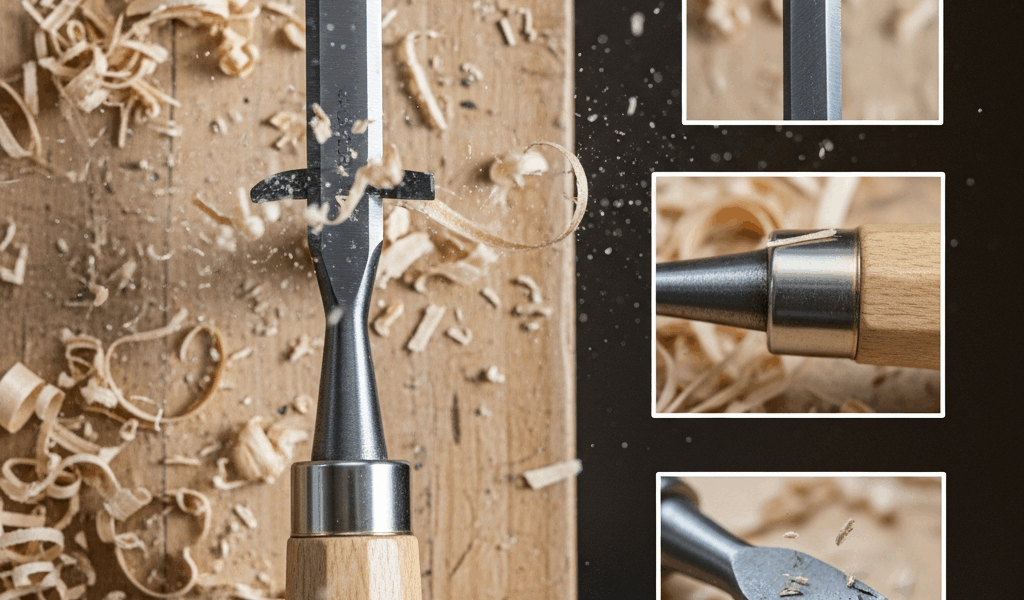
Why Chisels Chatter and When It Actually Matters
Chattering when striking wood—that rapid vibration that makes your chisel bounce and skip across the surface—has gotten complicated with all the varying explanations flying around. I’ve spent enough hours in my shop chasing this problem to know the distinction matters. As someone who’s dealt with this frustration more times than I’d like to admit, I learned that chattering is involuntary oscillation, usually between 50 and 200 cycles per second depending on what’s causing it. Normal vibration is different—it’s dampened feedback that stops immediately after the strike.
The frustration hits hardest because a chattering chisel sabotages your control. You can’t cut clean edges. The tool feels unreliable. But here’s the thing most woodworkers don’t realize: chattering almost always comes from one of three sources — a separated or cracked handle, loss of flatness along the blade’s back (behind the bevel), or flawed striking technique paired with the wrong mallet weight. Diagnosis first. That’s the only path forward.
Check the Handle First — Every Time
Frustrated by a chisel that wouldn’t cut straight, I spent three hours sharpening the blade using different stones and techniques, only to discover the handle was splitting at the socket. The handle was the problem all along. Start here, not with blade geometry or technique assumptions.
The grip test takes thirty seconds. Hold the chisel by the handle and squeeze firmly—not casually, actually grip it like you’re about to use it. Feel for any flex or looseness in the ferrule or where the blade enters the handle. A solid handle should be rigid. If there’s play, you’ve found your culprit. Separated handles vibrate independently of the blade, creating that maddening chatter.
Next, sight down the handle lengthwise under natural light. Look for any cracks radiating from the ferrule or socket area. These fractures absorb strike energy instead of transmitting it cleanly. Small radial checks (the fine cracks that appear naturally as wood seasons) aren’t structural failures if they’re not separating. But cracks that open visibly when you grip the tool? Those are problems.
The tap test separates cosmetic splits from true damage. Tap the handle with your knuckle near the ferrule—listen for a sharp, clear sound versus a dull thud. A clear tap means the wood is intact and bonded. A dull response suggests internal separation or delamination inside the socket where the blade sits. This is what creates chatter: the blade vibrates inside a loose cavity instead of moving as one unit with the handle.
If you find handle separation, the fix depends on severity. Minor separation at a ferrule can be addressed by carefully driving a thin wedge coated with epoxy into the gap — use a wooden toothpick or thin shim, not a metal wedge, you’ll split the wood further. Let it cure for 24 hours. For older chisels with wooden handles that have truly split at the socket, you’re looking at either professional handle replacement or retirement. I won’t glue a socket together and pretend it’s reliable; the repair won’t hold under repeated striking.
Test Blade Flatness on the Back
Probably should have opened with this section, honestly. Blade flatness is where most people get lost because they confuse sharpening with flatness. You can sharpen a chisel with a dished back all day and never fix the chatter.
The back of a chisel (the side opposite the bevel) must be flat for the tool to register properly against your workpiece. Any dishing or waviness creates micro-vibrations because the blade rocks on the high spots instead of settling flat. Use a straightedge and light to check this. Place a reliable straightedge — I use a 24-inch machinist’s straightedge, roughly $45 from any metalworking supplier — across the back of the blade, perpendicular to the edge. Hold it up to bright light and look for gaps.
Here’s what matters: deviation under 0.001 inch across the back is functionally flat for hand tool work. You won’t notice it in use. Deviation between 0.001 and 0.003 inch might cause chatter depending on how aggressively you’re striking. Over 0.003 inch, you have a real problem that needs lapping.
Lapping — flattening the back on a stone or abrasive surface — is genuinely tedious. I use a 1000-grit waterstone and take my time because rushing damages the edge. You’re looking at 20 to 45 minutes per chisel depending on how much dishing you’re correcting. If the blade is pitted, rusted, or shows stress cracks during lapping, stop. The tool is telling you it’s reached the end of its life. Don’t throw good time at bad steel.
Striking Technique and Mallet Weight Fixes
I’ve watched woodworkers use mallets that were either far too heavy or struck at angles that undermined their good tools. Both create chatter instantly.
Your mallet weight matters more than most people accept. For bench chisels, you want something between 20 and 32 ounces — at least if you want clean, controlled cuts. My go-to is a Robert Sorby lignum vitae mallet at 28 ounces; it transmits force cleanly without requiring aggressive follow-through. If your mallet weighs over 40 ounces, you’re forcing the issue. The chisel absorbs energy it wasn’t designed to handle and responds with vibration. Lighter is often better. Let the tool do the work instead of muscling it.
Striking angle is equally critical. Your mallet should strike the handle perpendicular to the blade’s direction of travel. This means the face of the mallet hits square and true. If you strike at an angle — which happens naturally when you’re tired or rushing — the force deflects sideways, causing the blade to chatter against the wood. Concentrate on hitting dead center every single time. This sounds mechanical, but it’s the difference between a quiet cut and chatter.
Follow-through matters too. Your strike shouldn’t be jerky or arrested mid-motion. Drive the mallet smoothly through the impact, letting the mallet’s weight do the work. An abrupt stop — where you tense your arm to control the blow — transfers energy unevenly and creates chatter. Think of it like swinging a hammer: smooth acceleration, controlled release, not aggressive braking.
The final adjustment is striking force. You don’t need to hammer chisels. Light, controlled strikes with a properly weighted mallet produce cleaner cuts and eliminate chatter caused by over-striking. If you’re using heavy mallet blows to drive a chisel, either your technique is wrong or your blade is dull. Fix those instead.
When Chattering Means Replace—Not Repair
Some damage isn’t worth fixing. I keep a few battered chisels in my shop because sometimes they’re genuinely done, and accepting that beats wasting hours on futile repairs.
Handle damage beyond simple separation — like missing chunks of wood, lamination failure where the handle is literally splitting into layers, or cracks that propagate when you grip the tool — means replacement. A handle can be replaced by a professional, but you’re looking at $60 to $120 in labor. If the chisel itself is a mid-range tool, replacement becomes logical.
Blade-side issues that indicate retirement: visible pitting across the working surfaces (not just cosmetic surface rust, but actual pits), stress fractures radiating from the edge or bevel (these spread under use), or lamination failure if the blade is a laminated construction. These are signs the steel has fatigued or been damaged beyond safe repair. A laminated blade that’s separating won’t hold an edge and won’t respond to any of these fixes.
If lapping reveals that you need to remove more than 0.030 inch of material from the back to achieve flatness, the blade is too far gone. You’re compromising the tool’s heat treatment and edge durability. Walk away.
Here’s my honest rule: if you’ve checked the handle, tested flatness, refined your technique, and the chatter persists, the tool has reached the end. Quality chisels are worth repairing when the damage is specific and fixable. But if multiple systems are compromised, replacement is cheaper than your frustration.




Stay in the loop
Get the latest crafted wood creations updates delivered to your inbox.