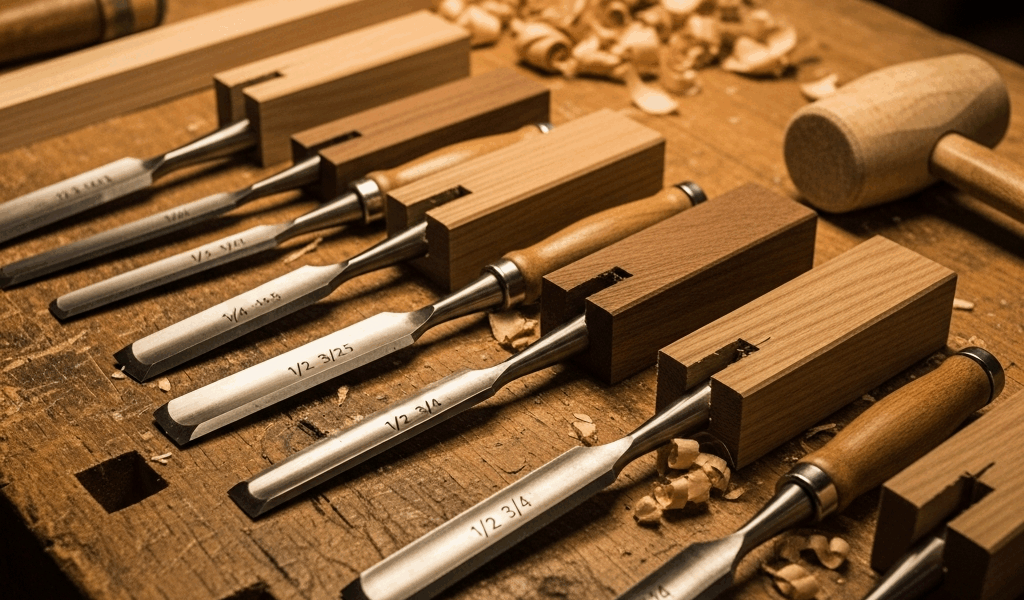
Why Mortise Chisel Width Matters More Than You Think
Mortise chisels have gotten complicated with all the sizing confusion flying around. I spent three years buying them like I was collecting Pokémon—convinced that owning every size meant I’d be ready for anything. Then the math became impossible to ignore: $40 to $80 per chisel, eleven of them in a drawer I opened maybe twice a year, and I kept reaching for the same two during actual work. That’s when mortise chisel sizes stopped being an abstract question and became a real money problem.
But here’s what nobody tells you: chisel width affects everything downstream. How your mallet strike transfers energy. Whether you maintain control when driving through maple or oak. How much cleanup time you’ll spend evening out walls. Whether you’ll actually finish the joint without crushing grain around the edges. That’s what makes width selection endearing to woodworkers who actually finish projects.
I learned the hard way that a 1/4-inch chisel vibrates differently than a 1/2-inch one. The narrower tool flexes more — which sounds like a disadvantage until you’re working in confined spaces or fighting tearout in difficult grain. A wider chisel absorbs mallet impact more effectively, letting you move larger volumes of wood per stroke. But it also demands more control and more strength to keep it perfectly vertical.
This isn’t beginner confusion about what a mortise chisel is. You already know. This is about whether you actually need that 3/4-inch or 1-inch sitting in your kit, collecting dust and eating up premium tool storage space.
The 1/4 Inch Chisel — When It Actually Earns Its Place
The 1/4-inch mortise chisel is the specialist of the group. Calling it a “workhorse” would be a lie.
I use mine specifically for small decorative mortises, inlay pockets that are under an inch wide, and grain-direction situations where a wider chisel would explode the fibers. There’s also that moment when you’ve undercut a mortise wall by 1/32 inch and need to pare back with surgical precision — the 1/4-inch gets that done without accidentally deepening the entire pocket another millimeter.
The narrow profile flexes enough that you can feel exactly what the wood is doing. In figured or reversing grain, that feedback matters. But here’s the trade-off: you can’t build momentum with a 1/4-inch. Excavating a 3/4-inch deep mortise in white oak? You’ll make many more passes, and your arm will know about it by pass number eight.
Budget-wise, a decent 1/4-inch mortise chisel from Narex or Lie-Nielsen runs $25 to $55. Worth owning if your work includes decorative elements or very tight joinery. Skip it if you’re mostly building simple frames and box joints.
1/2 Inch as Your Workhorse Mortise Chisel
This is the one.
The 1/2-inch (sometimes marketed as 12mm) mortise chisel is the single tool I’d grab if I could only keep one. Door frame construction, furniture mortises, box sides, table aprons — the 1/2-inch handles all of it with a balanced ratio of mallet strike to control.
Here’s why it works: the width is substantial enough that you can drive it with conviction using a 2-pound mallet without the handle flexing unnaturally. Strike energy transfers predictably into the wood. You execute clean corners and straight walls without the constant micro-adjustments that narrower tools demand. Working softwoods like pine or cherry, that consistent pressure means fewer torn fibers around the perimeter.
Hardwoods are where the advantage becomes obvious. Walnut or maple — the 1/2-inch still outperforms because you’re making maybe three or four passes to excavate full depth, versus six or seven with the 1/4-inch. The time difference compounds across a whole project, especially when you’re cutting ten or fifteen mortises.
The grain-direction advantage is subtle but real. When wood fibers run perpendicular to your chisel advance, a 1/2-inch width creates enough support on the sides that tearout stays localized. A 1/4-inch in the same scenario can initiate a long splinter that runs the full mortise length.
Probably should have opened with this section, honestly. Most woodworkers could complete their entire career with only a 1/2-inch mortise chisel and never feel limited.
Cost: expect $40 to $70 for a solid 1/2-inch. Dewalt, Irwin, and Lie-Nielsen all produce versions at different price points. The difference between a $40 and $60 option is mostly handle comfort and steel quality — both will cut mortises competently.
3/4 Inch and Larger — Why You Might Skip Them
There’s a temptation to buy larger mortise chisels “just in case.” Large table base mortises, heavy frames, jobs that need deep excavation. The logic feels sound until you actually try it.
A 3/4-inch or 1-inch mortise chisel is heavier. Your mallet needs to be heavier to make the strike effective — I’m talking 3 to 4 pounds instead of 2. That extra weight becomes fatigue on your shoulder and wrist during an afternoon of work. More mass also means less control. Corners won’t be as crisp. You’ll overshoot wall positions more often.
The real insight: wide mortises don’t actually require a single wide chisel. They benefit from overlapping passes with the 1/2-inch. Yes, that’s more strokes. But each stroke is more controllable, your accuracy is higher, and you’ll spend less time cleaning up crushed grain on the walls.
I tested this directly on a walnut table apron that needed a 1.5-inch-wide mortise. Using the 1-inch chisel was actually slower than three overlapping passes with the 1/2-inch, and the wall quality was noticeably better. The grain crushing from the wide chisel required sandpaper work. The narrow chisel left walls almost ready for finishing.
Bulk material removal is the only scenario where larger chisels win. Digging out a 4-inch-wide, 3-inch-deep mortise in softwood with thick tenons? A 1-inch chisel moves wood fast. That’s edge-case work, not typical joinery.
Unless your actual projects demand it — and most don’t — a 3/4-inch or 1-inch chisel stays in the store.
Building Your Actual Mortise Chisel Set
Here’s what I’d recommend based on real shop work, not theory.
Minimum viable set: just the 1/2-inch. Building frames, furniture, and standard joinery? This covers everything. One chisel, $50 investment, zero storage regret. You’ll be slightly slower on the 1/4-inch specialty work and large mortises, but you’ll finish projects.
Practical two-chisel set: 1/2-inch plus 1/4-inch. Add the 1/4-inch when your work includes decorative details, inlays, or difficult grain situations where you want surgical control. Combined cost: around $80. Storage: one small drawer section. These two tools handle 95% of typical woodworking mortise work.
Three-chisel set: 1/4-inch, 1/2-inch, and 3/4-inch. Only if you’re routinely cutting very wide mortises or working commercially where speed matters more than perfection. The 3/4-inch earns its place here because it actually gets used weekly, not monthly. But for hobbyist or part-time professional work, this third chisel often becomes clutter.
The trade-offs are real. You’ll never use the 1/4-inch on standard door frames. You’ll regret not owning one if your work involves boxes with visible grain-matched inlays. The 3/4-inch saves time on bulk work but creates fatigue on precision cuts.
Consider which 80% of your work looks like. Frame-and-panel furniture? Buy the 1/2-inch and stop. Decorative boxes and fine pieces? Add the 1/4-inch. Commercial production? All three makes sense, but your hand quality will suffer slightly.
One practical detail matters more than width — mortise chisel steel. A $25 Narex 1/2-inch chisel will outcut a $50 budget-brand 1/2-inch because the steel holds an edge longer and sharpens faster. I’m apparently the type who used to buy extra widths from brands I didn’t trust rather than buying one good width from a reliable maker. Spend money once on proven steel, not money three times on different sizes. Don’t make my mistake.
The actual width that matters is the one you’ll reach for during real work. Start with the 1/2-inch. Add others only when you hit genuine limitations, not theoretical ones.



Stay in the loop
Get the latest crafted wood creations updates delivered to your inbox.