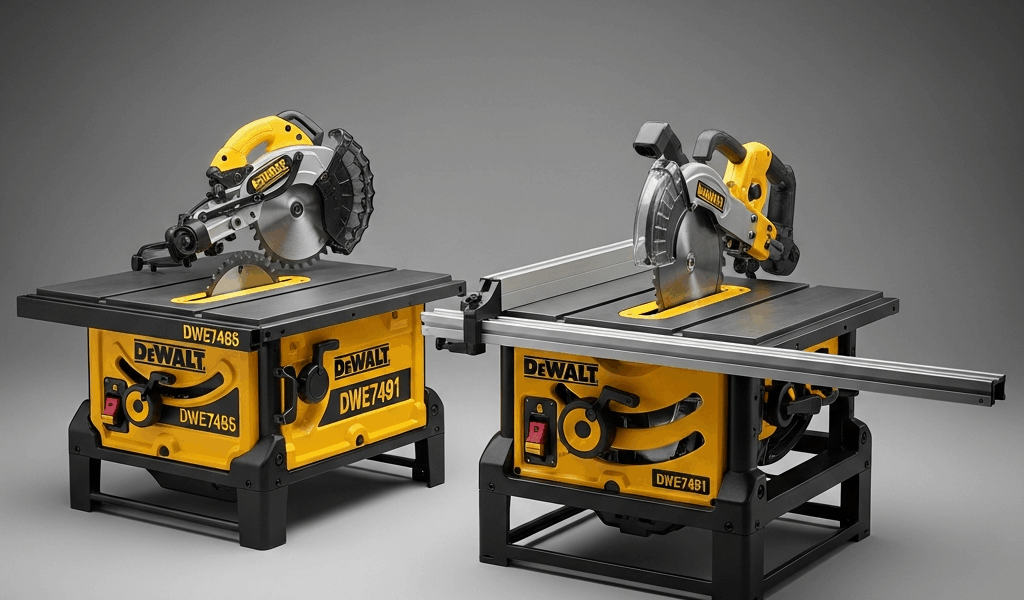
DeWalt DWE7485 vs DWE7491 — Which Table Saw Should You Buy?
Table saw shopping has gotten messy with all the nearly-identical-looking options flying around. As someone who ran the DWE7485 for nearly two years before eventually switching to the DWE7491, I figured out how to handle what separates these two saws — and more importantly, what that separation actually costs you in the shop. They sit next to each other at Home Depot, same yellow-and-black color scheme, similar price tags, and if you’re not paying close attention you’ll grab the wrong one. Side-step the error I made.
This article includes affiliate links. We may earn a commission at no extra cost to you.
DWE7485 vs DWE7491 — The Key Differences
Start with the blade. The DWE7485 runs an 8-1/4 inch blade. The DWE7491 runs a standard 10 inch blade. That single distinction — one number, one fraction — cascades into almost every meaningful difference between these two saws. Worth sitting with before moving on.
An 8-1/4 inch blade maxes out at roughly 2-1/2 inches of cut depth at 90 degrees. The 10 inch blade on the DWE7491 gets you 3-1/8 inches at 90 degrees. For most dimensional lumber, that gap won’t register. For 8/4 hardwoods — 2-inch-thick walnut, cherry, hard maple — it starts to matter quite a bit. I tried resawing a piece of 2-inch white oak on the DWE7485 once. The blade bogged down, the fence deflected slightly, and I ended up with a tapered board I couldn’t use for anything. Lesson learned the hard way, and not cheaply either.
Rip Capacity — 24.5 vs 32.5 Inches
The DWE7485 gives you 24-1/2 inches of rip capacity to the right of the blade. The DWE7491 gives you 32-1/2 inches. Eight inches sounds modest. In actual shop use, it’s enormous.
A standard sheet of plywood is 48 inches wide. Ripping it down the middle requires at least 24 inches of capacity. The DWE7485 clears that bar by half an inch — barely. It’ll do it, but there’s zero margin for error in your fence setup, and every time you break down sheet goods you’re working right at the edge of what the saw can physically handle. The DWE7491’s 32-1/2 inch capacity lets you rip cabinet panels, wide table aprons, and large drawer faces without holding your breath through the entire cut.
Dado Compatibility
But what is dado compatibility, really? In essence, it’s whether the saw can accept a stacked dado blade set — wider cutting heads that remove material in channels rather than single kerfs. But it’s much more than that. It’s the difference between building furniture with traditional joinery or spending twice as long routing every joint by hand.
The DWE7485 does not accept dado blade sets. The DWE7491 does — accommodating stacked dado sets up to 13/16 inch wide. If you build anything with drawer boxes, shelf dados, or half-lap joints, the DWE7491 is the only option between these two saws. You cannot router-jig your way around every joint. Some cuts just want a dado stack.
Weight and Footprint
The DWE7485 weighs 45 pounds. The DWE7491 weighs 90 pounds. That’s not a rounding error — it’s literally twice the weight. The DWE7485 fits in a truck bed with room for a toolbox and two guys can move it without much drama. The DWE7491 needs a proper stand — DeWalt sells the DW7491RS version bundled with a rolling stand — and once it’s set up in your shop, it’s probably not moving much. That’s what makes the weight question so central to this whole decision.
Motor Power
The DWE7485 runs a 15-amp motor producing around 1.85 horsepower. The DWE7491 also runs 15 amps but is rated at 2 horsepower. In real shop conditions, the DWE7491 handles hardwoods with noticeably more authority. The DWE7485 will push through hard maple or white oak, but you feel it working — the pitch changes, the feed rate slows. The DWE7491 just cuts.
Price
As of this writing, the DWE7485 runs around $369 to $399 at most retailers. The DWE7491 sits closer to $549 to $599, and the DW7491RS bundle with the rolling stand usually lands around $679. These prices shift — DeWalt runs holiday promotions fairly regularly, apparently — but that roughly $200 gap stays consistent across seasons.
When the Compact DWE7485 Makes Sense
Frustrated by lugging a full-size cabinet saw between job sites using a beat-up trailer and two trips per location, a lot of contractors eventually land on the DWE7485 and never look back. This is a job-site saw in the truest sense. Forty-five pounds, a fold-flat stand option, a blade that’s increasingly available at any hardware store — it’s built to live in a truck bed and perform on a concrete slab.
For trim carpenters, the DWE7485 is probably all you need. Ripping baseboard stock, cutting down casing, trimming door jambs — none of that pushes the capacity limits of an 8-1/4 inch saw. You’re not ripping 30-inch cabinet panels on a job site anyway. You’re making precise, repeatable cuts in dimensional lumber, and this saw handles that reliably.
Small Shop and Apartment Woodworkers
I know woodworkers running full furniture operations out of 200-square-foot spaces — one guy I met at a local woodworking club builds Shaker-style cabinets in a converted garden shed with a single overhead light. In that context, the DWE7485’s footprint is a genuine advantage. It doesn’t need a dedicated corner. You can work around it, slide it aside, store it on a shelf if needed. The DWE7491 demands real estate.
The 24-1/2 inch rip capacity, as tight as it is, covers a surprisingly wide range of projects. Cutting boards, small boxes, picture frames, end tables, nightstands — projects built from solid lumber rather than sheet goods rarely need more than 10 to 12 inches of rip capacity. The DWE7485 handles all of that with room to spare.
The Plywood Situation
Here’s the honest reality on breaking down plywood with the DWE7485. You can rip a 4×8 sheet down the center — just barely. But you really should be breaking down large panels with a track saw or a circular saw and a straightedge guide first, then cleaning up the edges at the table saw. That workflow works fine. Most experienced woodworkers do it that way regardless of which saw they’re running, honestly, because managing a full 4×8 sheet solo on any table saw is awkward and slightly dangerous.
Where the DWE7485 hits a real wall is casework — kitchen cabinets, built-in bookshelves, entertainment centers. Cabinet side panels are often 15 to 23 inches wide, which the DWE7485 handles. But wide drawer faces and full-width cabinet backs start pushing into territory the DWE7491 handles far more cleanly.
Who Should Buy the DWE7485
- Contractors and finish carpenters who move between job sites regularly
- Hobbyists with limited shop space who primarily work in solid lumber
- Woodworkers who already own a track saw for sheet goods breakdown
- Anyone upgrading from a job-site saw who doesn’t yet need dado capability
- Woodworkers on a tight budget who need a capable, accurate saw under $400
When You Need the Full-Size DWE7491
Furniture makers almost always end up here. I held out on the DWE7491 longer than I should have — convinced the DWE7485 could handle my work if I was just clever enough about my workflow. It couldn’t. The moment I started building a dining table with breadboard ends, which meant a stack of 8/4 lumber and mortise-and-tenon joints throughout, the limitations became undeniable. That’s what makes the DWE7491 endearing to us furniture builders — it stops making the saw your limitation and lets the work be the focus.
Dado Joints Change Everything
If you build boxes, drawers, shelving units, or any kind of cabinetry with traditional joinery, dado capability isn’t a luxury — it’s a production tool. A router can cut dados, sure. A router table can do it more conveniently. But a stacked dado set on a table saw is faster, more repeatable, and cleaner for production runs. Building a six-drawer dresser means cutting 12 drawer box sides, each needing bottom dados and possibly front-and-back dados for assembly. Doing that with a dado stack on the DWE7491 takes an afternoon. Doing it with a router takes considerably longer and introduces more variables at every step.
The DWE7491 accepts standard 8-inch dado sets. I run a Freud SD208 stacked dado set — street price around $109 — and the combination produces clean, flat-bottomed dados in hardwoods without any drama whatsoever.
Wider Rip Capacity for Real Shop Work
Thirty-two and a half inches. That’s enough to rip a plywood sheet into thirds, enough to handle wide panel glue-ups, enough to bring a 28-inch tabletop blank down to final width after jointing. That capacity removes a whole category of material-handling problems from your day. You stop thinking about whether the saw can do it and start thinking about the cut itself.
Wide rips in hardwood are also where the DWE7491’s 2-horsepower motor earns its keep. Running 10/4 live-edge slabs through any saw is a workout. The DWE7491 doesn’t stall. It doesn’t trip your circuit breaker. It cuts.
Thicker Cuts in Hardwood
The 3-1/8 inch cut depth at 90 degrees matters for anyone working with thick stock. Furniture legs are often turned or shaped from 3-inch blanks. Stair treads, workbench tops, large timber joinery — all of it benefits from that extra cut capacity. The DWE7485 simply cannot make these cuts. It’s a hard limit, not a soft one, and no amount of clever technique gets around it.
Who Should Buy the DWE7491
- Furniture makers working in hardwoods, especially 8/4 and thicker stock
- Woodworkers who build cabinets or casework with dado joinery
- Anyone whose shop has a permanent home for a 90-pound saw
- Woodworkers regularly breaking down full plywood sheets at the table saw
- Hobbyists who’ve outgrown a compact saw and want a long-term upgrade
The DW745 Replacement Question
Quick callout up front — because a significant chunk of the people comparing these two saws aren’t starting from zero. They owned a DeWalt DW745 and need to figure out what replaces it.
DeWalt discontinued the DW745 a few years back. It was a 10-inch job-site saw with a 20-inch rip capacity and a dedicated following among woodworkers who valued its portability and reasonable price point. No dado set compatibility. Around 45 pounds. Fifteen-amp motor. A lot of people built real furniture on that saw for a decade.
DWE7485 as the Spiritual Successor
On paper, the DWE7485 is the DW745’s replacement. Portable. Compact. No dado compatibility. The 8-1/4 inch blade is actually an improvement for portability — those blades are lighter and increasingly common at hardware stores. The fence system on the DWE7485 is also better than the DW745’s, with rack-and-pinion adjustment that’s smoother and a fence that locks more securely.
The rip capacity expanded too — 24-1/2 inches on the DWE7485 versus 20 inches on the DW745. That extra 4-1/2 inches matters. DW745 owners who felt cramped by that 20-inch capacity will find the DWE7485 a meaningful upgrade on that front alone.
The blade compatibility question is real, though. If you have a collection of quality 10-inch blades — a Freud LU87R, a Forrest Woodworker II, a Diablo D1040X — those will not work on the DWE7485. You’re starting a new blade collection for 8-1/4 inch. That’s an additional investment that doesn’t appear anywhere on the saw’s sticker price.
When DW745 Owners Should Skip the DWE7485
If you never ran dado sets on the DW745, the DWE7485 is a reasonable upgrade — better fence, more rip capacity, similar portability. If you worked around the DW745’s limitations using a router for joints and a track saw for sheet goods, that same workflow supports the DWE7485 just fine.
But if you’ve been feeling constrained by a job-site saw and the DW745’s discontinuation is your chance to rethink your setup, the DWE7491 is the more honest upgrade. You get a 10-inch blade that accepts your existing blade investment, dado capability you didn’t have before, wider rip capacity, and noticeably more authority in hardwood. The DW745 to DWE7491 path means a bigger, heavier saw — but it also means you won’t be having this same conversation in three years when your projects outgrow the compact format again.
One Practical Note on Blade Collections
Going from a DW745 to a DWE7491 means your existing 10-inch blades work immediately. A good 10-inch combination blade like the Freud LU83R010 runs about $65. A quality 10-inch dado stack like the DEWALT DW7670 runs around $169. These are blades you buy once and run for years. That’s a real advantage for former DW745 owners considering the DWE7491 — your existing accessories aren’t stranded, and you’re not rebuilding a collection from scratch.
The Bottom Line
Buy the DWE7485 if portability is genuinely part of your work — you move between job sites, your shop space is tight, or your projects are built primarily from solid lumber in manageable dimensions. It’s an accurate, well-built saw that performs above its weight class for what it’s designed to do. First, you should be honest about whether you’re actually a job-site guy — at least if you want to avoid buying twice.
Buy the DWE7491 if you build furniture, work regularly in hardwoods thicker than 1-1/2 inches, need dado capability, or consistently work with full-size sheet goods. The extra $150 to $200 buys you a saw that won’t limit your work for the next decade. DWE7491 might be the best option here, as serious shop work requires both capacity and dado flexibility. That is because projects scale up — and saws that can’t scale with them become expensive frustrations.
Learn from what tripped me up. I bought the DWE7485 first, outgrew it eighteen months later, and bought the DWE7491 anyway. Both are good saws — they’re just aimed at different woodworkers. Figure out which one you are before you spend the money, and you won’t have to spend it twice.



Stay in the loop
Get the latest crafted wood creations updates delivered to your inbox.