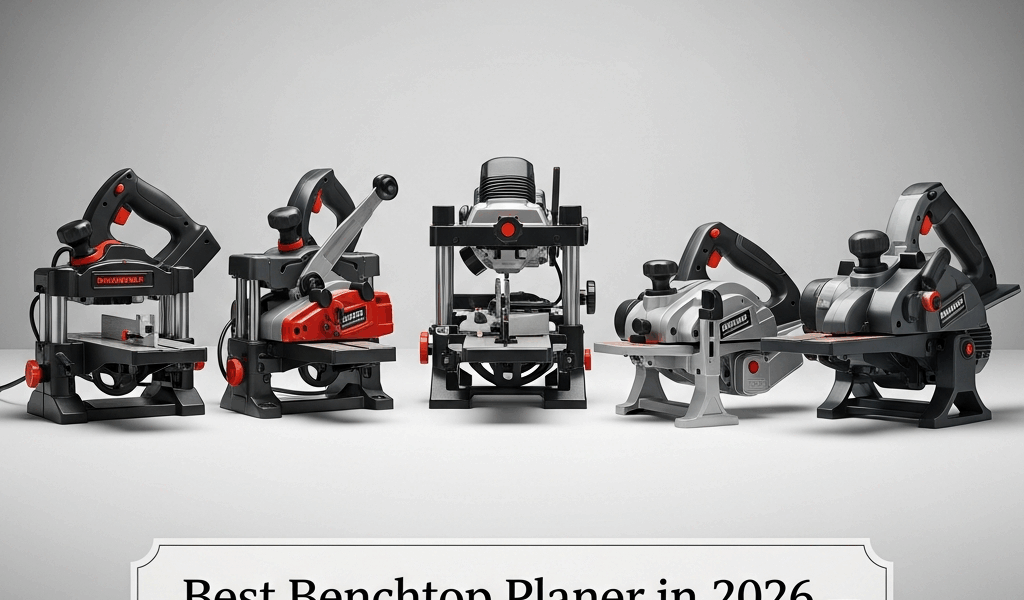
Best Benchtop Planer in 2026 — 5 Models Tested and Compared
Benchtop planers have shifted noticeably with all the conflicting advice flying around. As someone who spent years building dining tables and bedroom pieces from rough-sawn hardwood, I dug into the practical details of these machines the hard way — through bad purchases, borrowed equipment, and one return I’m still a little embarrassed about. I tested five planers over several years. Some bought new, one borrowed from a friend’s shop. Real wood ran through all of them: hard maple, white oak, walnut, cherry. Furniture-grade work where surface quality actually matters.
This article includes affiliate links. We may earn a commission at no extra cost to you.
Save yourself the trouble I had of hand planing everything until your shoulders give out. Get a machine. But get the right one.
What Makes a Good Benchtop Planer for Furniture
Most reviews focus on hobbyist deck projects or rough dimensioning. Furniture work is different. A board that comes off your planer needing minimal sanding is worth more than one that’s dimensionally perfect but fuzzy and torn-up. These aren’t the same thing, and most reviews don’t bother to separate them.
Snipe — The Problem Nobody Solves Completely
But what is snipe? In essence, it’s a shallow dip or gouge at the leading and trailing ends of a board as it enters and exits the planer. But it’s much more than that — it’s the thing that will drive you absolutely crazy if you don’t understand why it happens and how to manage it. Every benchtop planer produces it to some degree. The question is how bad.
For furniture work, snipe is annoying but manageable. Leave extra length on your boards, cut off the affected ends, done. What matters more — honestly — is whether the snipe is predictable and consistent, not whether it exists at all. The design of the infeed and outfeed rollers, plus the distance between them, determines a lot of that.
Cutter Head Type — Straight Knife vs Helical
This is the single biggest quality differentiator between benchtop planers. Straight-knife machines use two or three long blades running the full width. Helical heads use dozens of small carbide inserts arranged in a spiral pattern. On figured wood — curly maple, quartersawn oak — the surface finish from a helical head is noticeably better. Less tearout, quieter operation, and when an insert gets dinged up you rotate it to a fresh corner instead of replacing an entire blade set.
The cost difference is real. A helical head upgrade on a mid-range planer can add $200 to $400. Whether that’s worth it depends entirely on what you’re building.
Dust Collection
Planers make an absurd amount of chips — more than almost any other tool in the shop. A machine with poor chip ejection will pile shavings back onto your workpiece or clog the housing entirely. The best benchtop planers have wide 4-inch chip ejection ports and direct shavings cleanly into a collector. The difference between a good dust port and a bad one isn’t subtle when you’re running white oak all afternoon.
Width Capacity
Most benchtop planers run 12 to 13 inches wide. That covers the vast majority of furniture work — nearly every board I plane falls between 8 and 10 inches. Wide glued-up tabletops are the edge case, but here’s the thing: I plane each board before gluing anyway. Trying to run a 24-inch glued-up panel through a benchtop machine is a recipe for frustration. Just don’t do it.
5 Best Benchtop Planers Ranked
Worth mentioning before anything else. Here are the five machines I’d actually recommend to someone building furniture, ranked by overall performance for that specific use case.
1 — DeWalt DW735X
The DW735X is the machine I tell most woodworkers to buy. Street price runs $649 to $699 depending on where you find it. The “X” package includes infeed and outfeed extension tables — these matter more than you’d think for longer boards. Thirteen inches wide, three-knife straight cutter head, two-speed feed rate: 96 feet per minute for rough passes, 179 FPM for finishing passes.
That two-speed feature is genuinely useful. Running a slower feed rate on the final pass gives a noticeably cleaner surface. I’ve planed cherry and figured maple on this machine and come off with surfaces ready for 150-grit, then straight to 220. That’s not typical for a benchtop planer. That’s what makes the DW735X endearing to us furniture people — it behaves like a machine that actually cares about the final surface.
Snipe is present but mild with good technique. Chip ejection is excellent — 4-inch port, strong airflow, shavings go where you point the hose. At roughly 48 pounds, it’s portable enough to move but stable on a bench. One gripe: blade changes are fiddly. DeWalt’s three-knife system requires a gauge tool to set each knife correctly. About 30 minutes if you know what you’re doing. Not a dealbreaker — just know it going in.
2 — Grizzly G0959
The Grizzly G0959 is the machine I wish I’d bought first. It comes factory-equipped with a helical carbide insert head, which puts it in a different category for surface finish. Street price is around $725 to $750.
Frustrated by tearout on curly maple, I started running boards through a loaner G0959 at a friend’s shop — he’d set it up on an old workbench next to his table saw — and the difference was immediate. The surface coming off this machine on difficult grain needs almost no sanding. The helical head is quieter too, measurably quieter, not just slightly. Running it next to the DW735X in the same shop, the difference in noise level is significant enough that you notice it without trying to.
Thirteen inches wide, 4-inch dust port, smooth and repeatable depth-of-cut adjustment. The main downside is weight — 68 pounds — and the fact that Grizzly is a mail-order brand. If something goes wrong, you’re shipping it back, not walking into a service center down the road.
3 — Makita 2012NB
The Makita 2012NB might be the best option if portability is your top priority, as compact shop setups require flexibility above almost everything else. That is because most woodworkers underestimate how often they need to move equipment around — especially in smaller spaces. Twelve inches wide, 62 pounds, around $599 new. It’s a two-knife machine, which on paper sounds like a step down from the DW735X’s three knives, but the finish in practice is surprisingly clean.
The 2012NB folds. Infeed and outfeed tables fold down for transport or tight storage — no other benchtop planer in this price range does that. The handles are integrated into the design rather than bolted on as an afterthought. This is a machine clearly designed by someone who thought about real-world shop use, not just spec sheets.
Dust collection is acceptable — 4-inch port, decent airflow — but not as clean as the DeWalt. The chip ejection port is positioned slightly differently and throws a bit more debris back toward the operator when running without a connected collector. Small thing, but worth knowing. Knife changes are easier than on the DeWalt, which adds up as a quality-of-life difference over time. Snipe is similar to the DW735X — present, controllable, manageable with technique.
4 — DeWalt DW734
The DW734 is the entry point into this list — $399 to $429 most places. A 12.5-inch, three-knife machine with a single-speed feed of 96 FPM. No two-speed option like on the 735X, and that limitation shows on finish passes.
I used a DW734 for about eight months before upgrading. It did the job — dimensioned lumber accurately, produced acceptable surfaces on straight-grained wood. Where it fell short was figured wood and harder species like hard maple. The surface quality off the machine was rougher, and I found myself sanding more to compensate. That extra sanding time adds up fast on a big project.
For someone dimensioning lumber for painted furniture or utility pieces, the DW734 is a reasonable buy. For fine furniture with exposed surfaces in figured hardwoods, stretch the budget to the 735X or the G0959. Dust collection is functional but not exceptional — the 4-inch port is there but the airflow feels weaker than on the 735X. Budget for a good 1.5 HP dust collector behind it either way.
5 — WEN 6552T
The WEN 6552T earns a spot here for one reason: it’s $289 to $320, which is significantly cheaper than everything else on this list. For that price, it’s a legitimate 13-inch benchtop planer — two-knife straight head, 15-amp motor, 4-inch dust port.
I’ll be direct about where it falls short. Surface quality is noticeably rougher than the DeWalt or Makita. The depth stops are less precise. The table shows more flex on boards with any twist or bow because the casting isn’t as rigid. It’s a machine that gets boards close to dimension and expects you to sand more afterward.
Where it makes sense: a teaching shop, a makerspace with a tight budget, or someone doing primarily rough dimensioning rather than final surfacing. If you’re milling lumber to rough thickness before jointing and hand planing, the WEN is adequate. First, you should honestly ask yourself what you’re actually using a planer for — at least if you’re on a tight budget — because that question determines whether the WEN is a smart buy or a frustrating compromise.
Straight Knife vs Helical Head — The Real Difference
Most reviews treat this too casually. It matters more for furniture work than almost any other spec on the machine.
Straight-knife cutter heads — two or three long blades running the full width — slice across the grain as the board passes through. On straight-grained wood, this works well. On figured wood or any board where the grain direction reverses, a straight knife can catch and tear fibers rather than cut them cleanly. That’s tearout — small chunks of wood pulled up from the surface instead of sliced off cleanly. You’ll sand for an hour trying to fix what took three seconds to create.
Helical cutter heads use small square carbide inserts, typically around 15mm per side, arranged in a spiral pattern. Each insert engages the wood at a slight angle — more of a shear than a straight chop. The engagement is distributed across many small cutting edges rather than one long one. On figured maple or quartersawn oak with medullary rays, the difference in surface finish is dramatic. Not subtle. Dramatic.
Here’s what the upgrade actually costs in concrete terms. An aftermarket helical head for the DW735X runs approximately $350 to $400 from manufacturers like Byrd Tool. The Grizzly G0959 comes with a helical head from the factory and costs about $725 — roughly $75 more than a DW735X plus the cost of the upgrade. If you’re going to want the helical head eventually, buying the G0959 new makes more sense than buying the DeWalt and upgrading later. Skip the misstep I made of buying the cheaper machine thinking you’ll upgrade it and then doing the math afterward.
Maintenance is the other factor. Straight knives need replacing when they dull — a set of blades for the DW735X runs about $30 to $50, and you’re setting them with a gauge each time. Helical inserts last much longer because you rotate each small insert to a fresh corner when it dulls — four corners per insert — before replacing it. The per-use cost is lower over time, even if the upfront cost is higher.
How to Reduce Snipe on Any Benchtop Planer
Snipe is the thing that drives people to the woodworking forums at midnight. There are practical things you can do about it regardless of which machine you own.
Understand What’s Causing It
Snipe happens the moment a board is supported by only one roller — either just the infeed roller at the start of the cut, or just the outfeed roller at the end. With only one roller engaged, the board tips slightly, changing the depth of cut at those two points. That’s it. That’s snipe. Machines with rollers set closer together produce more snipe on shorter boards. Heavier machines with more rigid housings produce less — which is one reason the DW735X and G0959 snipe less than the WEN in side-by-side testing on the same boards.
Feed Technique — Lift the Board
The most effective technique is manually supporting the trailing end of the board as it enters the planer, holding it up slightly so it doesn’t tip down into the cutter. Same at the exit — support the leading end as it comes out. This requires a helper for long boards, or roller stands set at infeed and outfeed height.
For the first year I owned a planer, I was running boards through without support stands and wondering why I was always cutting 4 to 6 inches off each end. Once I set up a simple roller stand on each side — cheap ones from Harbor Freight, honestly — snipe on the DW735X dropped to about 1 to 1.5 inches. A length I can lose from most furniture parts without any consequence.
Auxiliary Extension Tables
The DW735X package includes extension tables specifically to address this. If your machine doesn’t come with them, building simple wooden tables that attach to the planer’s infeed and outfeed openings is a weekend project that pays dividends every single time you use the machine.
While you won’t need precision-machined cast iron, you will need a handful of basic materials: 3/4-inch MDF or melamine for the table surface, some scrap lumber for the legs, and UHMW plastic tape for low friction on the surface. The key is getting the height right so the table is exactly level with the planer’s bed. That’s the whole trick — nothing fancy about it.
Sacrificial Boards
Run a sacrificial board through the planer directly before your good board, close behind it. The sacrificial board — any scrap of similar thickness — exits the planer and keeps the outfeed roller engaged while your good board’s trailing end passes through the cutter head. Snipe on the trailing end is eliminated because the roller never loses engagement.
I use this for critical pieces — the top face of a tabletop, or a prominent show surface. Pair it with the lifting technique on the infeed side and you can get snipe down to nearly nothing on most machines. Takes a little setup. Completely worth it on expensive figured hardwood.
Leave Length and Cut It Off
The simplest approach: mill your lumber 4 to 6 inches longer than the finished dimension, plane it, then cut off the sniped ends on the table saw. No special technique required. This works for most furniture parts and doesn’t require perfect execution every pass. On large, expensive pieces of figured hardwood where waste matters, use the other techniques. For routine dimensioning, just leave the extra length and move on with your life.
One more thing — check your planer’s rollers and bed for debris before any critical session. A chip stuck on the bed or a gummed-up roller will cause irregular snipe or surface marks that look exactly like a technique problem when they’re actually a maintenance issue. Wiping down the bed and checking the rollers takes two minutes. It has saved me more than a few ruined boards over the years, apparently more than I’d like to admit.
Final Thoughts
For furniture-quality work, the DeWalt DW735X is the machine I recommend to most woodworkers — it handles the range of hardwoods and surface quality expectations that furniture making requires at a price point that most people can justify. The Grizzly G0959 is the better machine if you’re regularly working figured hardwoods and want the helical head from day one. Everything else on this list serves a specific situation. Know what you’re building, know what you’re willing to spend, and don’t overthink it longer than I did.


Stay in the loop
Get the latest crafted wood creations updates delivered to your inbox.