Woodworking has gotten complicated with all the tools and techniques flying around. As someone with extensive woodworking experience, I learned everything there is to know about this craft. Today, I will share it all with you.
Wood conditioner prevents blotchy stain absorption on certain species. Some woods need it, others don’t benefit from it, and a few actually look worse with pre-treatment. Here’s how to identify which woods require conditioning and which don’t.
What Conditioner Does
Wood conditioner is a thinned sealer that partially fills wood pores before staining. This reduces the absorption rate in porous areas, bringing them closer to the absorption rate of denser areas. The result is more uniform stain color across the board.
The conditioner doesn’t prevent stain from penetrating—it slows and moderates penetration. Properly applied conditioner lets enough stain through to color the wood while preventing the severe over-absorption that causes dark blotches.
Woods That Need Conditioner
Pine and other softwoods top the list. The dramatic density difference between early wood and late wood causes severe blotching without pre-treatment. Southern yellow pine shows particularly bad problems due to wide growth rings with high contrast.
Cherry benefits from conditioning even though it’s a hardwood. Cherry’s fine grain appears uniform but actually has variable density that shows up as random blotching when stained. Conditioner moderates these density variations.
Birch, maple, and alder also need conditioning. These hardwoods have relatively uniform appearance in raw form but contain enough density variation to blotch when stained. The blotching is less severe than pine but still objectionable in finished work.
Woods That Don’t Need Conditioner
Oak has open, consistent pores that accept stain uniformly. The natural contrast between porous early wood and denser late wood is expected and desired—it highlights oak’s grain pattern. Conditioning oak reduces this natural contrast, producing washed-out appearance.
Walnut stains uniformly due to its consistent density. The wood is naturally dark, and additional stain primarily affects tone rather than adding significant darkness. Conditioner is unnecessary and may prevent adequate stain absorption.
Mahogany, teak, and other tropical hardwoods have uniform density and consistent grain. They accept stain evenly without conditioning. Their natural oils may actually interfere with conditioner adhesion, making pre-treatment counterproductive.
Application Timing
Apply conditioner after final sanding but before staining. The conditioner seals the surface slightly, so sanding after conditioning removes the treatment and requires reapplication.
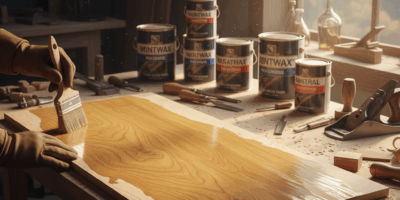
Brush or wipe conditioner onto all surfaces that will receive stain. Let it penetrate for 10-15 minutes, then wipe away excess. Most conditioners require 15-30 minutes drying time before you can apply stain. Check the product instructions—waiting too long defeats the purpose as the conditioner fully dries and becomes less effective.
Impact on Stain Color
Conditioner lightens the final stain color by reducing penetration. Plan on the stained wood being 20-30% lighter than unconditioned wood with the same stain. This is the trade-off for even coloring—you get uniformity but sacrifice intensity.
If you want darker color on conditioned wood, either apply an additional stain coat or choose a darker stain shade to start. Test this on scrap pieces—adding extra coats doesn’t always increase color proportionally.
Alternatives to Commercial Conditioner
Thinned finish works as conditioner. Mix your topcoat finish 50/50 with mineral spirits (for oil finishes) or water (for water-based finishes). Apply it as you would commercial conditioner. This approach ensures compatibility between the conditioner and your final finish.
Gel stain eliminates the need for conditioner by sitting on the surface rather than penetrating deeply. The thicker consistency prevents over-absorption in soft areas. Gel stain works particularly well on pine and other problem woods, though it produces a different look than liquid stain.
Testing on Scrap
Always test conditioner on scrap from your project wood before committing to the project pieces. Prepare multiple test pieces: one with conditioner, one without, and one with different conditioner drying times if you’re uncertain.
Apply your intended stain to all test pieces and evaluate the results. The difference between conditioned and unconditioned should be immediately obvious on woods that need treatment. If you can’t see significant blotching on the unconditioned sample, skip the conditioner on your project.
Common Mistakes
Over-applying conditioner creates a sealed surface that won’t accept stain at all. The wood looks barely tinted or remains nearly its natural color. This happens when you apply conditioner too heavily or don’t wipe away excess. Solution: sand lightly to open the surface and reapply stain.
Waiting too long between conditioning and staining lets the conditioner cure fully. You end up staining over a dried finish rather than into partially sealed wood. The stain won’t penetrate adequately. Follow the manufacturer’s staining window—typically 15 minutes to 2 hours after conditioning.
Using conditioner on woods that don’t need it reduces stain effectiveness without solving any problem. Oak with conditioner looks muddy. Walnut barely changes color. Save the time and money by conditioning only when necessary.
Blotch-Prone Areas
Even on woods that generally don’t need conditioning, certain areas may benefit from treatment. Sapwood areas in otherwise uniform boards often absorb more stain than heartwood. Consider spot-treating these areas while leaving the rest unconditioned.
End grain always absorbs more stain than face grain on any species. Applying conditioner to end grain specifically helps moderate this over-absorption. This targeted approach gives you better control than conditioning entire surfaces unnecessarily.
Recommended Woodworking Tools
HURRICANE 4-Piece Wood Chisel Set – $13.99
CR-V steel beveled edge blades for precision carving.
GREBSTK 4-Piece Wood Chisel Set – $13.98
Sharp bevel edge bench chisels for woodworking.
As an Amazon Associate, we earn from qualifying purchases.