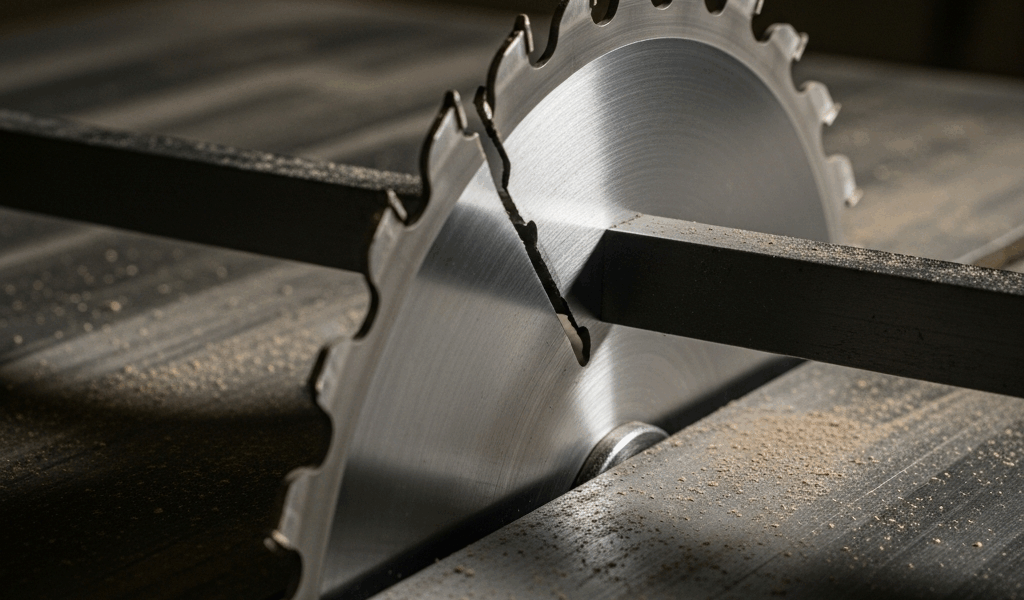
Table Saw Blade Wobble — How to Diagnose and Fix It
Table saw blade wobble has gotten complicated with all the conflicting advice flying around. As someone who’s spent the better part of fifteen years diagnosing wonky cuts in a home workshop, I learned everything there is to know about tracking down the source of a bad blade. Today, I will share it all with you.
When the blade doesn’t run true, you feel it before you even see it. Rough edges. Tearout in spots that make no sense. And honestly — the safety stuff is worse. A wobbling blade can bind mid-cut, throw stock back at you, catch a piece you weren’t expecting it to catch. I watched a contractor-grade blade snag a 2×6 once. Scared me straight. That was 2011, and I’ve never skipped a blade check since.
But what is blade wobble, exactly? In essence, it’s any lateral deviation of the spinning blade from its intended flat plane of rotation. But it’s much more than that — it’s a symptom pointing at one of four or five fixable root causes. You don’t need a technician. You don’t need to spend $400 before you’ve even looked at the thing. You need a systematic approach, a little patience, and maybe a $20 dial indicator.
So, without further ado, let’s dive in.
Is It the Blade or the Saw?
Start here. This takes two minutes flat and eliminates roughly half of all wobble cases before you touch a wrench.
Swap your blade out for one you actually trust. A blade from another saw, or borrowed from a friend — something you’ve cut with recently and know runs clean. Standard arbor hole is 5/8 inch on most saws, but verify yours before you install anything. Install it the same way you always would.
Make a test rip through a 2×4. Watch the blade as it moves through. Listen for that characteristic whipping sound. Feel whether the saw pulls sideways. You’ll know.
If the wobble disappears, your original blade was warped. Blades get warped from heat exposure, bad storage, or — I learned this the hard way, don’t make my mistake — stacking them flat on a concrete floor through a New England winter. I inherited a set of Freud blades from my father’s old shop. Nice blades, too. Ruined within a season from sitting in an unheated garage. Replace the blade. Problem solved. Move on.
If the wobble persists with the known-good blade? The problem lives in the saw itself — the arbor, the flange, the bearings, or the shaft. Keep reading.
Check the Arbor Flange
The second most common cause of blade wobble is debris on the flange surfaces — and I’m not talking about a little sawdust. Resin buildup, hardened glue, rust, or bent metal from years of blade swaps. That’s what you’re actually hunting for.
Unplug the saw. Non-negotiable. Reach over and verify the blade is locked before your hands go anywhere near it.
Remove the blade. Most saws take an 8mm or 15mm wrench on the arbor nut — 15 seconds with a cordless drill if you have one handy.
Now look at both flange surfaces with a flashlight. Upper and lower. You’re looking for anything that breaks the flat, clean contact the blade needs to sit flush. On my DeWalt contractor saw — a 10-inch model I’ve had since 2014 — I found a thin ring of hardened glue on the inner edge of the lower flange. It had apparently been there for years. I’m apparently oblivious to maintenance sometimes, and that DeWalt works for me while other saws I’ve owned never revealed these issues until something went wrong.
Clean both flanges with a wire brush or a scotch pad. Don’t go overboard — you’re removing debris, not refinishing the metal. Rust? White vinegar and a stiff brush. Let it sit 15 minutes, wipe it clean. That’s it.
Check whether the flange face is warped by eye, against a bright light source. Visible dents or warping mean replacement. Expect to pay $40–80 depending on your saw manufacturer — call them directly, because aftermarket flanges vary in quality.
Reinstall the blade. The flat mounting washer between the blade and the arbor nut needs to sit perfectly flush. If it rocks or tilts even slightly, something’s bent. Replace the washer — they run $3–8 on most platforms — before you do anything else.
Test cut. Wobble gone? Grab a coffee. You’re done.
Still wobbling? Time to get out the dial indicator.
Arbor Shaft Runout
Probably should have opened with this section, honestly — it would’ve saved me a lot of time on one particular repair. More on that in a second.
The arbor shaft must spin true. If it’s bent or worn even slightly, you’ll have wobble. Measuring this requires a dial indicator — a basic one runs $15–25 on Amazon or at your local Home Depot. I own three now, which tells you how often I actually use them.
Install a blade. Clamp the dial indicator to something stable — a piece of scrap wood clamped to the saw table works perfectly fine. Position the needle against the side face of the blade, roughly halfway between the arbor and the outer edge. Needle perpendicular to the blade surface.
Manually rotate the blade by hand. Gently, no power. One full revolution. Watch the dial move.
That movement is called runout. The acceptable limit is 0.002 inches. Many saws run at 0.003 or 0.004 inches and the user never notices. Once you hit 0.005 inches, you feel it in cuts. That’s wobble territory.
Under 0.002 inches? The arbor is fine. Move on to bearings.
Exceeds 0.005 inches? The shaft is bent. That means professional repair — a tool repair shop can replace the arbor assembly for $150–300 on a contractor saw, or $300–500 on a cabinet saw where the parts cost more and the labor takes longer.
The reason I said I should’ve opened with this section: I once dropped a contractor saw — a Ridgid R4512 — out of a pickup truck bed during a move. Couldn’t figure out why it wobbled for two weeks afterward. Checked the blade three times, cleaned the flanges twice. Finally measured the runout. Bent like a hockey stick. Two weeks of scratching my head, and the answer was in a $20 gauge I already owned.
Worn Bearings
The arbor rides on sealed ball bearings. After thousands of cuts — and years of use on contractor-grade saws especially — those bearings wear out. When they go, the arbor shaft gets lateral play. That lateral play is wobble.
Here’s the test: saw unplugged, blade locked, reach behind the blade and grab the arbor shaft. Push sideways. Gently.
There should be nothing. Zero movement. If you feel even 1/16 of an inch of lateral give, the bearings are worn. This is particularly common on contractor saws that have been used hard — cabinet saws have larger, heavier bearing assemblies and typically hold up longer before failing.
Bearing replacement means partial disassembly. Remove the blade, the arbor nut, the flanges, then slide the shaft out of the housing. The bearings are pressed onto the shaft — removing them requires a bearing puller or an arbor press. A bearing puller costs around $25–35 at most hardware stores.
Is this DIY territory? On contractor saws, yes — bearings run $25–45, and the assembly is straightforward enough that model-specific YouTube videos will walk you through the whole job. On cabinet saws, the assembly is more complex. Unless you’re comfortable with precision work, a shop is worth the cost.
Speaking of cost: contractor saw bearing service at a shop runs $75–150 in labor. Cabinet saws, $200–400. DIY with purchased bearings — $30–50 plus your afternoon.
That’s what makes this repair endearing to us DIY woodworkers — it’s a real fix, not a workaround, and it’s genuinely within reach on most consumer saws.
What I’d Check First Next Time
If I rebuilt this diagnostic sequence from scratch — which I basically have, across five different saws — here’s the order: blade swap first, then flange inspection, then bearing check, then arbor runout measurement. That sequence moves fastest through the most common causes on most saws most people actually own.
While you won’t need a full machine shop, you will need a handful of things: a dial indicator, a wire brush, white vinegar, a spare blade you trust, and maybe a bearing puller if things get that far. First, you should unplug the saw before touching anything — at least if you want to keep your fingers. A dial indicator might be the best single investment here, as proper diagnosis requires actual measurement. That is because eyeballing runout is unreliable and will send you chasing the wrong fix.
Blade wobble isn’t a mystery. It’s a symptom. Work through the list methodically, and you’ll find it — every time.




Stay in the loop
Get the latest crafted wood creations updates delivered to your inbox.