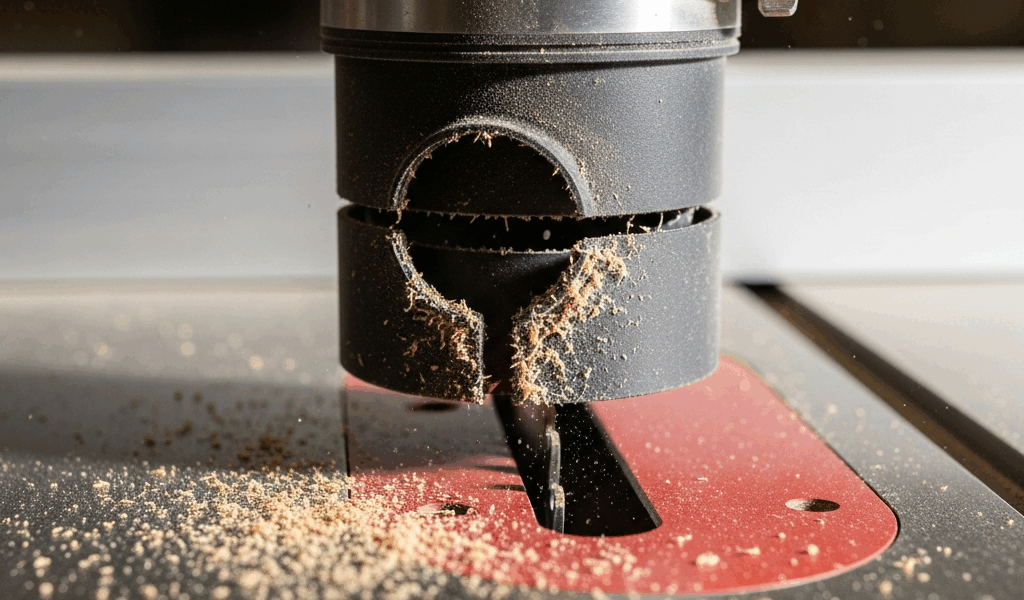
Why Your Dust Collection Sucks (Literally)
I’ve retrofitted dust collection on probably forty older table saws at this point, and I can tell you the same thing happens every time: the saw ships with a 2.5-inch port, the shop owner buys a 4-inch hose to match their collector, and suddenly they’re staring at weak suction that wouldn’t clear a pile of pine shavings. The frustration is real — they blame the collector, they blame the hose, they add a Y-splitter. Nothing works.
That root cause sits right there at the saw. A port diameter that hasn’t evolved since the 1990s.
Older Jet and Craftsman cabinet saws came with 2.5-inch dust ports as standard. Even now, budget models from DeWalt and Makita ship with 3-inch ports. Your collector probably has a 4-inch inlet. That mismatch creates a bottleneck that kills CFM before the dust even reaches the collection bag. Probably should have opened with this section, honestly — it’s the first thing I check when someone says their new collector isn’t performing.
The typical response? Grab whatever reducer bushing is on the shelf at the big box store. Cheap plastic tapers collapse under suction. Flexible transition ducting sags and pinches closed. Y-splitters create dead zones where dust settles instead of flowing. Each “fix” makes the problem worse, not better.
Port Diameter vs Hose Diameter — The Mismatch That Kills CFM
Here’s the physics without the academic padding: air velocity drops dramatically when hose diameter exceeds port diameter. A Festool CT 48 collector moves 168 CFM. Run that through a 2.5-inch port instead of its designed 4-inch inlet, and you’re losing roughly 40% of effective suction at the saw blade.
The math is straightforward. Velocity equals CFM divided by area. A 4-inch hose has 12.57 square inches of cross-section. A 2.5-inch port has 4.91 square inches. You’re forcing high-velocity air through a tiny opening, which creates backpressure. The collector works harder. Dust clogs faster. Your saw’s motor compensates by running hotter.
Look at these common mismatches:
- Jet Cabinet Saw (2.5-inch port) + Makita VC4710 (4-inch inlet) — 35% CFM loss at source
- DeWalt DWE7491RS (3-inch port) + Festool CT 48 (4-inch inlet) — 28% CFM loss
- Older Craftsman Contractor Saw (2.5-inch port) + typical shop collector (4-inch inlet) — 40% loss minimum
That loss compounds across the run. Add 10 feet of hose, and you’re down another 15-20% from friction alone. By the time air reaches the collector inlet, you’ve lost half your theoretical suction.
The solution isn’t complicated. Measure your port diameter first. Measure your hose ID — interior diameter, the actual opening, not the outside. Know your collector’s CFM rating at idle. Most shop collectors are rated for 4-inch hose; they assume you’re not forcing 120 CFM through a pinhole.
When Adapters Work and When They Fail
Not all reducers are created equal. I’ve learned this the hard way by watching cheap ones collapse mid-cut.
Smooth tapered aluminum reducers from Oneida or Jet hold up under sustained suction. They cost $30–$60. The taper creates gradual area reduction, which minimizes turbulence and velocity shock. Steel designs are even more robust if you’re running a portable collector with serious pull.
Cheap plastic PVC reducers? They collapse inward under vacuum. You’ll see the hose section pinch closed as suction builds. This usually happens after 20 minutes of use — long enough that you blame everything except the adapter itself.
Flexible transition ducting (the accordion-style stuff) seems like a fix-all. It isn’t. Over time, it sags where the run dips. Dust accumulates in the sag. That dust column restricts flow and eventually blocks completely. I’ve pulled out nearly 2 pounds of compacted sawdust from 10 feet of flex hose on a contractor saw that hadn’t been cleaned in three months. The saw’s suction dropped from decent to nothing.
Rigid ducting — PVC or galvanized steel — maintains diameter under suction. A 3-inch to 4-inch smooth taper in rigid material costs $35–$80 but actually works. It won’t collapse. It won’t sag. It’ll move air predictably.
The temptation to just adapter everything is understandable. It’s cheaper than redesigning the dust port. But you’re treating the symptom, not the problem. The port itself is the bottleneck.
The Right Way to Upsize or Downsize Your Port
Three practical paths forward. Pick one based on your saw and budget.
Path 1: Accept reduced flow with a quality adapter. If your saw has a 2.5-inch port and your collector has a 4-inch inlet, run a smooth tapered aluminum reducer (Oneida Air Systems part OA-AL-2534 is solid, about $45). Pair it with 3-inch rigid ductwork at minimum. This limits your collector’s effective CFM to roughly 60% of rated capacity, but it works for occasional weekend use and one-saw operations. Cost: $100–$150 total.
Path 2: Replace the hose with matching diameter. If you’re running 4-inch hose through a 3-inch port, downsize to 3-inch hose instead. You’ll need a 3-inch collector inlet adapter — most modern collectors come with interchangeable ports. Makita and DeWalt both sell 3-to-4-inch adapters for their cabinets. Real suction improves because velocity through the port stays consistent. Cost: $60–$120 for new hose and adapters.
Path 3: Upgrade the port itself. This is the permanent fix. Buy a dust port replacement — many aftermarket 4-inch or 3.5-inch ports are available for standard cabinet saws. Jet sells 4-inch ports ($120–$160) that bolt directly to cabinet models. Some saws require cutting and welding, which adds $150–$300 in labor if you’re not doing it yourself. But once it’s done, suction is never weak again. Any collector works at full CFM. Cost: $250–$500 depending on the saw.
Material matters. Steel ports last forever. Aluminum is lighter and sufficient for portable setups. Avoid plastic — it cracks and blocks airflow unpredictably.
Shop Setup That Doesn’t Choke Your Collector
Port size isn’t the whole story. Duct routing matters.
Run your hose with gradual bends, not sharp 90-degree angles. The longer the run, the more friction you lose. Positioning your collector within 8 feet of the saw keeps backpressure manageable. If you’re 20+ feet away, you need oversized hose (at least 4-inch) to compensate.
Secure rigid ducting with support straps every 3 feet. Flex hose sags under its own weight over long runs — a 20-foot stretch of unsupported 4-inch hose might dip 2–3 inches mid-run, creating that dust trap I mentioned earlier.
Clean your inlet filters regularly. A clogged filter kills CFM faster than anything else. Most collectors lose 20% suction per month under heavy use if filters aren’t cleaned weekly.
Here’s the checklist I use before signing off on a retrofit:
- Measure saw dust port diameter (calipers work best)
- Measure hose interior diameter
- Check collector CFM rating and inlet size
- Test actual suction at the saw port with a magnehelic gauge or manometer (you should see 40–60 inches of water column for full dust capture)
- If readings are low, trace the bottleneck: port, adapter, hose, or distance
- Fix the smallest diameter in the chain — that’s your constraint
One more thing: don’t assume your saw’s rated collection capacity matches reality. Jet publishes ideal numbers. Real-world performance depends on your setup. I’ve tested three identical cabinet saws with the same collector and gotten 30% variance based purely on hose routing and port condition.
Measure. Test. Fix the actual problem. Your dust collection won’t suck after that.




Stay in the loop
Get the latest crafted wood creations updates delivered to your inbox.