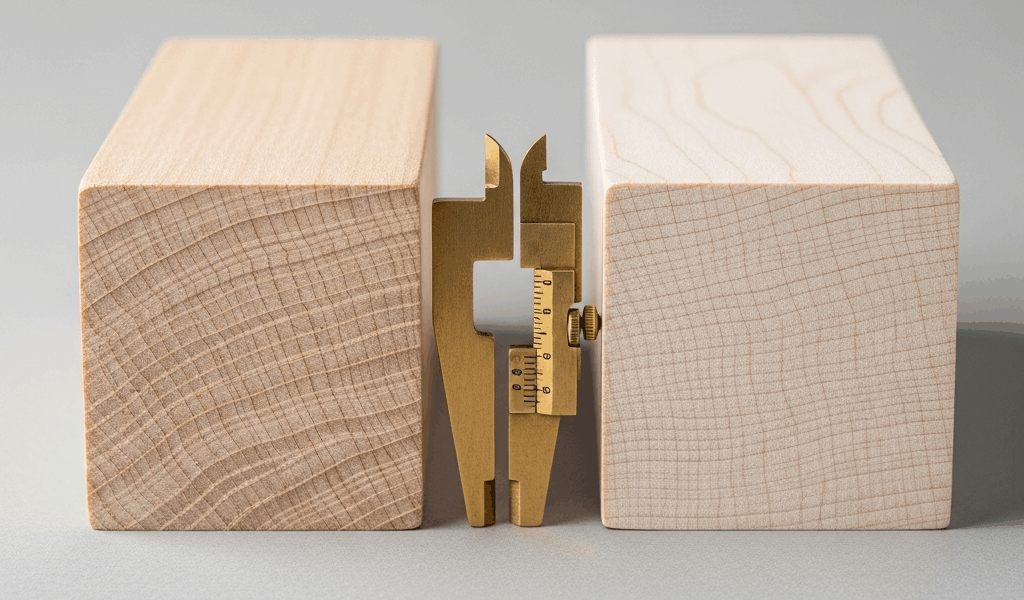
Birch vs Maple for Woodworking — Cost, Hardness, and When to Use Each
If you’ve spent any real time comparing birch vs maple for woodworking projects, you already know the problem: they look almost identical in the lumber yard, especially when you’re staring at rough-sawn boards under fluorescent shop lighting. I built furniture out of whatever hardwood my local mill had cheap for the first three years. Made a lot of assumptions. Most of them wrong. After burning through enough board feet of both species to finally understand where they actually differ — in the hand, under a plane, and after a finish cures — I can tell you the choice matters more than the surface-level similarity suggests.
Birch vs Maple — Quick Comparison Table
Before getting into the shop talk, here’s the side-by-side. These numbers are based on current pricing I’ve seen at Woodcraft and local hardwood dealers in the Mid-Atlantic, plus the standard Janka hardness figures from the Wood Database.
| Property | Hard Maple (Acer saccharum) | Yellow Birch (Betula alleghaniensis) |
|---|---|---|
| Janka Hardness | 1,450 lbf | 1,260 lbf |
| Average Cost (board foot) | $6–$9 | $4–$6.50 |
| Color Range | Creamy white to pale tan | Light yellow to reddish-brown heartwood |
| Grain Pattern | Fine, very uniform | Fine, but more variation — wavy figure common |
| Weight (dried) | ~44 lbs/cu ft | ~43 lbs/cu ft |
| Common Uses | Cutting boards, flooring, butcher block, furniture | Cabinet boxes, plywood, painted furniture, drawer boxes |
| Finish Behavior | Blotches easily, needs conditioner | Also blotches, slightly more forgiving |
| Plywood Availability | Limited, expensive | Widely available, multiple grades |
That 190-point Janka gap is real, but in a furniture context it rarely decides the outcome. What decides the outcome is usually the grain variability, the finishing behavior, and yes — what you’re paying per board foot.
How Each Wood Works in the Shop
Surprised by the differences when I finally ran both species through the same project, I started keeping notes on machine behavior, glue-up times, and finish results. Here’s what actually shows up at the bench.
Hardness — What the Numbers Feel Like
Hard maple at 1,450 lbf is legitimately hard. Dull your chisels fast. Carbide bits on a router table will still give you clean profiles, but high-speed steel in a drill press starts complaining after a few hundred holes. I ruined a set of Irwin Marples bench chisels on a maple mortising job in 2019 because I was lazy about sharpening. Learned that lesson expensively.
Birch at 1,260 lbf is still a hardwood. Don’t confuse it with something soft. But it is noticeably more forgiving — hand-cut dovetails feel different, and the chisel work is cleaner with less effort on the mallet. For anyone doing a lot of hand tool work, that gap is more meaningful than the numbers suggest.
Grain Pattern and Figure
Maple’s consistency is its signature. The grain is so tight and uniform that wide glue-ups disappear — you can laminate three or four boards and the result looks like a single slab. That’s why it’s the go-to species for butcher blocks and workbench tops. Curly maple and bird’s-eye maple exist, obviously, but the plain stuff is almost aggressively regular.
Birch has more personality. The sapwood is pale and maple-like. The heartwood runs into golden and reddish-brown territory, and the transition between the two can be abrupt. On painted projects this is irrelevant. On clear-finished furniture, you have to select your boards more carefully or you’ll end up with a piece that looks patchy. I’ve also found more wavy figure in birch — sometimes beautiful, sometimes a tearout nightmare on the planer.
Tool and Finish Differences
Both species blotch with oil-based stains. Neither one is easy to color evenly without a pre-conditioner or a washcoat of dewaxed shellac (I use Zinsser SealCoat thinned 50/50 with denatured alcohol before any pigmented finish). The difference is that maple’s grain is so uniform that the blotching pattern tends to be more predictable — it usually shows up as slightly darker end grain areas. Birch’s variability means the blotching is less predictable. On a clear film finish — waterborne poly, conversion varnish, hard wax oil — both species look excellent. Maple has a cooler, bluer white tone. Birch reads a little warmer.
On the machine side: both species need sharp tooling. Maple is more punishing when tooling is dull. Router bits that are 75% of their life on soft maple are effectively done on hard maple. Birch is slightly more forgiving but still well past the forgiveness range of something like poplar or soft maple.
Glue-Ups
Both glue well. Tight grain means you need good clamping pressure — don’t assume a light squeeze will do it. I use Titebond III on anything structural and Titebond Original on interior furniture. Open time on hard maple in a warm shop is shorter than you’d expect. Get your joints prepped, dry-fit everything, and don’t mix the glue until you’re ready to move.
The Cost Question — When Birch Is the Smart Choice
Probably should have opened with this section, honestly, because for a lot of projects the cost differential is the whole conversation.
Hard maple at a Woodcraft near me runs $8.49 board foot for 4/4 FAS grade right now. Yellow birch, same store, same grade, is $5.25. That’s roughly a 38% premium for the maple. On a small side table that uses 12 board feet of lumber, that’s about $38 difference. On a set of kitchen cabinets using 60 board feet of solid lumber plus plywood? You’re looking at a $240 swing, and that’s before we get into plywood.
Baltic birch plywood — which is technically European birch, not yellow birch, but the same species family — is dramatically more available and less expensive than maple plywood. A 5×5 sheet of 3/4″ Baltic birch B/BB grade runs around $65–$75 at a plywood supplier. Comparable maple veneer plywood in a domestic hardwood grade is easily $90–$120 for a 4×8 sheet, if you can find it.
The Appearance Argument
For painted projects, birch wins the cost argument every time. There is no visual justification for paying 30% more for maple when you’re covering it with Benjamin Moore Advance in Chantilly Lace. The surface texture is comparable. The density means it won’t dent more easily in any meaningful way. Use birch, pocket the difference.
For clear-finished furniture where grain matching matters, the calculus shifts. Maple’s uniformity makes it easier to produce consistent results, especially for less experienced finishers. The extra cost buys you predictability. Birch requires more careful board selection and slightly more skill at the finishing stage to get a result that looks intentional rather than accidental.
Where Birch Holds Up Fine
- Interior cabinet boxes (face frames in maple, boxes in birch — standard cabinetmaking practice)
- Drawer boxes where they’ll be finished or hidden
- Shop furniture — workbenches, tool cabinets, jigs
- Painted furniture of any kind
- Secondary wood in period furniture construction
- Any project where the wood will be laminated with veneer
Where You Should Pay for Maple
- Cutting boards and butcher blocks (hardness and food safety)
- Flooring and stair treads (wear resistance matters)
- Workbench tops that will take real abuse
- Clear-finished tabletops where grain uniformity is part of the design
- Any piece where the wood species is part of the selling point
Which Wood for Which Project
Let’s get specific. Generic “it depends” answers are useless. Here’s how I actually make the call.
Kitchen Cabinets
Use birch plywood for the box construction. Full stop. Baltic birch is stable, machines cleanly, holds screws well, and is available in void-free cores that matter for cabinet assembly. The face frames and door fronts are where you make the visual decision — if the kitchen is being painted, birch solid or MDF is fine for face frames. If it’s natural or stained, maple face frames with birch box interiors is the standard production approach and it works.
Built by a cabinetmaker friend using this exact approach — Baltic birch boxes, hard maple face frames, waterborne conversion varnish finish — a full kitchen that would have cost $900 more in all-maple materials came out looking identical at the reveal. His clients had no idea and no reason to care.
Cutting Boards and Kitchen Accessories
Maple. Don’t cut corners here. The hardness matters for longevity, the closed grain resists moisture penetration better, and hard maple has the food-safe reputation for a reason. End grain maple cutting boards are a category unto themselves — the self-healing property of end grain only works well with dense wood. Birch end grain boards aren’t bad, but they show knife marks faster.
Dining Tables and Chairs
This is where budget and finish intent make the call. A dining table with a natural oil finish where the wood grain is part of the aesthetic? Maple is the better wood — cleaner, more consistent, easier to repair and re-oil. A painted dining table or a piece with a solid opaque lacquer? Birch performs identically to the eye and saves you real money. Chairs are typically painted or stained dark anyway, and the grain selection stress goes away with either species.
Bedroom Furniture
Dressers, nightstands, bed frames — birch is entirely appropriate. The wear demands are lower than a kitchen or dining room. A birch dresser with a good waterborne poly topcoat will outlast its owner if it’s built right. I’ve made three dressers in birch over the last six years. Two are still in daily use with zero issues. The third I refinished after a moving company dragged it across gravel — that’s not a wood species problem.
Workbench Tops and Shop Furniture
Laminated hard maple for the bench top if you can afford it. The hardness matters when you’re planing against a stop or pounding on the surface. For the base, legs, and stretchers? Birch is completely adequate. My current bench has a 4-inch laminated hard maple top and a birch base. Total lumber cost was about $340 for the top and $95 for the base. Same bench in all-maple would have been closer to $180 more and the base wouldn’t have benefited from a dollar of it.
Plywood for Shop Jigs and Fixtures
Baltic birch, always. The void-free core and consistent thickness makes it the standard for jigs, router sleds, and fixtures. It’s not even a conversation. Hard maple plywood for jig work would be a waste of money and harder to source.
The real lesson after years of working both species is that the birch vs maple decision is almost never about one being better — it’s about matching the wood to the actual demands of the project. Maple’s hardness and consistency are worth the premium in specific applications. Birch’s cost, availability, and workability make it the smarter choice in others. Know which category your project falls into before you order lumber, and you’ll waste less of both.

Stay in the loop
Get the latest crafted wood creations updates delivered to your inbox.