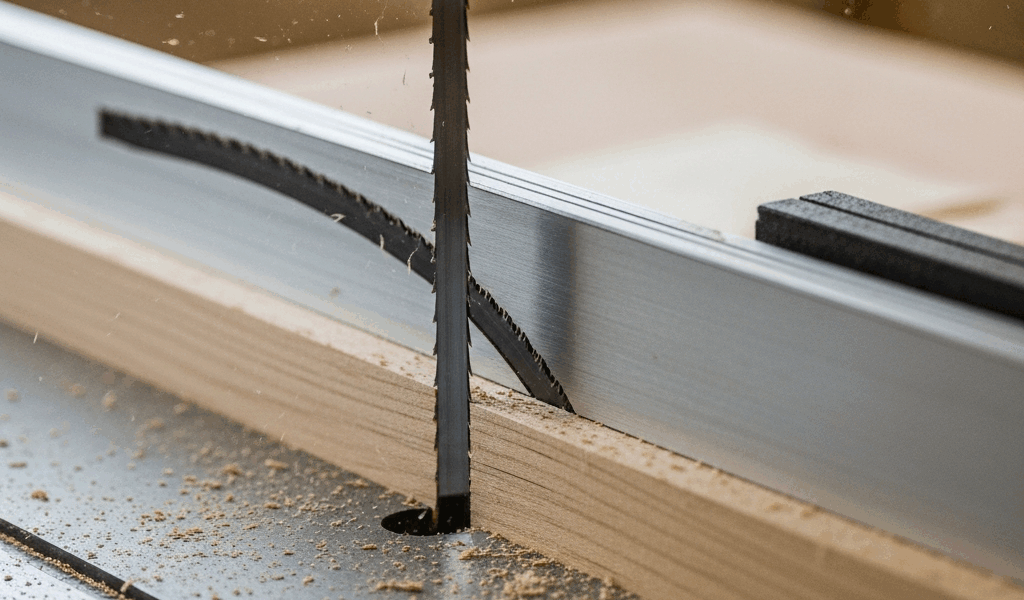
Why Your Bandsaw Is Drifting in the First Place
Bandsaw drift has changed quite a bit thanks to the conflicting advice flying around. You set up what looks like a perfectly straight cut. The blade has other ideas entirely. And what feels like a fence problem — at least nine times out of ten — isn’t.
So, without further ado, let’s dive in. There are five root causes worth knowing before you touch anything:
- Uneven tooth set — One side of the blade’s teeth leans harder than the other, dragging the cut sideways
- Dull blade — A worn blade loses its bite and deflects the moment you apply feed pressure
- Wrong blade tension — Too loose and it wanders under load; too tight and tracking falls apart completely
- Blade too narrow for the material — A 1/8″ blade cutting thick hardwood flexes and wanders in ways a 3/8″ blade simply doesn’t
- Fence not matched to actual drift angle — Your fence runs parallel to the miter slot, but your blade naturally cuts 3 degrees off-square
Most bandsaw drift articles stop at number five and call it a day. That’s wrong. Setting the fence to compensate for a dull blade is a band-aid. It fails the next time you feed stock faster, or switch wood species, or both.
Figure out which category you’re actually in before adjusting anything. That’s the job right now.
How to Test If the Blade Is the Problem
The freehand drift test is your first move. No fence. No guides cranked tight. Just you, the blade, and a pencil line.
Scribe a line down a piece of scrap — something at least 12 inches long, wide enough to guide comfortably by hand. I use a 3/4″ pine board, whatever’s sitting near the saw. Set blade tension to where it should be for your blade width, and make sure tracking puts the blade centered on the upper wheel. Then feed the board in at a moderate, steady pace. Don’t force it. Watch what the blade does.
Consistent drift in one direction — always pulling right, always pulling left, same angle every time — points to an uneven set problem or a fence that needs angling. The drift is predictable. That’s actually good news. Predictable problems have solutions.
A blade that wanders erratically, changing direction as you push, is telling you something worse. Dull teeth, undertension, or both. That kind of drift shifts moment to moment and no fence adjustment in the world will tame it.
Here’s what I see most often in practice. A blade that yanks hard right the instant it bites? Uneven set, favoring the right side. A blade that starts straight but drifts progressively as you increase feed pressure? Dull blade — it’s losing its ability to hold a line when things get demanding. A blade that behaves on hardwood but wanders on plywood? Probably undertensioned. Plywood’s layered construction creates resistance spikes the blade can’t handle without enough rigidity behind it.
Write down what you observed. Seriously. That one note saves hours of random fence tweaking later.
Fixing Drift Caused by Blade Condition or Tension
Quick note before the rest of this. A fresh blade fixes roughly 70 percent of drift complaints before any fence work even enters the picture.
When to replace the blade: If you’re resawing stock regularly, plan on a new blade every 40 to 60 hours of actual cutting time. A 3 TPI blade in 1/4″ or 3/8″ width handles most woodshop bandsaw work without complaint. I’m apparently a brand loyalist at this point — Starrett works for me while generic off-brand blades never last more than a session or two before the drift starts. A Starrett or Lenox blade runs $25 to $35. The time you stop losing to drift is worth three times that easily.
Dull teeth don’t cut cleanly anymore. They rub. They deflect. The blade heats up and the metal fatigues. You can feel it in your hands — you’re pushing harder and the cuts are getting worse simultaneously. That’s your cue. Don’t try to rescue it. Side-step the error I made of squeezing another few hours out of a dead blade and wondering why everything drifts.
Tension by blade width: A 1/4″ blade needs roughly 15,000 to 18,000 PSI of tension. A 3/8″ blade wants 20,000 to 25,000 PSI. Your manual has the range for your specific saw — use it. If you don’t own a tension gauge, the old-school test works fine. Pluck the blade like a guitar string below the lower wheel. It should ping. A clear, bright note. A dull thunk means undertension and guaranteed drift the moment you start feeding stock.
After tensioning, check tracking immediately. The blade needs to run centered on both wheels. A blade tracking too far forward pulls sideways in the direction of wheel rotation. Spin the upper wheel by hand and watch the blade closely. Adjust the tracking knob until it stays centered through a full rotation. Thirty seconds of work. Eliminates one of the biggest drift sources going.
Once blade and tension are sorted, run the freehand test again. Drift gone? You’re finished. Still drifting? Move on to fence angling.
Setting the Fence to the Actual Drift Angle
But what is drift angle, really? In essence, it’s the angle your specific blade naturally wants to follow when cutting freehand. But it’s much more than a nuisance — it’s a measurable, workable property you can build your fence setup around.
Your blade is sharp and properly tensioned now. Tracking is centered. It still pulls 3 degrees off-square when you guide by eye. That’s normal. Most blades carry some inherent drift — a combination of set, flex, and tooth geometry baked into the way that particular blade was manufactured.
Run the freehand test one more time. Mark where the blade naturally wants to travel. Use a sliding bevel, or just scribe a pencil line directly on the bandsaw table alongside the blade path. Either works. What you’re capturing is the blade’s actual behavior, not where you wish it would go.
Set the fence parallel to that drift line — not to the miter slot. If your blade drifts 3 degrees right, angle the fence 3 degrees right. Your cuts come out square to the stock edge because the blade is running at its natural angle and the fence is guiding along that same angle. The two agree with each other instead of fighting.
That’s what makes this method endearing to woodworkers who’ve wasted afternoons on random fence adjustments. You’re measuring reality and setting up around it. Nothing to fight against.
When Drift Comes Back After You Already Fixed It
You had perfect cuts for three hours. Then the blade starts wandering again. Here’s what’s happening.
Blade fatigue is real. The longer a blade runs, the more teeth and spine flex accumulate. Micro-cracks develop. Rigidity drops. Your drift angle can shift slightly mid-session — not dramatically, but enough to ruin a cut. That’s not a fence problem. That’s a blade telling you it’s done.
Feed rate inconsistency brings drift back too. You get tired. You push a little harder without noticing. The blade deflects more. Slow down. Let the blade work at its own pace. Fighting it makes everything worse.
Check your blade guides while you’re at it. Guides set more than 1/4″ away from the workpiece give the blade room to flex — and it will use that room. Guides too close create friction and slow things down, but the working distance exists for a reason. Back guides off for tall resawn stock, then forget to readjust for standard thickness work, and you’ve handed the blade a free pass to wander. Adjust back in before the next cut.
Pre-cut bandsaw checklist:
- Blade tension correct for width and material type
- Blade tracking centered on both wheels
- Guides sitting within 1/4″ of the workpiece
- Freehand test shows consistent drift angle — or none at all
- Fence set parallel to actual blade drift line, not miter slot
Run through this before each session. Five minutes at the start beats forty minutes of troubleshooting mid-cut. Drift becomes predictable instead of the kind of thing that ruins an afternoon.




Stay in the loop
Get the latest crafted wood creations updates delivered to your inbox.