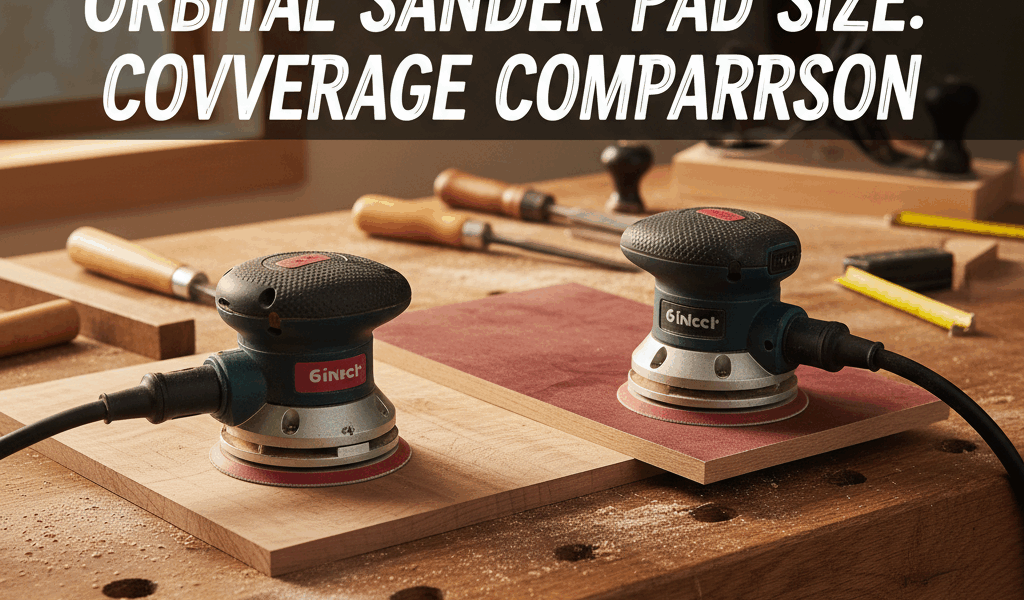
Choose a 5-inch random-orbit sander for maneuverability, broad abrasive availability, and varied furniture work; choose a 6-inch model when large flat surfaces, higher production rate, and a compatible dust-extraction system justify the larger pad. Pad diameter alone does not determine speed or finish quality. Orbit size, motor behavior, abrasive, dust extraction, pressure, and technique matter.
This page compares random-orbit pad sizes—not belt sanders. For tool-type selection, see our belt sander versus random-orbit sander guide.
5-inch vs 6-inch random-orbit sanders
| Factor | 5-inch | 6-inch |
|---|---|---|
| Best fit | Varied furniture parts and general DIY | Large panels, tabletops, doors, and production work |
| Maneuverability | Easier on smaller parts and near edges | More pad overhang on narrow work |
| Potential coverage | Smaller nominal disc area | About 44% greater geometric disc area |
| Actual removal rate | Depends on the complete system | Can be faster, but not from diameter alone |
| Abrasive availability | Common in consumer retail | Common in professional systems; confirm local supply |
| Dust extraction | Hole pattern must match | Greater area still requires compatible holes and airflow |
Why area is not the same as speed
A 6-inch circle has about 44% more geometric area than a 5-inch circle, but that does not prove it completes every job 44% faster. Actual removal depends on abrasive mineral and condition, grit, orbit diameter, pad rotation, motor load, down pressure, surface flatness, extraction, and how much of the pad remains supported.
Do not publish or rely on fixed pass counts for a tabletop. Overlap, stroke length, surface defects, material, and required finish make those calculations artificial.
Choose 5-inch when
- parts vary from drawer fronts to moderate panels;
- the sander must work near edges and inside wider cabinet openings;
- light weight and one-handed repositioning matter;
- local abrasive availability is important; or
- you are buying one general-purpose random-orbit sander.
Choose 6-inch when
- most work consists of large flat panels, slabs, doors, or tabletops;
- the tool, pad, abrasive, and extractor form a supported system;
- production rate matters more than access to narrow areas; and
- the added size and weight remain comfortable through the real work cycle.
Compare orbit size separately
Two sanders with the same pad diameter can cut very differently because their orbit diameters differ. Larger orbits generally favor faster removal; smaller orbits generally favor refinement. Some professional systems offer multiple orbit sizes or modes.
Use the manufacturer’s stated application rather than assuming pad diameter reveals aggressiveness. The correct comparison includes pad size, orbit, speed control, braking behavior, vibration, extraction, and abrasive system.
Check the abrasive and hole pattern
Before choosing a sander, verify:
- disc diameter and attachment method;
- dust-hole or multi-hole pattern;
- availability of required grits and abrasive types;
- interface-pad compatibility;
- maximum permitted speed; and
- the tool maker’s backing-pad requirements.
A disc with mismatched extraction holes can block airflow. An unsupported pad or abrasive can affect dust capture, balance, and safety.
Edge control matters more with a larger pad
Keep the pad flat and supported. A larger disc extends farther beyond narrow stock, making it easier to tip the tool and round an edge. Sand edges with controlled technique and finish critical arrises by hand when necessary.
Dust and exposure
NIOSH has found that orbital hand sanding can generate significant wood dust and that dust-removal features may not capture all emissions. Use source extraction, maintain airflow and filters, match the abrasive-hole pattern, and follow applicable ventilation and personal-protection requirements.
If collection weakens, check our random-orbit dust collection troubleshooting guide.
Test before committing
- Bring or reproduce a typical small part and large panel.
- Check grip diameter, trigger or switch, vibration, hose drag, and balance.
- Confirm the pad stays flat without excessive effort.
- Test the available abrasive and extractor system.
- Price the full abrasive range and replacement pad, not one sample disc.
- Inspect finish under raking light after an appropriate grit progression.
Frequently asked questions
Is a 6-inch sander always faster?
No. It has more nominal pad area, but actual rate depends on orbit, power under load, abrasive, pressure, extraction, and surface support.
Does a 6-inch sander leave a better finish?
Not inherently. Scratch quality depends on orbit, grit sequence, abrasive condition, cleanliness, pad condition, pressure, and technique.
Can you put a 5-inch pad on a 6-inch sander?
Only if the manufacturer explicitly approves that pad for the exact model. Pad mass, balance, mounting, speed, and dust holes are safety and performance factors.
Bottom line
Choose 5-inch for a versatile first random-orbit sander and mixed-size furniture work. Choose 6-inch for recurring large surfaces when the complete professional sanding and extraction system supports it. Compare orbit and abrasives as carefully as diameter.




Stay in the loop
Get the latest crafted wood creations updates delivered to your inbox.