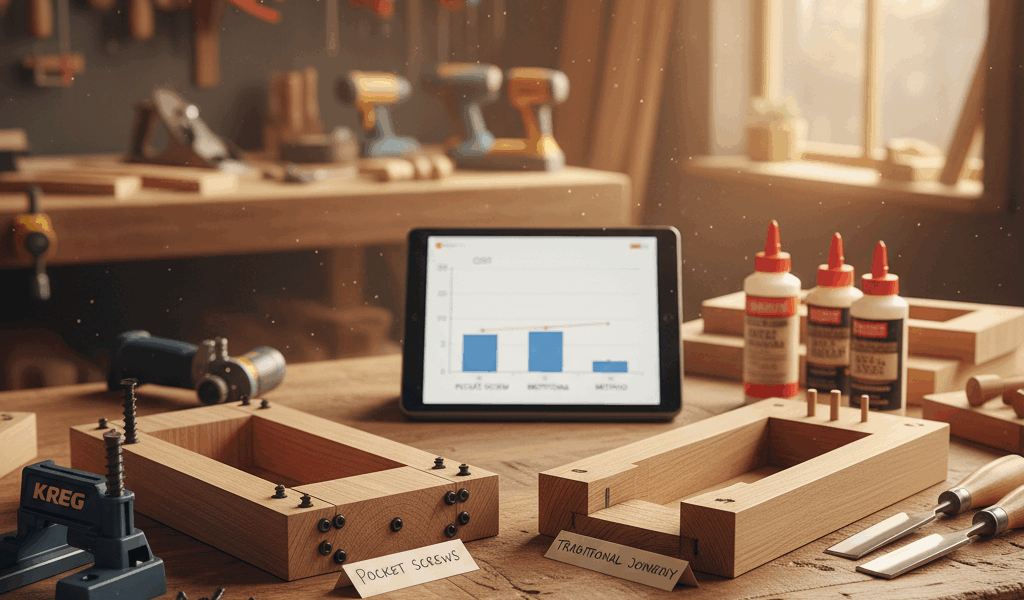
Pocket hole joinery has gotten a reputation for being either a complete shortcut or surprisingly capable, depending on who you ask. As a woodworker who uses pocket holes regularly for face frames, cabinet boxes, and quick furniture assembly, I’ve developed a clear sense of where this technique belongs. Today, I’ll share what I know about pocket hole joinery — including where it actually works and where it doesn’t.
The Honest Assessment
Pocket hole joinery costs less in time and equipment than traditional joinery but produces joints with different strength characteristics. Not categorically better or worse — different. The Kreg Jig is on my bench because it does real work in real situations. It’s not there because it replaces mortise-and-tenon on load-bearing furniture. These are two different tools for two different applications.
The confusion comes from treating pocket holes as a universal joinery solution. They’re not. In the right applications they save hours. In the wrong ones they eventually fail.
Where Pocket Holes Do Real Work
Face frames are the clearest case. A glued and pocket-screwed face frame joint is fast, strong enough for the application, and pulls itself tight without clamps. The pocket screw does the clamping while the glue cures. I’ve built dozens of face frames this way and never had one fail.
Cabinet boxes benefit from the same logic. The box is constrained by the case and face frame once assembled — the joints don’t need to resist racking loads on their own. Box construction with pocket holes is genuinely fast, and fast matters when you’re building a kitchen’s worth of cabinets over a weekend.
Edge-glued panel assembly. Benchtop substructure. Face frame to cabinet attachment. Drawer box construction. All of these work well with pocket holes. The common factor is that something else provides the structural constraint — the pocket hole just needs to hold the joint together while everything else does the load work.
Where They Don’t Belong
Chair joints are the most common mistake I see. Chairs live under dynamic loads from every direction — sitting, rocking, people leaning back. Pocket holes under those conditions loosen. Maybe slowly, maybe fast, but eventually. Chair joints need traditional joinery: mortise-and-tenon at minimum, properly fitted and glued.
Table apron-to-leg joints are borderline. A table that will see heavy use under racking loads needs more. A light side table with apron-to-leg blocks providing additional support can get away with pocket holes. Know which one you’re building.
Technique That Actually Matters
Drill into face grain or edge grain — never end grain. End grain pocket screws hold far less effectively than face grain connections and will pull out under moderate load. This is the mistake that makes people think pocket holes are inherently weak when the real problem was drilling orientation.
Glue plus pocket screws, not pocket screws alone. The screw pulls the joint tight; the glue provides the long-term strength. On a joint that doesn’t get glued, the screw is doing all the work and screws aren’t meant to do all the work. Took me a few failed joints early on before this became automatic.
Use the right screw length and collar depth for your stock thickness. Kreg provides charts for this and they matter. The wrong screw in thin stock blows through the face. The wrong screw in thick stock won’t pull the joint tight.
Before You Go
Pocket holes are a legitimate method when used appropriately, and the time savings on face frames and cabinet work are real and significant. Know the limits, glue every joint you also screw, and drill into face or edge grain. Master those three things and the Kreg Jig earns its spot on the bench.

Stay in the loop
Get the latest crafted wood creations updates delivered to your inbox.