“`html
Miter saws win for framing — here’s the time math
I’ve spent enough time on framing crews to know exactly why every carpenter reaches for a miter saw instead of a chop saw. The answer isn’t about preference. It’s about money and speed.
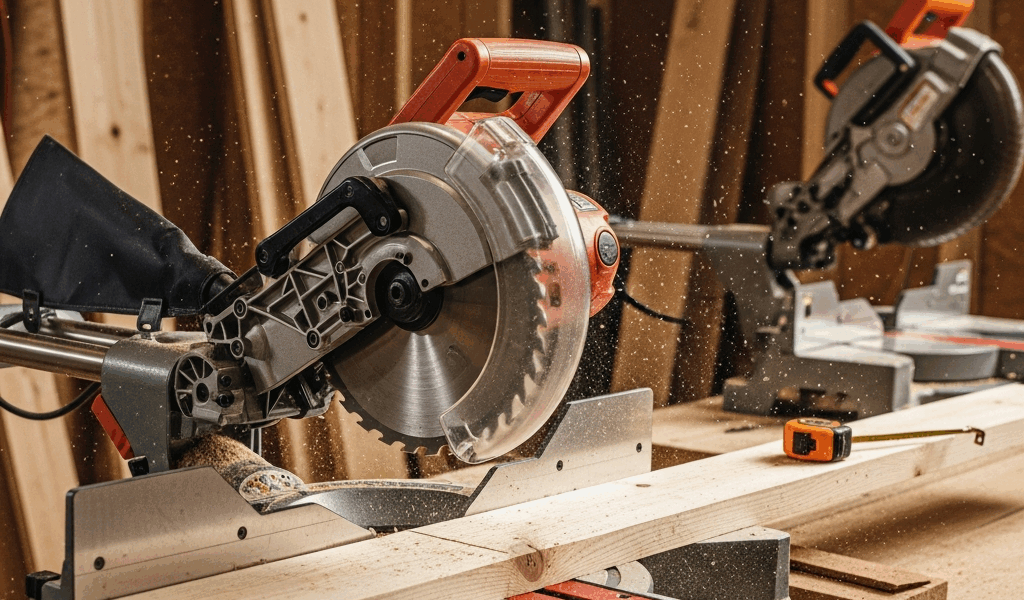
A 12-inch compound miter saw — the DeWalt DWS779 or Makita LS1019L that show up on job sites constantly — cuts 60+ cross-cuts per hour on framing stock. A chop saw? Thirty cuts, maybe 35 if you’re rushing. That’s doubled throughput on a single tool. On a typical framing job where you’re making 200+ cuts for plates, studs, headers, and blocking, that’s the difference between two hours and four hours at the saw. It adds up fast.
Setup time kills chop saw economics worse. You bolt a chop saw to a bench or cart. You plug in the angle grinder underneath — yes, that’s what it is, a repurposed angle grinder with a cutting wheel. You adjust the depth stop. You clamp every piece. A miter saw? Pull it out of the truck, set it on its stand, square the fence to the blade once, and you’re cutting in 90 seconds. On a remodel or renovation where you’re moving between rooms, that actually matters.
But here’s the detail that actually convinced me: blade wear and waste. A carbide-tipped miter blade rated for crosscuts costs $40–80 and handles 10,000+ clean cuts before you notice tearout. A chop saw blade is a grinding wheel. It doesn’t cut so much as it detonates the wood — you’re essentially exploding through the material. On 200 cuts through framing lumber, a chop saw produces 20–30% more dust and splintering at the exit face. That means either hand-finishing every cut or accepting loose fibers that compress during fastening and create weak joints. I’ve ripped out trim work on old jobs where chop saws were the original tool. The joints were never tight.
Angle cuts are non-negotiable in framing
This is where miter saws separate from chop saws completely.
A chop saw cuts straight down. Perpendicular. 90 degrees. That’s it. A miter saw pivots left and right (miter function) and tilts forward and back (bevel function), reaching compound angles from 0 to 52 degrees in most cases. For framing work, you live in those angles — honestly, it’s where the real work happens.
Pitched roofs need jack rafters cut at 22.5 degrees. Octagonal bay windows require 45-degree miter cuts on both the miter and bevel axes simultaneously. Door jambs at odd wall angles. Crown molding when you’re wrapping a frame. Every single one of these is standard framing work — not special or rare.
I watched a crew three years ago try to frame an octagonal sunroom addition with a chop saw as their primary tool. They had a table saw on site for ripping, but all cross-angle cuts went through the chop saw or got hand-finished with a circular saw. On the 32 octagonal frame pieces alone, they lost six hours to hand-cutting and checking angles. A miter saw would have handled those in 45 minutes. They didn’t just lose time — they lost accuracy. Two jambs had to be re-cut when they installed the door frame and discovered the angles were off by a degree. That’s what makes angle-cutting tools essential to this trade.
Chop saws force you into three bad options: hand-cut the angle with a circular saw (dangerous and imprecise), set up your table saw for every angled cross-cut (slow, requires ripping into the middle of the material, unsafe for short pieces), or buy a miter saw anyway because you finally realized you need one.
The DeWalt DWS779 I mentioned earlier has a 52-degree bevel range and holds angles within 0.1 inches over 10 feet. That’s accuracy. A chop saw has no angle capacity. It’s not even in the same category.
Chop saws only win in demolition
I should be honest about what chop saws are actually good for, because they excel at something. Probably should have opened with this section, honestly.
Demolition and rough cutting of nail-embedded lumber. That’s the real use case. If you’re tearing out old framing, cutting through materials with nails, bolts, or contamination, a chop saw doesn’t care. The grinding wheel just powers through. A miter saw blade would catch, burn, or shatter against embedded metal — you’re looking at a destroyed blade and downtime. A $60 chop saw blade gets destroyed and replaced. A $70 miter blade gets destroyed and costs you money and reputation.
Rough demolition. Site cleanup. Cutting pallets. Chopping pressure-treated posts that have been sitting in storage for five years. These are the edge cases where the chop saw’s mindless brutality is actually an asset, not a liability.
But here’s the reality: demolition is 10% of a framing crew’s work. Most of that gets done with a reciprocating saw or jigsaw anyway because you need precision to avoid cutting through wiring or plumbing. The chop saw wins a narrow lane. It doesn’t win at framing.
Cost per cut — miter saw pays for itself
Used 12-inch compound miter saws cost $300–600 depending on model and condition. A chop saw, new, costs $150–250. That’s a $150–450 difference. On the surface, the chop saw looks like it wins on capital cost.
Now calculate the job economics. A typical residential framing job — one-story addition, room reframe, second-floor renovation — involves 1500–2500 cross-cuts. Let’s say 2000 cuts as a middle estimate.
Miter saw: 2000 cuts at 60 cuts per hour equals 33 hours of cutting. One premium carbide blade at $70 (lasts through this job and the next). Minimal waste, minimal hand-finishing. Total material loss from tearout and blade drift: roughly 2–3% of stock.
Chop saw: 2000 cuts at 30 cuts per hour equals 67 hours of cutting. Three grinding wheels at $60 each ($180 total). Significant waste from the brutality of the cut — 15–25% of pieces need hand-finishing or rework. On a 2000-board-foot job, that’s 300–500 board feet of wasted material or rework time. At $0.80 per board foot (2024 lumber pricing for construction-grade 2x material), that’s $240–400 in material loss alone.
Cost per cut on the miter saw: roughly $0.05 (including blade amortization and one annual maintenance). Cost per cut on the chop saw: roughly $0.15 (blade wear, waste, rework). Over 2000 cuts, that’s a $200 difference in your favor for the miter saw — before you even account for the labor time differential. That’s 34 additional hours at $35/hour, which equals $1190 in labor you’re burning on a slower tool.
A miter saw pays for itself on the second job if you’re doing residential framing. By the third job, it’s pure profit over a chop saw setup.
Setup time and workspace — miter wins again
A chop saw bolts permanently to a bench or mobile base. Once it’s mounted, you don’t move it. On a job site with limited access — interior remodels, finished basements, attics — you either drag the entire bench through the space or hand-cut everything. Neither option works.
A miter saw sits on a folding stand or mobile base that moves through a doorway. You roll it from the kitchen to the bedroom to the closet. You set it up in five minutes. You break it down in three. On multi-room jobs, this flexibility matters enormously — I’ve saved entire days just by not having to haul equipment between spaces.
Dust collection matters too. A miter saw accepts a 2.5-inch to 4-inch dust shroud that connects to a shop vac. You eliminate 80% of airborne dust. A chop saw spits sparks and metal fines everywhere — it’s messy and destructive. Without a catch basin underneath (and good luck fitting that in a finished basement), you’re dealing with debris on finished surfaces, in HVAC returns, embedded in drywall. On interior work, carpenters choose miter saws because the cleanup time is literally half.
Fence precision also matters on longer pieces. A miter saw has a movable fence that stays square to the blade. A chop saw has minimal fence adjustment. Try making 20 cuts on an 8-foot board and keeping them all the same length — the chop saw drifts. The miter saw stays locked.
For framing work, the choice has been settled for 15 years. Miter saws are faster, more accurate, more versatile, and cheaper per cut. Chop saws exist in a narrow demolition niche. If you’re buying one tool for framing, it’s a miter saw. The numbers prove it.
“`




Stay in the loop
Get the latest crafted wood creations updates delivered to your inbox.