The Verdict Up Front
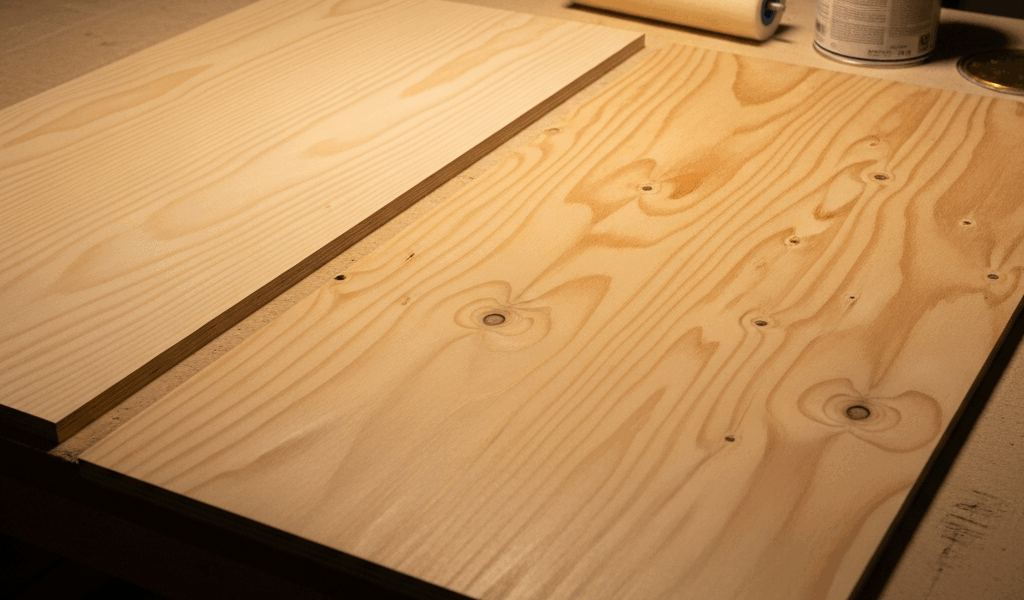
Maple plywood vs birch plywood has grown more complex with the conflicting advice flying around. So here’s the short answer before anything else: Baltic birch wins on flatness. Domestic maple plywood — specifically paint-grade MDF-core — wins on paintability for finished surfaces. Those are two different products solving two different problems on the same project. Mixing them up is how you end up with a cabinet run that looks perfect in the shop and cupped by the time it hits the job site.
One thing I need to establish right now, because everything else here depends on it: “maple plywood” is not a single product. You’ve got domestic maple plywood with a softwood core, domestic maple plywood with an MDF core (sold as paint-grade), and furniture-grade hardwood-core versions that are increasingly hard to source on any consistent basis. These behave completely differently under primer. When I say maple plywood wins on paintability, I mean MDF-core paint-grade maple ply — not the sticker-priced sheet at your local big box store with a maple veneer face and a mystery core that flexes when you pick it up by one end.
Baltic birch, by contrast, is a far more consistent product category. You get exactly what the name describes: a void-free multi-ply birch sheet, imported from the Baltic region, running roughly 13 plies in a 3/4-inch sheet. Keep that number in mind.
Flatness — Why Baltic Birch Has a Structural Advantage
The flatness advantage comes down to ply count and core quality. A standard 3/4-inch sheet of domestic maple plywood typically runs 7 to 9 plies — and a significant chunk of those are softwood, poplar or pine, regardless of what species is on the face. I learned this the hard way on a shop cabinet build a few years back. Bought what was clearly labeled “maple plywood,” priced it into my quote, then cut into the sheet and found a softwood sandwich where solid core should have been. Not what I expected. Definitely not what my customer was paying for.
Baltic birch at 13 plies per 3/4-inch sheet means more cross-grain layers actively resisting movement. Each alternating layer fights the tension of the ones beside it. The result — after 48 hours of acclimation in a shop running somewhere between 40 and 60% humidity — is a sheet that moves noticeably less than domestic maple ply. Sheet-to-sheet consistency is better too. Pull ten sheets of Baltic birch from the same lift and they behave like siblings. Pull ten sheets of domestic maple ply from a home center and you’re dealing with cousins who grew up in different states.
Now, MDF-core maple paint-grade ply deserves its own note here. MDF core is phenomenally flat — flatter than Baltic birch, honestly. But it’s heavy. The edges are fragile and will blow out under anything less than a sharp bit and a slow feed rate. And it does not hold screws at the edge the way a void-free birch core does. Right product for door panels and face applications. Wrong product for box construction where you’re driving pocket screws into a shelf edge.
Paintability — Grain Telegraphing and Surface Prep
Quick note before the rest of this, because it’s where most comparison articles completely fall apart.
Birch veneer has a tighter, more diffuse grain structure than hard maple. Under primer, that matters. Hard maple’s grain pattern — particularly on rotary-cut domestic maple face veneer — can telegraph through two coats of a standard primer. Birch grain telegraphs less aggressively. On that one metric, birch looks like the clear winner for paint.
Here’s the problem. Baltic birch face veneers are thin. We’re talking 0.5mm to 1mm. Sand aggressively before priming — which is exactly what you’d want to do for a smooth painted finish — and you risk cutting through to the next ply layer. That shows up as a dark blotch under paint. Once you see it, you can’t unsee it. Domestic maple ply, especially in hardwood-core grades, runs a thicker face veneer that tolerates more sanding passes before you’re in danger territory.
The practical fix on Baltic birch: use a high-build primer, not a shellac-based primer. Zinsser BIN is excellent for stain blocking and adhesion — great product — but it doesn’t fill grain the way a high-build primer does. Something in the oil-based high-build category works better here. I’ve had consistent results with Sherwin-Williams PrepRite High Build, around $45 to $55 a gallon depending on location. It levels the surface without the aggressive scuff sanding that puts thin birch veneers at risk. On Baltic birch, one coat of high-build followed by a light 220-grit sand gets you where you need to be. MDF-core maple paint-grade is more forgiving on coat count — the MDF surface itself is nearly grain-free, so you’re starting from a better place.
Both species need edge treatment before painting. The raw edge of any plywood — Baltic birch, domestic maple, MDF-core — should be banded, filled with edge filler, or both before primer touches it. Iron-on veneer tape works fine for Baltic birch cabinet box edges. For MDF-core panels, a skim coat of lightweight spackle or a dedicated MDF edge sealer before primer is non-negotiable. Skip it and the edge will absorb primer like a dry sponge and never, ever get smooth. Side-step the error I made.
Where Each Material Actually Belongs in a Painted Project
Baltic birch belongs in your painted cabinet boxes and drawer boxes. It holds screws in the core, it stays flat through seasonal movement, and the faces are secondary since boxes will be mostly hidden or edge-banded anyway. Using Baltic birch for painted face frames is a waste of money with zero finish-quality payoff. Face frames are solid wood. Stop overthinking it.
MDF-core maple paint-grade plywood belongs on your door panels and any prominently painted face surface where smoothness is the primary goal and panel edges are either hidden in a frame or wrapped in solid edging.
Frustrated by ballooning material costs on a 25-sheet cabinet run, I once spec’d domestic hardwood-core maple ply across the board as a compromise — reasonable middle path, decent results. The source dried up after two orders. That’s the reality of the domestic hardwood-core option right now. It exists. It works. And it’s inconsistently available depending on your market.
One more thing on cost: Baltic birch pricing shifted hard after 2022 — tariffs, supply chain disruption, the usual story. Expect to pay meaningfully more per sheet compared to a domestic furniture-grade birch alternative. On a 20-sheet box run, that difference adds up fast. Price it out before you commit to the spec.
What to Actually Buy and Why
For a painted cabinet project, here’s the actual buy list: MDF-core paint-grade maple plywood for doors and face panels, Baltic birch for box construction if budget allows, furniture-grade birch ply as the cost compromise on boxes if it doesn’t.
At the lumber yard, ask specifically for void-free core certification on any birch you’re buying. Reputable hardwood dealers can provide it. Inspect the face veneer on maple ply intended for painted work — press your thumbnail lightly near the edge and get a feel for thickness. Paper-thin face veneers on a sheet that’s going to get sanded are a problem you can catch at the point of purchase, before it becomes a problem on the job.
I’m apparently picky about this and buying from a local hardwood dealer works for me while big-box birch never does. Those sheets typically have a softwood core with voids and a birch face veneer on top. They’ll move, they’ll telegraph core voids under paint, and they won’t hold edge fasteners reliably. The per-sheet savings aren’t worth it.
Acclimate your sheets for a minimum of 48 hours in the shop before cutting. Stack them flat with stickers between sheets so air can circulate on both faces. Cut a sheet that went from a cold delivery truck to your table saw in thirty minutes and you’re building your measurements on material that hasn’t finished moving yet. The finished cabinet will remember that — even after you’ve forgotten you made the call.



Stay in the loop
Get the latest crafted wood creations updates delivered to your inbox.