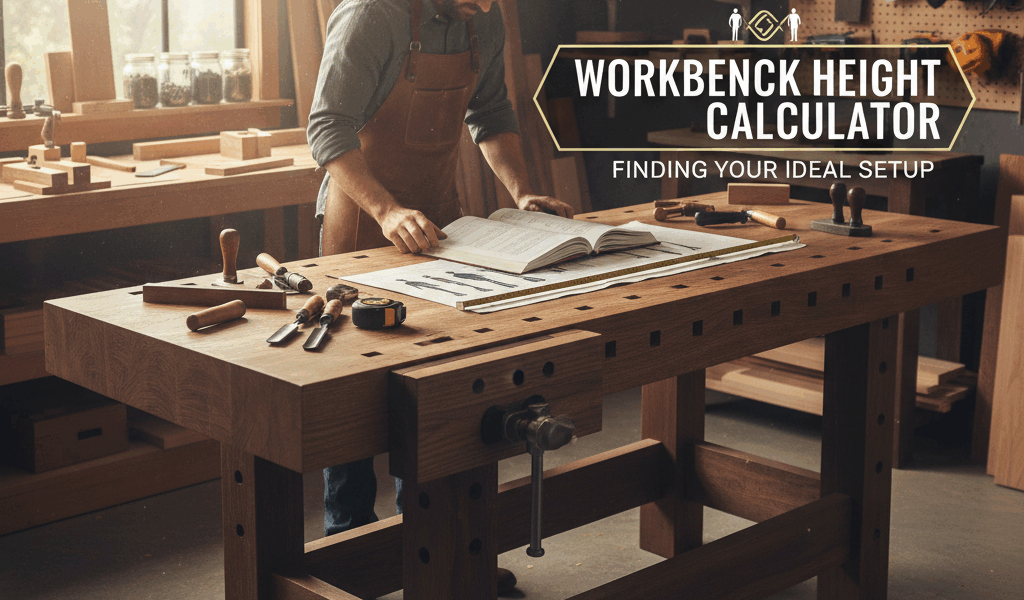
Workbench height has gotten complicated with all the “wrist height” formulas and “lower is better for hand tool work” debates flying around. As someone who built a bench at the wrong height once and spent a season before correcting it, I’ve learned what actually determines the right height for your specific work. Today, I’ll share everything I know.
Setting your workbench at the wrong height is one of those problems that doesn’t announce itself dramatically — it just makes everything slightly harder, slightly more tiring, and slightly less accurate. You accommodate the discomfort without realizing you’re compensating, and over time it adds up.
Standard Height Formula
The traditional rule: bench surface at the height of your relaxed wrist when standing with arms at sides. For most people, 34-38 inches from the floor. This baseline works for hand tool work — planing, sawing, chiseling — where you need to apply downward pressure and use body weight to power the cut. Your weight assists the tool rather than fighting the bench height.
Height by Work Type
Hand tool work: Wrist height or 2 inches lower (32-36 inches). Lower benches provide better leverage for planing — you can push through the full stroke without rising onto your toes. I built my first bench at wrist height exactly and found it slightly too high for extended planing sessions. Dropped the benchtop two inches and the difference in fatigue was immediate.
Assembly and power tools: 36-38 inches. You’re not applying downward pressure — you’re positioning and driving fasteners. Higher is more comfortable for standing work without stooping.
Fine detail work: 38-40 inches. Carving, inlay, and precision fitting benefit from bringing the work closer to eye level. Less forward lean means better visibility and more controlled fine movements.
Body Proportions Matter
Two people at the same height may need different bench heights because arm length relative to overall height varies. Torso-to-arm proportions matter more than height alone. The formula gives you a starting point; actual testing tells you the right answer for your body.
Test before committing: stack scrap lumber or use adjustable sawhorses to approximate your target height. Spend a full work session at that height doing the tasks you actually do most. What feels fine for twenty minutes may not work for three hours.
Adjustable vs Fixed Height
Fixed benches offer maximum stability. Heavy timber construction at a single height provides a solid work surface that doesn’t shift under forceful operations. That’s what makes traditional workbenches endearing to those of us who do hand tool work — no adjustment mechanisms to introduce flex or rattle.
Adjustable benches accommodate multiple users or multiple work types. The tradeoff is complexity and the potential for stability issues. Many woodworkers compromise: one primary bench at optimal hand tool height, a secondary surface at a different height for assembly or power tool operations.
Calculating Your Height
- Stand naturally with arms relaxed
- Measure from floor to wrist crease — this is your baseline
- Subtract 2 inches for heavy hand tool work (planing, chopping)
- Use baseline for general work
- Add 2 inches for primarily assembly and power tool work
- Add 4 inches for detail carving and precision tasks
Common Mistakes
Building too tall forces tiptoeing during heavy planing strokes. You lose leverage and fatigue quickly, and the cut quality suffers from inadequate downward force. Building too short means constant forward lean at the waist — back fatigue accumulates over a session and accuracy suffers as you tire. Copying another woodworker’s bench height without accounting for the difference in your body proportions is the third common mistake.
Testing Before Building
Before committing to a permanent height, test it for a full day with your actual work. Hand plane several boards at length. Assemble a project. Do the tasks you actually do most often. The test reveals whether your calculated height works in practice or needs adjustment. Getting bench height right the first time prevents the significant effort of modification later — cutting legs shorter or building a platform both add work that’s completely avoidable.
One Final Thought
The bench height decision is worth the calculation and testing time. An hour of setup and a day of testing prevents years of subtle accommodation. Measure from your body, test the result, then build with confidence in the number you arrived at.
Recommended Woodworking Tools
HURRICANE 4-Piece Wood Chisel Set – $13.99
CR-V steel beveled edge blades for precision carving.
GREBSTK 4-Piece Wood Chisel Set – $13.98
Sharp bevel edge bench chisels for woodworking.
As an Amazon Associate, we earn from qualifying purchases.