Reading wood grain correctly determines board stability and helps predict how the wood will move with seasonal humidity changes. Growth rings visible on board ends reveal critical information about future warping, cupping, and twisting.
Growth Ring Orientation
Growth rings appear as curved lines on the end grain of a board. The curve orientation tells you how the board was cut from the log. Rings that form a “U” or “cup” shape indicate the board came from near the outside of the log. Rings forming a relatively straight vertical line indicate the board came from near the center.
The ring pattern predicts how the board will cup as moisture content changes. Boards cup away from the heart of the tree—the side closer to the center of the original log becomes convex while the outer side becomes concave.
Flat Sawn vs Quarter Sawn
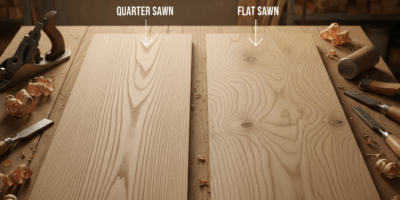
Flat sawn boards (also called plain sawn) show growth rings running roughly parallel to the wide face—typically at angles less than 45 degrees to the face. These boards show dramatic grain pattern with cathedral or arched figures. They represent the majority of boards from any log since this sawing method produces the most lumber per log.
Quarter sawn boards show growth rings running nearly perpendicular to the face—at 45-90 degree angles. The grain appears as straight, parallel lines rather than curves. Quarter sawing produces less usable lumber per log and costs more, but provides superior stability.
Stability Differences
Flat sawn boards move more with seasonal humidity changes. The width dimension expands and contracts significantly—approximately 8-10% total movement in oak between dry winter conditions and humid summer conditions. The thickness dimension moves much less—only 3-4% in the same conditions.
Quarter sawn boards move less across the width—approximately 4-5% in oak. The perpendicular ring orientation minimizes the expansion and contraction that causes problems in wide panels. This reduced movement makes quarter sawn lumber preferred for applications where dimensional stability matters.
Cupping Prediction
A flat sawn board with rings curving left to right will cup with the bark side (outside of tree) becoming convex. If you can see which face was closer to the bark, expect that face to crown upward as the board dries or loses moisture.
When gluing up panels from multiple boards, alternate the growth ring direction. One board with rings curving up, next board with rings curving down, and so on. This balancing act reduces overall panel cupping since adjacent boards try to cup in opposite directions.
Reading Ring Tightness
Closely-spaced growth rings indicate slow growth—typically from colder climates or dense forests where trees compete for sunlight. These tight-grained boards are generally more stable and stronger than boards with widely-spaced rings.
Widely-spaced rings show rapid growth with lots of low-density early wood between the harder late wood lines. These boards move more with humidity changes and show less strength in bending applications. They’re not bad lumber, just different characteristics to account for.
Rift Sawn Middle Ground
Rift sawn boards fall between flat sawn and quarter sawn, with rings at 30-60 degree angles to the face. They show less dramatic grain figure than flat sawn and more than quarter sawn. Stability falls between the two extremes—better than flat sawn but not quite matching quarter sawn performance.
Rift sawing produces even less yield per log than quarter sawing, making it the most expensive cut. Few lumber suppliers stock rift sawn material regularly. When you find boards at this orientation, they likely came from the log as a byproduct of flat sawing rather than intentional rift cutting.
Pith Location Impact
Boards containing the pith (center) of the tree show the worst stability. The pith creates internal stresses that cause checking, splitting, and severe warping. Professional sawyers cut around the pith, converting it into low-grade material or leaving it in the slab waste.
If you see a small dark core running along the board’s length, that’s pith. Plan on that board moving unpredictably regardless of the growth ring orientation. Use it for short pieces where movement won’t matter, or reject it entirely for critical applications.
Practical Application
For table tops and wide panels, quarter sawn lumber provides the best results. The reduced movement prevents seasonal gaps between boards and minimizes cupping. The higher cost is worth it when you need stability.
For face frames, cabinet sides, and applications where boards are constrained by the overall structure, flat sawn lumber works adequately. The structure limits movement, so the reduced stability doesn’t cause problems.
For edge-to-edge glue-ups using flat sawn boards, alternate growth ring direction. Look at the end grain and orient one board with the arch pointing up, the next pointing down, and continue alternating. This simple step significantly reduces panel cupping.
Moisture Content Timing
Growth ring orientation matters most during initial drying and seasonal changes. Properly dried lumber (6-8% moisture content for indoor projects) has already completed most of its movement. What remains is seasonal fluctuation—typically 2-4% moisture content variation through the year.
Even this small seasonal change causes noticeable movement in flat sawn boards. Quarter sawn boards handle the variation better, maintaining tighter joints and flatter surfaces through seasonal cycles.