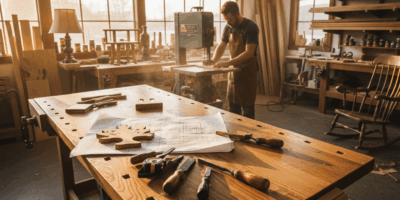
The woodworking shop has gotten a reputation as just a place to make sawdust, but for those of us who spend real time in one, it’s something much more specific than that. As a woodworker who has shaped several shops over the years — from a cramped single-car garage to a more considered dedicated space — I’ve come to understand what makes a shop feel like a real place to work. Today, I’ll share what I’ve learned about building a shop that becomes a genuine sanctuary.
The History Written Into a Well-Used Shop
My current bench has a gouge in the top left corner from the day I dropped a mortising chisel handle-down from about four feet. The chisel was fine. The bench isn’t going anywhere. That mark is there now and it probably always will be. Sounds small, but those accumulations of marks, wear patterns, and evidence of solved problems are what make a shop feel like yours rather than a staged showroom. The layout lines that never quite came off, the smear of finish on the cabinet door you use for test swipes, the saw till that started as a temporary fix and became permanent — these aren’t imperfections. They’re a record.
A shop that has no history in it is a shop nobody’s worked in. The ones worth being in show their use.
Knowing the Space Well Enough to Stop Thinking About It
There’s a specific kind of flow state available in a familiar shop that you simply cannot access in an unfamiliar one. When I’m in someone else’s shop — even a better-equipped one — I spend cognitive overhead figuring out where things are, what clearances look like, how the dust collector connects. That overhead is expensive. In your own shop, that overhead disappears and the thinking can go entirely to the problem in front of you.
I’m apparently a “reset the shop before I start a new project” person. Everything back in its place, bench clear, floor swept. That five minutes pays back in not losing twenty minutes hunting for the marking gauge mid-layout. It also just makes walking into the shop the next morning better.
A Shop Arranged Around How You Actually Work
No two shops look the same because no two woodworkers work the same way. I hand-plane a lot, so my bench is positioned for good natural light and I have a tool cabinet within arm’s reach of my vise. A friend of mine does almost entirely power-tool work — his bench is against a wall, his table saw is the center of gravity in the room, and his workflow radiates out from that. Neither layout is correct. Both are right for the person using the space.
The mistake most people make when setting up a first shop is copying a shop layout from a magazine or YouTube video without asking whether that layout matches how they actually move through a project. Start with how you work. Build the layout from that, not the other way around.
Before You Go
A good shop earns its feel over time. You can’t buy it in one trip to the tool store. The shops that are genuinely good places to work got that way because the person using them kept paying attention — moving things that were in the wrong place, adding storage where they needed it, building jigs for recurring operations. It’s an ongoing process, not a one-time setup. Get in there and start working. The shop will tell you what it needs.