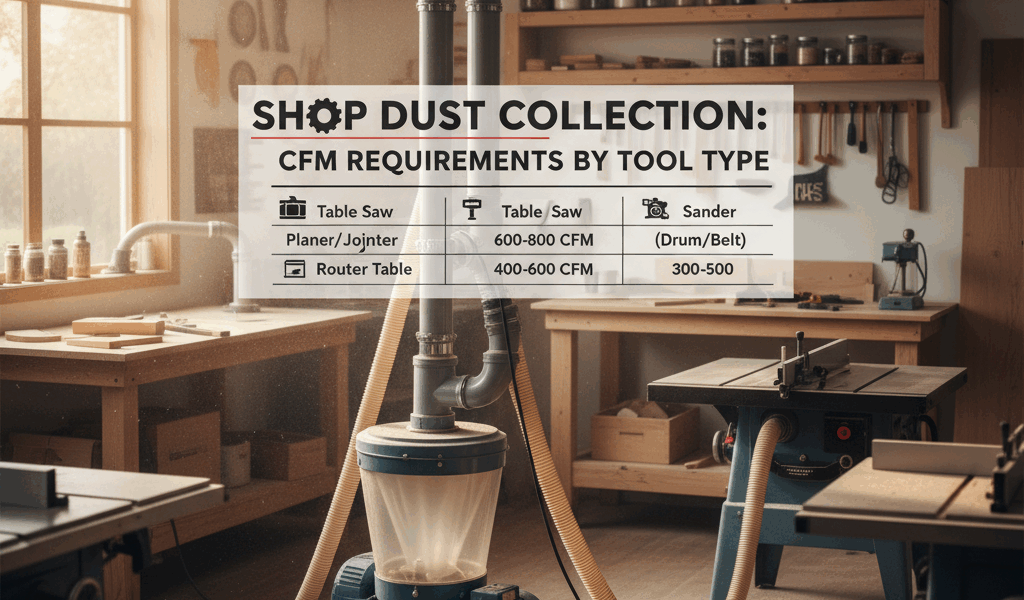
Effective dust collection depends on matching your collector’s airflow capacity to each tool’s requirements. Too little airflow leaves dust in the air and on surfaces. Too much wastes energy and may cause collection problems at the source. Here’s what different tools actually need.
CFM Basics
CFM (cubic feet per minute) measures the volume of air a dust collector moves. Each woodworking tool requires a minimum CFM at the collection point to capture dust before it becomes airborne. These numbers assume 4-inch or larger duct work with minimal bends.
Table Saw Requirements
A cabinet table saw with blade guard collection needs 350-400 CFM. Contractor saws with open stands often require 400-450 CFM due to less efficient dust ports. The dust port at the blade guard captures most of the sawdust if the airflow is sufficient.
Under-table collection on cabinet saws adds another 350 CFM requirement. Most shops prioritize the blade guard port since it catches dust closest to the source. Running both ports simultaneously requires a collector with 700+ CFM capacity or a blast gate system to direct flow.
Planer Dust Output
Portable thickness planers generate massive chip volumes in concentrated bursts. A 12-inch planer needs 400-450 CFM minimum, while a 15-inch model requires 500-550 CFM. These tools produce chips rather than fine dust, which actually makes collection easier since chips have more mass and velocity.
The short bursts of high-volume output can overwhelm undersized collectors, causing clogs at the tool port or the collector inlet. Size up rather than down for planer collection.
Router Table Collection
Router tables need 300-350 CFM when the collection port is properly positioned below the bit. Fine dust from routing escapes easily, so adequate airflow matters more than with chip-producing tools.
Multiple small ports work better than one large port. A split collection setup with ports on both sides of the fence captures dust more effectively than a single-point system, but requires higher total CFM.
Miter Saw Collection
Miter saws are difficult to collect from effectively. The dust port on most saws needs 350-400 CFM but still only captures about 60-70% of the dust. The blade throws debris in multiple directions, overwhelming the single collection point.
Some woodworkers build collection hoods around the saw to improve capture, which increases the CFM requirement to 450-500 but captures more total dust.
Band Saw Requirements
A 14-inch band saw needs 350-400 CFM split between the upper and lower collection ports. The lower port handles most of the dust volume and should receive priority airflow.
Resawing operations generate more dust than normal cutting and may benefit from increased airflow, but the dust production is still lower than table saws or planers.
Calculating Total Shop Needs
Add up the CFM requirements for tools you run simultaneously. Most small shops operate one tool at a time, so the single highest CFM requirement determines collector size. A 1.5 HP collector providing 650 CFM handles most single-tool operations.
For two-tool operation or larger shops, calculate the combined CFM of your most common tool pairs. Add 20% for duct losses and filter resistance. This gives you the minimum collector capacity needed.
Duct Size Impact
These CFM numbers assume 4-inch minimum duct diameter with smooth walls. Reducing to 3-inch ducts cuts effective airflow by approximately 50%. Corrugated flex hose reduces airflow by 30-40% compared to smooth pipe. Account for these losses when sizing your system.
Recommended Woodworking Tools
HURRICANE 4-Piece Wood Chisel Set – $13.99
CR-V steel beveled edge blades for precision carving.
GREBSTK 4-Piece Wood Chisel Set – $13.98
Sharp bevel edge bench chisels for woodworking.
As an Amazon Associate, we earn from qualifying purchases.