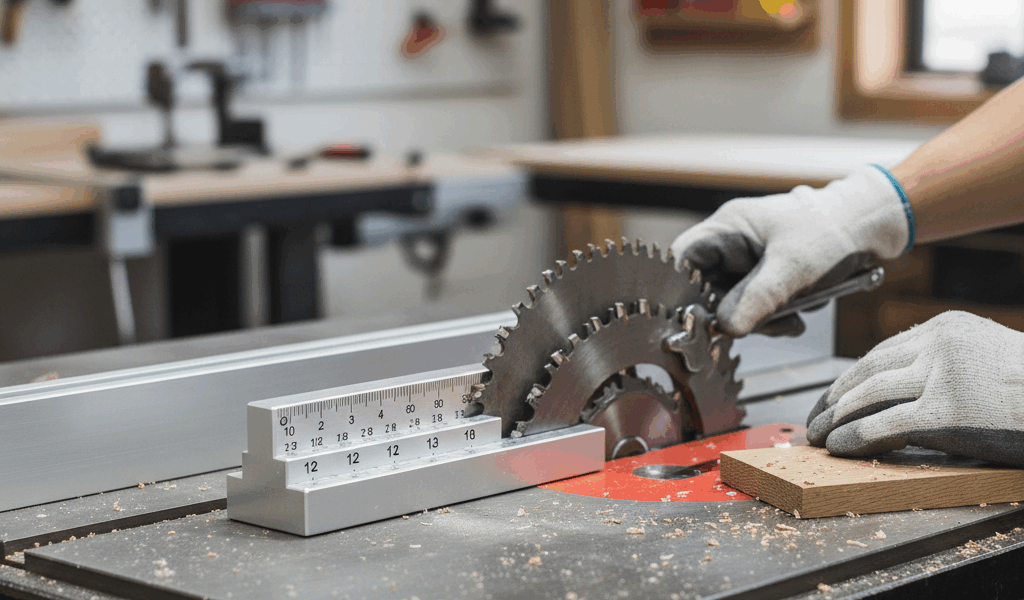
Dado blades have gotten complicated with all the stacked-versus-wobble debates and “check compatibility first” warnings flying around. As someone who has used dado sets extensively for cabinet work and joinery, I’ve learned what actually matters when choosing and using this tool. Today, I’ll share everything I know.
The Dado Blade: What It Does and How to Use It

What a Dado Blade Actually Is
A dado blade set is designed to cut wide grooves in a single pass. Unlike a standard table saw blade that cuts a single kerf, a dado set removes material across a wider path. The stacked dado set — the professional standard — uses two outer blades with removable chipper blades sandwiched between them. Adding or removing chippers, and adding shims for fine adjustment, changes the cut width. The result is a groove of precisely the width you set, cut cleanly in one pass.
Types of Dado Blades
- Stacked Dado Blade: Two outer blades plus chippers. Width is set by selecting which chippers to include and adding shims for fine-tuning. More setup time but significantly better accuracy and cut quality than the alternative.
- Wobble Dado Blade: A single blade on an adjustable hub that oscillates to cut wider grooves. Faster to set up, but the cut quality is noticeably inferior — the bottom of the groove isn’t as flat and clean as a stacked set produces. For rough work where the groove bottom won’t be seen, it’s acceptable. For cabinetry joinery, it isn’t.
Applications That Make a Dado Set Worth Having
- Dado Joint: A groove cut across the grain that accepts a shelf or partition. The mechanical interlock produced by a properly fitted dado joint is stronger than any adhesive-only connection.
- Rabbet Joint: A notch along the edge or end of a board for right-angle connections — the standard back-panel joint for cabinet carcases.
- Tongue and Groove: Used in paneling and flooring for snug-fitting joints that allow seasonal wood movement without opening gaps.
That’s what makes dado blades endearing to us woodworkers who do case work — once you’ve cut the joints by hand or with repeated single-blade passes, doing them in one accurate pass feels like cheating in the best way.
Choosing the Right Set
For fine woodworking and cabinetry, buy a quality stacked dado set. The cut quality difference between a good stacked set and a wobble blade is immediately apparent, and the joints you’re cutting with it are structural. Look at kerf width range, maximum cut depth, and tooth configuration for the material you primarily work with. A set that handles both hardwoods and softwoods cleanly is worth more than a specialized set at a lower price.
Installation and Safety
Verify your table saw’s arbor length accommodates the full stacked set at your intended width — this is the critical compatibility check. Not all saw arbors are long enough for the maximum-width dado configuration. The arbor threads must extend fully through the arbor nut; a nut that’s only partially threaded is unsafe. Use a zero-clearance insert for dado cuts to minimize splintering at the cut edges and reduce the risk of narrow workpieces dropping into the throat opening. Never use the riving knife with a dado set — it’s designed for a single-kerf blade and won’t work with the wider cut.
Stand to the side of the blade path, use featherboards to keep stock against the fence, and use a push stick for narrow workpieces. Kickback from a dado set is less common than from a standard blade but still possible — don’t position yourself directly behind the blade during cuts.
Maintenance
Resin builds up on carbide teeth with use, especially when cutting soft species. Clean the blades with blade cleaner or oven cleaner periodically — pitch buildup on carbide teeth causes burning and degraded cut quality. Check teeth for chips or missing carbide before each use; a damaged tooth produces inconsistent cuts and can catch unexpectedly. Professional sharpening when the edge is genuinely dull is worth the cost for a quality set.
One Final Thought
A dado set is one of those tools that, once you have it, you can’t imagine doing without. The joints it produces quickly and accurately underpin most cabinet and case construction. Get the stacked set rather than the wobble blade, verify arbor compatibility before purchasing, and use it with appropriate safety measures. That’s the complete story.
Recommended Woodworking Tools
HURRICANE 4-Piece Wood Chisel Set – $13.99
CR-V steel beveled edge blades for precision carving.
GREBSTK 4-Piece Wood Chisel Set – $13.98
Sharp bevel edge bench chisels for woodworking.
As an Amazon Associate, we earn from qualifying purchases.