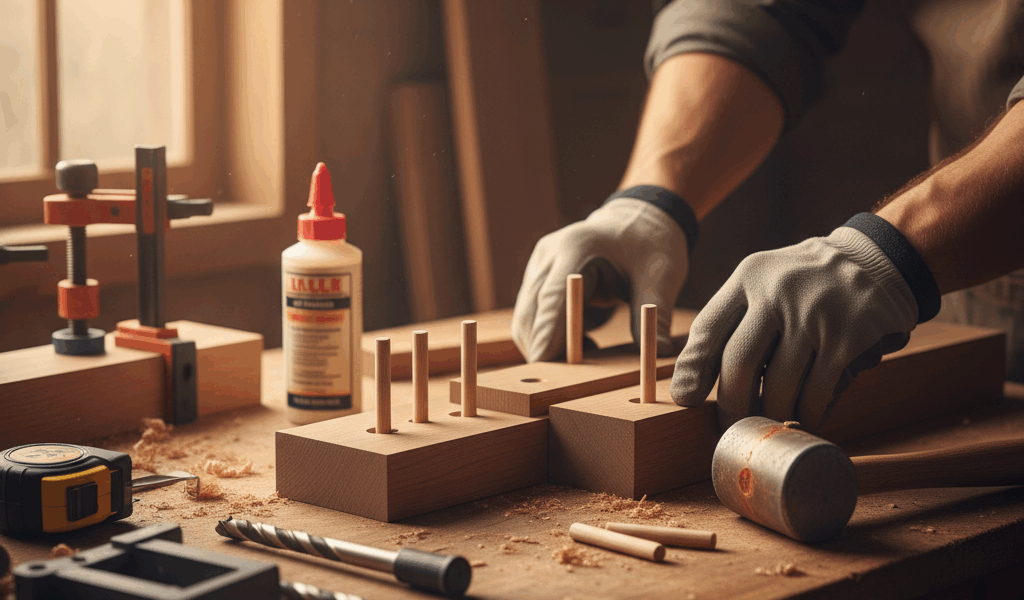
Dowel joinery has gotten complicated with all the jig comparisons and “use a biscuit cutter instead” debates flying around. As someone who has used dowels extensively for furniture and cabinetry and made most of the beginner mistakes, I’ve learned what actually makes dowel joinery work and when it’s the right choice. Today, I’ll share everything I know.
Dowel Joinery: What Works and Why
The Basics
A dowel is a cylindrical rod inserted into corresponding holes in two pieces of wood. The dowel distributes pressure evenly across its cross-section, reinforces the joint against racking forces, and keeps the surfaces aligned during glue-up. Unlike a screw or nail, a dowel works in compression and shear rather than tension — it’s a different mechanical model, which is why dowels in glued furniture joints produce reliable long-term results.
The hidden nature of dowels is a real practical advantage. No exposed fasteners, no screw holes to fill, no hardware visible from any angle. That clean appearance is why dowels remain standard in furniture manufacturing despite the availability of faster alternatives.
Choosing the Right Dowel
Match the dowel species to the wood you’re joining when possible — this produces uniform expansion and contraction behavior with humidity changes, which matters for long-term joint stability. The rule of thumb for diameter: at least one-third the thickness of the pieces being joined. For 3/4-inch stock, that means 1/4-inch minimum dowels; most furniture joints use 3/8 inch for better grip. Length should be calculated so the dowel penetrates about 1 to 1.5 inches into each piece without bottoming out in the hole — leave 1/16 inch clearance at the bottom for glue expansion.
Preparing for Dowel Joinery
Precise hole placement is the whole game with dowels. Even a 1/16-inch alignment error between the holes in two mating pieces can cause the joint to pull apart or pull one surface high. A doweling jig — a guide that holds the drill bit at the right position and angle relative to the workpiece — is worth owning if you do any significant amount of this work. Jigs produce consistent results across multiple holes without requiring you to re-mark each one. The Veritas or Dowelmax jigs are the quality options; the inexpensive metal sleeve jigs work adequately for occasional use.
Drilling the Holes
A drill press guarantees perpendicular holes — the most reliable method. For handheld drilling, a guide block prevents the bit from wandering at entry. Drill holes slightly deeper than half the dowel length in each piece, accounting for the clearance at the bottom. Mark the entry point with a punch or awl before drilling to prevent the bit from skating across the surface — this is especially important on hard, smooth materials where a drill bit will skate several millimeters before it starts cutting.
Inserting the Dowels
Apply a thin film of glue to the dowel itself, not flooded into the hole. Excess glue creates hydraulic pressure when you insert the dowel that can crack the surrounding wood if the fit is tight. Insert the dowel into the first piece, align the second piece, and bring them together. Gentle tapping with a mallet seats the joint; clamp while the glue cures. Dry-fit everything first without glue to verify alignment before the clock starts running on your open time.
Applications
Dowels work well in furniture frames, chair rail and leg connections, cabinet face frames, and small box assembly. They’re the standard joint for aligning table legs with aprons when combined with mortise and tenon structure. That’s what makes dowels endearing to us woodworkers who need hidden fasteners — they’re reliable, accessible without specialized machinery, and produce professional results when done carefully.
Comparing to Other Joinery
Mortise and tenon joints are stronger for the same application but require more skill and time. Biscuits offer faster alignment but less mechanical strength and require a biscuit joiner. Pocket holes are the fastest option but leave exposed hardware on one face and don’t provide the same alignment precision. Dowels sit in the middle — stronger than biscuits and pocket holes, more accessible than mortise and tenon, appropriate for a wide range of furniture assembly applications.
Common Problems
Misaligned holes are the main failure mode — they prevent the joint from closing properly or pull one surface high relative to the other. Measure carefully, use a jig, dry-fit before gluing. Using too-large dowels for the stock thickness is another mistake; a 1/2-inch dowel in 3/4-inch stock leaves inadequate wood surrounding the hole and can split when the joint is assembled. Match the dowel diameter to the stock thickness following the one-third rule.
One Final Thought
Dowel joinery rewards careful setup and punishes careless drilling. Get the alignment right, use a jig, dry-fit every joint before gluing, and use appropriate dowel sizing for your stock. Those four practices cover most of what goes wrong with this technique, and following them produces clean, strong, invisible joints that outlast the furniture they’re in.
Recommended Woodworking Tools
HURRICANE 4-Piece Wood Chisel Set – $13.99
CR-V steel beveled edge blades for precision carving.
GREBSTK 4-Piece Wood Chisel Set – $13.98
Sharp bevel edge bench chisels for woodworking.
As an Amazon Associate, we earn from qualifying purchases.