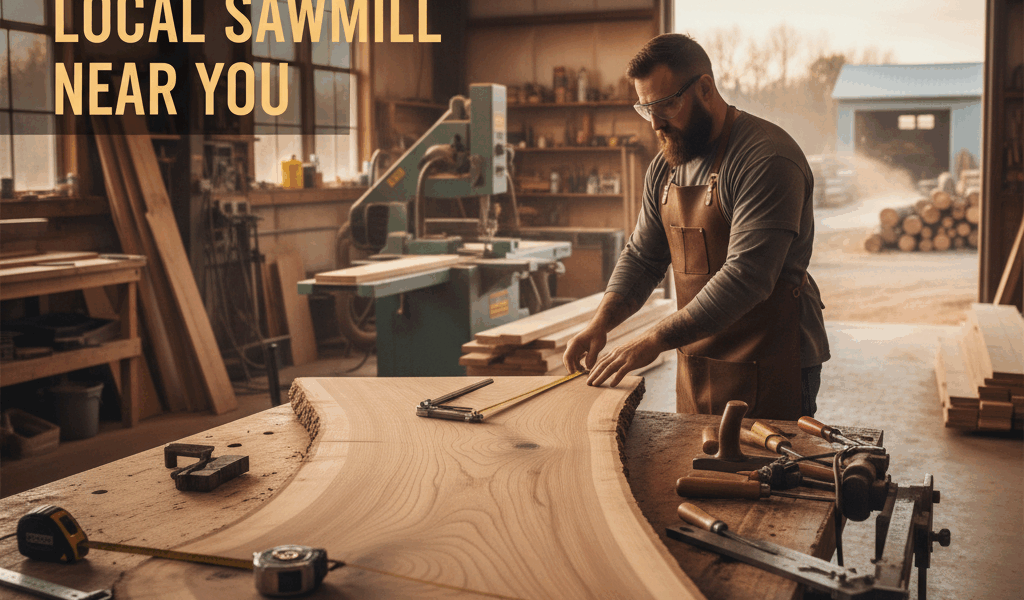
Finding a local sawmill has gotten complicated with all the “just search online” advice and uncertainty about what to expect when you actually show up. As someone who has sourced lumber from local mills for projects ranging from shop furniture to finish work, I’ve learned what sawmills offer, how to use them effectively, and why they’re worth the extra effort. Today, I’ll share everything I know.
Finding a Sawmill Near You

What a Sawmill Actually Does
Sawmills cut logs into dimensional lumber. The primary service is milling — taking raw logs and producing boards, planks, or beams at specified dimensions. Beyond basic milling, most operations also offer custom cuts (non-standard dimensions or profiles), kiln drying to bring moisture content down to usable levels, and sometimes planing or finishing services. Stationary mills are larger fixed operations; portable sawmills can be brought to a logging site, which matters if you have timber on your property you want milled in place rather than hauled to a facility.
Why a Local Sawmill Is Worth Finding
The most practical reason is access to species and cuts that retail lumber yards simply don’t carry. A local sawmill might offer species native to your region that aren’t commercially distributed, live-edge slabs, wide-format boards, or non-standard dimensions that would be special-order elsewhere. The material directly from a mill is also less processed — you’re getting full-dimension stock rather than the surfaced and dried lumber that’s been through multiple steps at a commercial facility.
Local mills often provide better transparency about the wood’s origin and handling. Knowing the wood came from a specific forest twenty miles away, milled to your specified dimensions, is different from buying anonymous lumber from a regional distribution center. That level of information matters if sustainable sourcing is a priority for you — and it’s the kind of thing that’s easy to verify with a local operation and essentially impossible to verify at retail scale.
Wood Types Commonly Available
- Pine: Most universally available, excellent for construction and furniture
- Oak: Common at mills in hardwood-producing regions, excellent structural and furniture wood
- Cedar: Often available where cedar is native, valuable for decay resistance
- Maple: Harder to find at smaller mills but worth asking about for flooring and cabinetry applications
Regional species vary — what a mill in the Pacific Northwest carries is completely different from what a mill in Appalachia offers. Call ahead about specific species rather than assuming availability.
Finding One
Search for “sawmill near me” or “local lumber mill” along with your state or county. Local forestry services often maintain lists of operating mills in their area. Asking other woodworkers or contractors who source specialty lumber locally is often the fastest path — word of mouth points you toward mills that are actually useful rather than just geographically close. Local timber frame builders and log home companies always know the regional mills.
Preparing for a Visit
Arrive with specific requirements: dimensions in board feet, species preferences, whether you need kiln-dried or green lumber, and what the intended use is. Mill staff can make better suggestions when they understand what you’re building. Basic familiarity with lumber terminology (board feet, quarter-sawn versus flat-sawn, green versus kiln-dried) makes communication faster. Bring a list — open-ended questions waste time for both of you.
Safety and Practical Considerations
Active sawmill operations have heavy machinery, log handling equipment, and significant noise. Follow any posted guidelines and instructions from staff without exception. Eye protection and hearing protection are appropriate for any extended mill visit. If you’re buying large quantities of lumber, clarify stacking, loading, and transport logistics before you arrive — mill staff often have specific requirements about how wood is loaded.
Pricing and Value
Mill pricing varies by species, dimensions, drying, and additional processing. Kiln-dried hardwoods cost more than green softwoods. Bulk purchases often have better per-board-foot pricing — ask about quantity thresholds if you’re buying for a significant project. Compare to retail prices for equivalent species and dimensions, but account for the quality and access advantages: a clear, wide walnut board from a local mill at premium price may represent better value than paying similar money for commercial-grade material at retail.
Building a Relationship
Regular customers at local mills often get better service, earlier notification when exceptional material comes through, and staff who understand their preferences over time. If you’re doing significant woodworking, establishing a relationship with one or two local mills is worth the effort. It’s the kind of resource that improves the quality of your work in ways that retail sourcing can’t replicate.