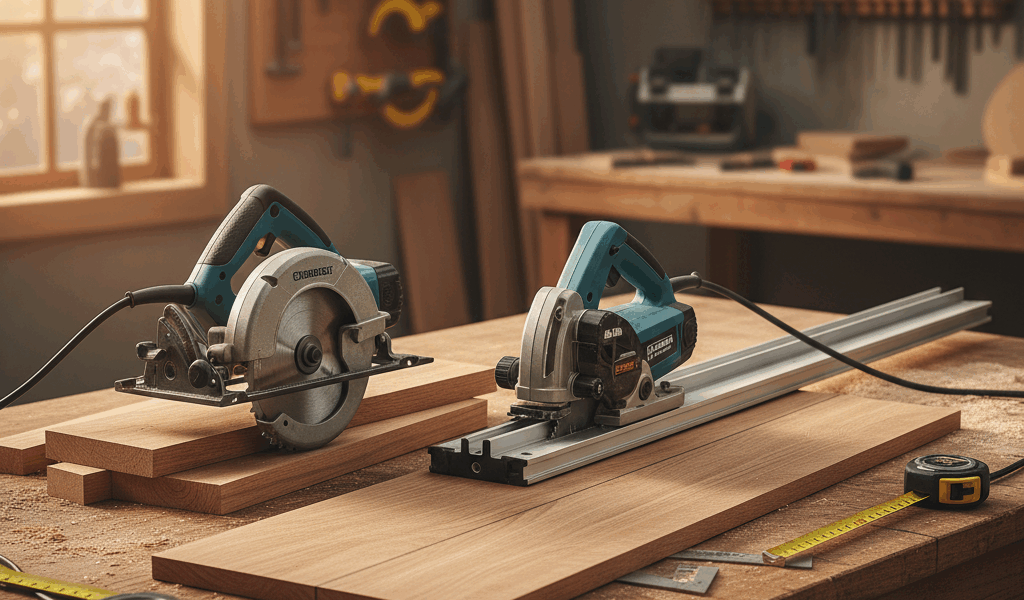
Straight-cut tools have gotten complicated with all the track saw hype and circular saw loyalists both making their cases. As someone who has owned and used both extensively in the shop and on job sites, I’ve learned where each tool genuinely earns its place. Today, I’ll share everything I know about the circular saw vs. track saw debate.
Circular saws and track saws both make straight cuts in sheet goods and lumber, but they achieve accuracy very differently. Understanding what each tool can and can’t do helps you choose the right one for your actual cutting needs — or decide you need both.
Accuracy Capabilities
A standard circular saw with a clamped straightedge produces cuts accurate to approximately 1/16 inch over an 8-foot cut with careful setup. The blade can wander slightly from the straightedge, and the saw base doesn’t always track perfectly parallel. Getting better accuracy takes practice and real attention to setup details.
A track saw delivers accuracy within 1/32 inch over that same 8-foot distance with minimal practice. The track guides the saw precisely, and the blade aligns with the track edge within thousandths of an inch. The system is designed for accuracy from cut one.
Setup Time

Setting up a circular saw with a straightedge means measuring from the cut line to account for the blade-to-edge offset, clamping the straightedge securely, and verifying alignment before cutting. That process takes 3-5 minutes per cut including measurements and clamp placement.
Track saw setup means laying the track directly on the cut line — no offset measurement needed since the blade cuts exactly at the track edge. One or two clamps and you’re ready. Setup takes 1-2 minutes per cut. That time savings multiplies quickly across a full sheet-goods processing session.
Repeatability
Circular saw cuts require re-measuring and setting up the straightedge for each cut. The offset distance changes if you swap blade diameter or use a different saw. Getting identical cuts demands careful measurement every single time.
Track saws maintain consistent accuracy across multiple cuts without recalculating. Mark the line, place the track, cut. No offset math needed. Cutting multiple sheets to identical dimensions is faster and more reliable than any circular saw setup.
Plunge Cutting
Standard circular saws can’t plunge cut effectively. You either drill starter holes or carefully tip the saw into the work — a technique that’s both dangerous and often damages the workpiece. Interior cutouts require a different tool or creative workarounds.
Track saws are plunge saws by design. Lower the blade into the work at any point along the cut. This enables interior cuts and stopped cuts without any starter holes. That capability genuinely expands the tool’s usefulness well beyond simple through-cuts.
Edge Quality
Circular saws produce edges that need light sanding or planing for cabinet-quality work. The blade exit side shows tear-out unless you score the cut line or use zero-clearance techniques. The edge is fine for construction work but needs cleanup for fine woodworking.
Track saws deliver edges that often need no additional work. The track’s built-in splinter guard minimizes tear-out on both entry and exit sides. Cuts in quality plywood look nearly as clean as table saw cuts. That’s what makes track saws endearing to cabinet and furniture makers — you stop losing material to cleanup cuts.
Portability Comparison
A circular saw, straightedge, and clamps fit in a standard toolbox or truck storage. The lightweight system moves between job sites easily. The saw alone weighs 8-10 pounds, and an aluminum straightedge adds 3-5 pounds for an 8-foot length.
Track saw systems include the saw (9-12 pounds) plus tracks. A 55-inch track weighs 6-8 pounds; a 102-inch track weighs 10-14 pounds. Most users need both lengths. The complete system requires dedicated storage and careful transport to protect the track. Some manufacturers offer cases; otherwise you’re building your own storage solution.
Cost Analysis
A quality circular saw runs $120-200. Add $50-80 for an aluminum straightedge and $20-40 for clamps. Total investment lands around $200-300 for a functional straight-cutting system.
Track saws start at $300-400 for entry-level models and reach $600-800 for professional versions. Additional track lengths add $150-250. Complete systems cost $500-1,000 depending on brand and accessories. I’m apparently a “tool investment” person and the track saw always delivers for me — but the price premium is real and worth acknowledging.
Crosscut Capacity
Circular saws with long straightedges handle any length cut, limited only by your straightedge length. Building a 10-foot straightedge costs less than $50. The saw itself has no length restriction.
Track saws require track for the full cut length. An 8-foot cut needs a 102-inch track ($150-250). A 10-foot cut requires connecting two tracks with connector accessories or buying the longest available track. Long cuts get expensive as track costs stack up.
Depth of Cut
Standard 7.25-inch circular saws cut approximately 2.5 inches deep at 90 degrees — handles any sheet good and most dimensional lumber. The deep capacity is useful for framing and construction work.
Track saws typically cut 2 to 2.25 inches deep at 90 degrees. That’s adequate for sheet goods and most cabinet work but slightly less than circular saws. For cutting 2x lumber the difference rarely matters. For cutting 4x lumber or thick slabs, the circular saw’s extra depth helps.
Best Applications
Choose a circular saw for:
- Construction and framing work
- Budget-conscious tool purchases
- Infrequent straight cutting needs
- Jobs with extreme portability requirements
- Situations where cut quality is less critical
Choose a track saw for:
- Cabinet and furniture making
- Frequent sheet good processing
- Situations demanding consistent accuracy
- Shop environments with dedicated tool storage
- When edge quality matters enough to justify the cost
Combination Approach
Many shops own both tools — circular saw for rough work and job site duty, track saw for shop work that demands precision. This approach puts the right tool on the right task rather than forcing one tool to do everything.
The circular saw handles roof sheathing, framing, and demolition where accuracy matters less than speed and ruggedness. The track saw handles cabinet panels, furniture parts, and finish work where accuracy and edge quality justify the setup time and cost. If you have the budget and the storage, having both is genuinely the practical answer.
Recommended Woodworking Tools
HURRICANE 4-Piece Wood Chisel Set – $13.99
CR-V steel beveled edge blades for precision carving.
GREBSTK 4-Piece Wood Chisel Set – $13.98
Sharp bevel edge bench chisels for woodworking.
As an Amazon Associate, we earn from qualifying purchases.