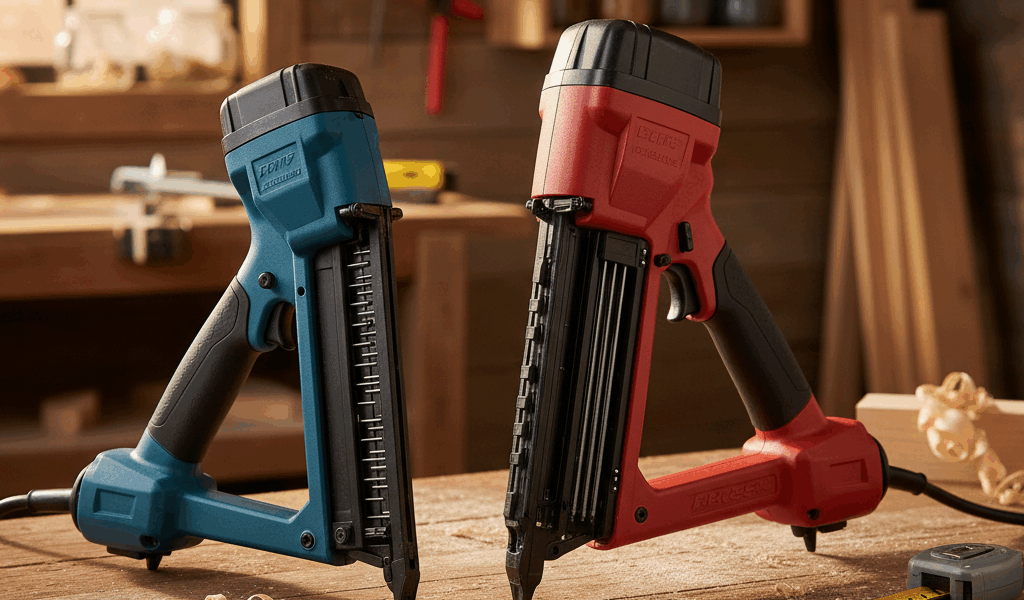
Brad nailers versus finish nailers have gotten complicated with all the gauge number confusion and “just get the finish nailer” advice flying around. As someone who uses both regularly and made the mistake of buying only one first, I’ve learned what each tool actually does differently and when those differences matter. Today, I’ll share everything I know.
Both tools shoot nails pneumatically or via battery — the difference is the nail gauge (thickness) they use, and that gauge difference has real downstream effects on holding power, splitting risk, and hole visibility.
Gauge Differences

Brad nailers shoot 18-gauge nails — thin fasteners at 0.0475 inches diameter. That small diameter leaves minimal holes that fill and disappear easily, and the thin nail parts wood fibers without generating enough stress to split even near edges and end grain.
Finish nailers shoot 15-gauge or 16-gauge nails — substantially thicker at 0.0720 and 0.0625 inches respectively. The extra material is what provides the holding power advantage. The tradeoff is larger holes and meaningfully higher splitting risk in thin stock and hardwoods.
Length Ranges
Brad nailers handle 5/8 to 2 inches. This covers most trim, cabinet face frames, and furniture backs — anything where glue is doing the primary bonding work and the nail is just holding position during cure.
Finish nailers handle 1 to 2.5 inches (16-gauge) or 1.25 to 2.5 inches (15-gauge). The longer maximum length handles thicker material — door jambs, stair treads, baseboard over thick subflooring, furniture carcass joinery.
Holding Power
Brad nails provide adequate holding for trim under 3/4 inch thick and for anything where glue carries the actual load. The nails hold pieces in place while the glue cures — they’re positioning fasteners, not structural fasteners. Finish nails provide roughly twice the holding power due to diameter and length, which matters for applications where you need structural holding independent of glue: crown molding anchored to ceiling framing, baseboard held against drywall without glue backing, furniture joints where adhesive isn’t practical.
Splitting Concerns
Brad nails essentially don’t split wood — thin diameter, low stress. Finish nails can split thin hardwood stock, especially near ends and edges. The rule of thumb is staying 3/4 inch from ends and 1/2 inch from edges, and pre-drilling pilot holes at critical locations when working with hardwood narrower than two inches. I’ve split trim pieces using a finish nailer without pre-drilling that I could have shot with a brad nailer without concern — knowing which to reach for prevents that.
Hole Visibility
Brad nailer holes are nearly invisible after filling with appropriately colored putty. On stained natural wood they’re acceptable; on painted trim they disappear. Finish nailer holes are more visible and require careful color-matched filler to minimize their appearance in stained work. On natural-finished hardwood, even well-filled finish nail holes read as repairs.
Typical Applications
Use brad nailers for:
- Thin trim moldings
- Cabinet face frame assembly
- Furniture backs and drawer bottoms
- Small decorative trim
- Plywood edge banding
- Any delicate work where splitting is a real risk
Use finish nailers for:
- Baseboard and crown molding
- Door and window casing
- Stair treads and risers
- Furniture carcass assembly
- Chair rail and picture rail
- Any application requiring structural nailing
15-Gauge vs 16-Gauge Finish Nailers
15-gauge uses an angled magazine and provides slightly better holding power — well-suited for construction and installation work. 16-gauge uses a straight magazine and leaves slightly smaller holes, which makes it the preferred choice in finish carpentry where hole size still matters. The angled magazine on 15-gauge models allows closer nailing in tight corners.
Which One to Get First
If buying one nailer: a 16-gauge finish nailer is the more versatile choice. It handles most brad nailer applications adequately while covering heavier work brads can’t do. The compromises — slightly larger holes, somewhat higher splitting risk in delicate work — are manageable. The ideal is owning both, which is what most active woodworkers and trim carpenters end up with. That’s what makes having both endearing to those of us who do varied work — you stop reaching for the wrong tool and the right result follows.
Recommended Woodworking Tools
HURRICANE 4-Piece Wood Chisel Set – $13.99
CR-V steel beveled edge blades for precision carving.
GREBSTK 4-Piece Wood Chisel Set – $13.98
Sharp bevel edge bench chisels for woodworking.
As an Amazon Associate, we earn from qualifying purchases.