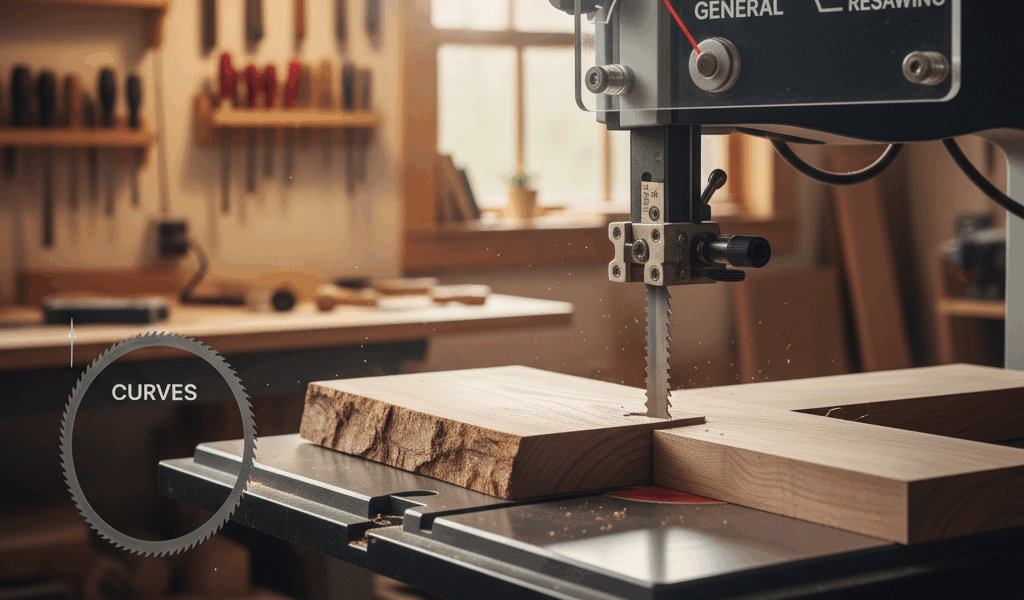
Band saw setup has gotten complicated with all the blade options and conflicting specs flying around. As a woodworker who uses a band saw for both resawing and curved work, I’ve learned that blade width is one of the most consequential choices you make before cutting. The wrong width blade makes the job either unnecessarily difficult or flat-out impossible. Today, I’ll share everything I know about matching band saw blade width to your work.
Band saw blade width determines the minimum curve radius you can cut and directly affects your resaw capacity. Using the wrong width blade limits your cutting options without you necessarily knowing why the cut isn’t working.

Narrow Blades for Curves
A 1/4-inch blade cuts curves with a 5/8-inch radius minimum. This handles most scroll work and curved furniture parts. The narrow blade tracks easily through tight turns without binding or burning. If you’re cutting decorative shapes, chair legs with compound curves, or scroll patterns, a 1/4-inch blade is what you want.
A 3/8-inch blade needs a 1.5-inch minimum radius. This handles gentler curves and still provides enough width for reasonable straight cuts. I’m apparently a “3/8 as my everyday blade” person and it handles the widest range of tasks for me while constantly swapping blades always slows the work down. It’s a solid compromise for shops that do mixed work.
A 1/2-inch blade requires a 2.5-inch minimum radius. Use it for broad curves and situations where blade stability matters more than tight-radius capability.
Wide Blades for Resawing
A 1/2-inch blade is the minimum width for serious resawing on a 14-inch band saw. It provides enough beam strength to resist deflection through thick stock while still flexing around the upper and lower wheels.
A 3/4-inch blade is the preferred choice for resawing stock 6-8 inches high. The extra width reduces drift and blade wander in thick material. Drift becomes noticeable with narrower blades — you end up making constant fence adjustments to maintain a straight cut rather than just pushing the board through. That’s what makes resawing on the wrong blade frustrating: the drift tells you something is off, but not obviously what.
A 1-inch blade is optimal for 12-inch resaws or production work where blade stability matters most. Not all 14-inch saws can tension a 1-inch blade properly — check your saw’s maximum recommended width before purchasing one.
Tooth Count Impact
Blade width and tooth count work together. A 1/4-inch blade typically comes with 6-10 TPI for general curved cutting. Higher TPI (10-14) gives smoother cuts but cuts slower and clogs faster in thick material — fine for thin stock, wrong for anything substantial.
Wide resaw blades use 3-4 TPI for aggressive cutting with good chip clearance. This combination produces the fastest cuts with minimal strain on the motor. Going finer than 4 TPI on a wide resaw blade risks clogging and overheating in thick hardwoods.
Blade Thickness (Gauge)
Blade thickness affects how well the blade resists deflection and how easily it flexes around the wheels. Standard thickness handles most applications. Heavy-gauge blades resist deflection better during resawing but require more tension and may exceed wheel capacity on smaller saws. Thin-kerf blades remove less material and require less motor power but deflect more easily in thick stock — good for curved cutting, problematic for resawing.
The General-Purpose Selection
If you keep only one blade, a 3/8-inch blade with 6 TPI handles the widest range of tasks reasonably well. It cuts curves with a 1.5-inch radius, rips stock up to 3-4 inches thick, and crosscuts accurately. You give up some performance at the extremes — tight curves and deep resawing — but maintain useful capability across the full range of band saw work. For most hobbyist shops, that compromise is completely acceptable.
Shops doing frequent resawing benefit from a dedicated 1/2-inch or 3/4-inch resaw blade and a separate 1/4-inch or 3/8-inch blade for curved work. Blade changes take 5-10 minutes including tensioning and tracking adjustment — worth it when you’re switching between genuinely different applications.
Wheel Size Limits
A 14-inch band saw handles blades from 1/8-inch to 3/4-inch comfortably, with some models accepting 1-inch blades if they have sufficient tension capacity. Larger 17-20 inch saws handle 1-inch and wider blades more easily. Benchtop saws with 9-10 inch wheels max out at 1/2-inch — the tighter wheel radius stresses wider blades and makes tracking difficult.
Material Thickness Guidelines
Stock under 2 inches thick: any blade 1/4-inch or wider works. Choose based on curve requirements rather than thickness.
2-4 inch thick material: use a 3/8-inch or 1/2-inch blade minimum. Narrower blades deflect and produce wavy cuts.
4-8 inch resawing: use a 1/2-inch or 3/4-inch blade. The added width maintains straight tracking through the full depth of cut.
Material over 8 inches thick: use a 3/4-inch or 1-inch blade. Maximum stability is needed to prevent drift in these deep cuts.
One Final Thought
Blade width is one of those band saw decisions that has no adjustment to fix once you’re cutting — you either have the right blade for the job or you don’t. Match width to your minimum curve radius for curved work and to your stock height for resawing, check your saw’s wheel size limits, and you’ll get clean cuts without fighting the machine on every pass.
Recommended Woodworking Tools
HURRICANE 4-Piece Wood Chisel Set – $13.99
CR-V steel beveled edge blades for precision carving.
GREBSTK 4-Piece Wood Chisel Set – $13.98
Sharp bevel edge bench chisels for woodworking.
As an Amazon Associate, we earn from qualifying purchases.