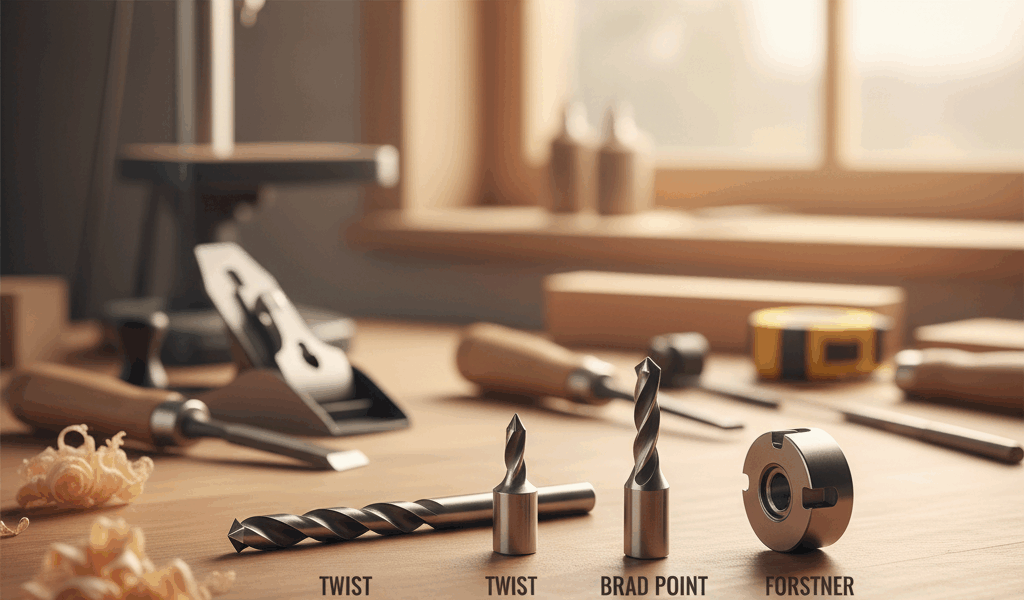
Three drill bit types dominate woodworking: twist bits, brad point bits, and Forstner bits. Each excels at specific tasks while performing poorly at others. Understanding these differences helps you select the right bit for accurate, clean holes.
Twist Bit Design
Twist bits have two helical flutes that evacuate chips as the bit rotates. The point is split with two cutting edges meeting at an angle—typically 118 degrees for general purpose bits or 135 degrees for harder materials. These bits are designed primarily for metal but work adequately in wood.
The split point tends to wander on wood surfaces before engaging fully. This makes precise hole placement difficult without a center punch or pilot hole. The cutting action tears wood fibers rather than slicing them, producing rougher holes than wood-specific bits.
Brad Point Advantages

Brad point bits feature a sharp center spur that locates the hole precisely. Two outer spurs score the hole perimeter before the cutting edges remove material. This design prevents wandering and produces clean entry holes with minimal tear-out.
The center spur keeps the bit on target even when starting holes at an angle or on curved surfaces. This makes brad points the preferred choice for precise drilling in furniture and cabinet work where hole location matters.
Forstner Bit Characteristics
Forstner bits cut flat-bottomed holes with clean, smooth walls. The rim-cutting design scores the hole perimeter while a chisel-like center removes waste. Unlike twist and brad point bits, Forstners can drill overlapping holes and holes at any angle without wandering.
The large cutting area generates more heat than twist or brad point bits. Clearing chips frequently and running at moderate speeds prevents burning. The flat bottom makes Forstners ideal for hinge mortises, shelf pin holes, and any application requiring a clean, flat hole bottom.
Hole Quality Comparison
Twist bits produce acceptable holes for general purpose work but leave rough walls and may cause tear-out at entry and exit points. The exit hole is particularly rough as the bit breaks through the back face.
Brad point bits create clean entry holes with minimal tear-out. Exit holes are cleaner than twist bits but may still show splintering if you don’t back up the workpiece or drill from both sides to meet in the middle.
Forstner bits deliver the cleanest holes in all three types. Entry and exit points are crisp, and hole walls are smooth. Backing up the workpiece or drilling partway from both sides eliminates exit tear-out entirely.
Speed and Feed Rates
Twist bits drill quickly—the aggressive point and efficient chip evacuation allow high feed pressure. For holes up to 1/2 inch diameter, twist bits are the fastest option if hole quality isn’t critical.
Brad point bits require slightly slower feed rates than twist bits to avoid burning the center spur. The improved hole quality justifies the minor speed reduction in most woodworking applications.
Forstner bits drill slowly compared to twist or brad point bits. The large cutting area requires lighter feed pressure and frequent chip clearing. For holes over 1 inch diameter, Forstners take 2-3 times longer than brad points of the same diameter.
Size Ranges
Twist bits come in sizes from 1/16 inch to 1/2 inch in standard sets, with larger sizes available individually. The wide availability and low cost make them convenient for general drilling.
Brad point bits typically range from 1/8 inch to 1/2 inch in common sets. Larger sizes up to 1 inch are available but less common. The focus is on sizes used for typical cabinet and furniture assembly.
Forstner bits start at 1/4 inch and extend to 4 inches or larger. The common range is 1/2 inch to 2 inches—sizes used for hinge mortises, large dowels, and recessing hardware. The flat-bottom design doesn’t work well below 1/4 inch where the center becomes too small to stabilize the bit.
Angled Holes
Twist bits wander severely when starting holes at angles. The split point has no preference for the wood surface and skitters sideways until the full cutting edge engages. This makes precise angled holes nearly impossible without jigs.
Brad point bits start angled holes more reliably thanks to the center spur, but the long point can deflect on steep angles. For angles beyond 15-20 degrees from perpendicular, accuracy suffers.
Forstner bits excel at angled holes. The rim cutters engage the surface fully regardless of angle, preventing wandering. You can drill compound-angle holes accurately with Forstner bits—something nearly impossible with twist or brad point bits.
Overlapping Holes
Twist and brad point bits can’t drill overlapping holes. Once the first hole removes the center material, the bit has no surface to engage and wanders into the void.
Forstner bits drill overlapping holes easily. The rim guides the bit even when the center area is missing. This capability enables cutting slots, mortises, and elongated holes that would require different tools with other bit types.
Cost Comparison
Twist bit sets cost $15-30 for a comprehensive range of sizes. Individual bits cost $2-5. The low cost makes twist bits expendable—throw them away when dull rather than sharpening.
Brad point sets run $30-60 for quality bits. Individual bits cost $5-12 depending on size. The higher cost reflects the precision ground points and better steel used in wood-specific bits.
Forstner bits are the most expensive: $15-30 each for quality brands in common sizes. A set covering 1/2 inch to 2 inches costs $100-200. The precision required to manufacture flat-cutting bits and the carbide tips on premium versions drive the higher price.
Best Applications
Use twist bits for:
- Pilot holes for screws
- General-purpose drilling where precision doesn’t matter
- Through-holes in rough construction
- Any situation where you already have twist bits on hand
Use brad point bits for:
- Precise hole locations for dowels and hardware
- Cabinet and furniture assembly
- Holes where clean entry is important
- Shelf pin holes and adjustable shelf systems
Use Forstner bits for:
- Hinge mortises requiring flat bottoms
- Large clean holes for hardware recessing
- Overlapping holes and elongated mortises
- Any application requiring the cleanest possible holes
- Angled holes where accuracy matters
Drill Press vs Handheld
All three bit types perform better in a drill press than handheld. The press maintains perpendicular entry and prevents wandering. For twist and brad point bits up to 1/2 inch, handheld drilling is acceptable with care. For Forstner bits over 3/4 inch, a drill press becomes essential for safety and accuracy—the torque and side loads are difficult to control handheld.
Recommended Woodworking Tools
HURRICANE 4-Piece Wood Chisel Set – $13.99
CR-V steel beveled edge blades for precision carving.
GREBSTK 4-Piece Wood Chisel Set – $13.98
Sharp bevel edge bench chisels for woodworking.
As an Amazon Associate, we earn from qualifying purchases.



Stay in the loop
Get the latest crafted wood creations updates delivered to your inbox.