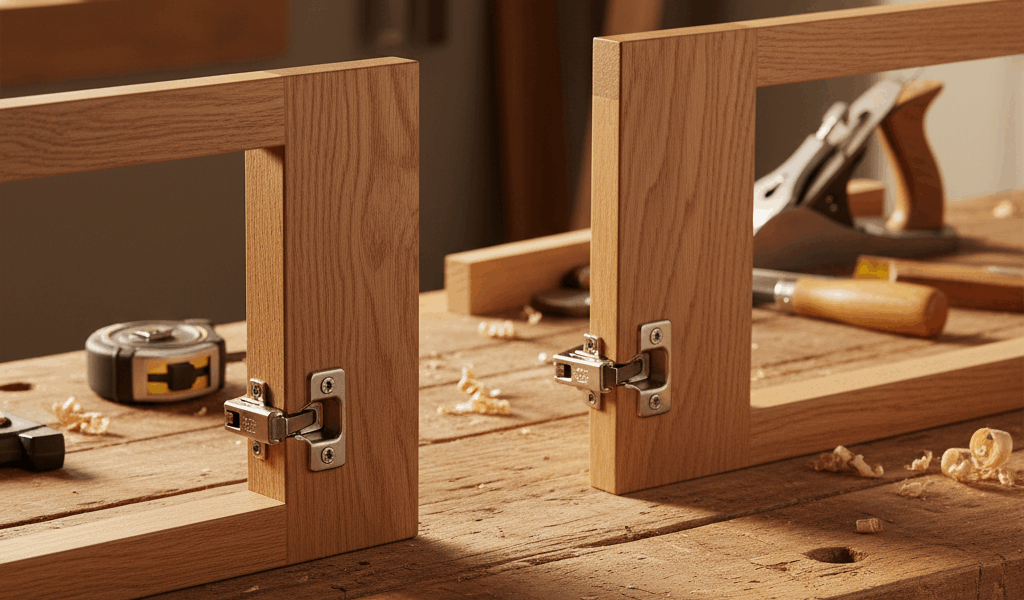
As a woodworker who has built a lot of cabinets over the years, I’ve drilled more hinge cups and hung more doors than I care to count. Getting hinges wrong means doors that won’t close properly, and fixing it is more work than getting it right the first time. Today, I’ll share everything I know about cabinet hinge types.
Cabinet hinges come in different overlay configurations to suit different door and cabinet relationships. Understanding full overlay, half overlay, and inset mounting lets you choose the correct hinges before you start drilling — not after you’ve already built the doors.
Full Overlay: What It Is and When You Need It
Full overlay means the door covers the entire face frame or the full thickness of the frameless cabinet side. The door overlaps approximately 3/4 inch on each side, completely hiding the cabinet opening. This is the default configuration for frameless European-style cabinets and the most common choice when you want no face frame showing at all.
The hinge cup goes in the door; the mounting plate attaches to the cabinet side. The bent hinge arm positions the door the full overlay distance. On a run of cabinets where doors share openings, each door fully overlaps its side and both doors meet at center without a gap into the cabinet interior.
Half Overlay: The Shared-Partition Configuration
Half overlay is for two doors sharing a common center partition. Each door overlaps approximately 3/8 inch, so both can close against the shared panel without hitting each other. The combined overlay from both doors is roughly 3/4 inch — matching the partition thickness.
The hinge arm bend is different from full overlay, and this is not a small difference. Full overlay hinges in a half overlay application produce doors that collide or won’t close. I keep full and half overlay hinges in separate labeled bins in the shop. Sounds obvious, but I’ve grabbed the wrong type mid-project more than once, usually before I’d had coffee. Label everything.
Inset: The Demanding Option That Looks Like Furniture
Inset mounting puts the door flush with the face frame. The door sits inside the opening rather than overlapping it — the full face frame shows around every door. It’s a traditional, furniture-like look that you simply cannot replicate with overlay hinges.
The tradeoff is precision. Gaps around inset doors need to be consistent — 1/16 to 1/8 inch — which means your door sizing and hinge placement have to be accurate. Overlay doors are more forgiving because the door covers any irregularity in the opening. Inset is the least forgiving of the three. The result looks different from overlay in a way that’s immediately apparent to anyone in the room, which is why it’s worth the extra care when that aesthetic matters to the project.
Face Frame vs. Frameless: Not Interchangeable
Face frame hinges account for the frame thickness in how the mounting plate positions the door. Standard face frame hinges are designed for 3/4-inch frame stock. Frameless hinges mount directly to the cabinet side panel edge. Using face frame hinges on a frameless cabinet — or vice versa — produces doors that are incorrectly positioned regardless of what adjustments you make. Know which type of cabinet you’re building before you order anything.
The 35mm Cup Is the Standard
Almost every European-style cabinet hinge uses a 35mm cup requiring a 35mm Forstner bit at 12-13mm depth. That dimension is consistent across full overlay, half overlay, and inset versions. Drill all your cup holes identically. The hinge arm and mounting plate determine door position — the cup is just the cup. A 35mm Forstner from Freud or similar quality brand gives you a clean, consistent hole that the hinge snaps into without slop.
Mounting Plates Give You Fine Adjustment
Some manufacturers offer plates in different thicknesses — 0mm, +3mm, -3mm — that shift door position slightly without changing anything else. These are interchangeable on the same screw pattern. If a door is close but not quite right after installation, trying a different plate often fixes it without re-drilling. Worth knowing before you reach for the drill and make the situation worse.
The Adjustment Range
Quality Blum or Grass hinges adjust in three directions: depth (in-out), height (up-down), and lateral (side-to-side), typically ±2mm each direction. That’s enough to correct minor installation errors and align doors across a run. Cheap hinges often have no real adjustment capability, which makes door alignment nearly impossible without perfect initial placement. On kitchen cabinets or any built-ins with multiple doors, that adjustment range earns its cost every time you use it.
Opening Angle
Standard hinges open 95-110 degrees. Wide-angle hinges open to 165-175 degrees, useful for pantry cabinets or anywhere you need to swing a door fully out of the way for access. They’re a few dollars more per hinge. On a tall pantry where you’re reaching deep inside, the wide-angle opening is genuinely useful rather than just a spec difference.
Soft-Close Is Worth It on Kitchen and Bath
Soft-close slows the door in the last few inches of travel to prevent slamming. The damping mechanism is in the hinge arm, so it works the same across overlay styles. Expect $3-8 more per hinge. On kitchen and bathroom cabinets that get opened and closed dozens of times a day, it prevents the cumulative damage that a slamming door does to cabinet boxes over years of use. I spec soft-close on every kitchen I build now without really thinking about it anymore.
Load Rating and When to Add Hinges
Standard cabinet hinges support around 30-35 pounds per pair. Heavy cabinet doors — thick solid wood panels, glass inserts, or oversized sizes — need either additional hinges or heavy-duty versions. Overlay style doesn’t meaningfully change load capacity. What matters is hinge arm construction and the number of hinges. When in doubt, add a third hinge rather than wonder later.
Choosing the Right Hinge: The Short Version
Frameless cabinet, exterior door: full overlay, frameless version. Frameless cabinet, shared partition: half overlay, frameless version. Face frame cabinet: specify face frame version in the correct overlay style — full overlay is most common, inset for furniture-style applications. Measure your actual application. Full overlay should cover the panel edge completely. Half overlay lets two doors close against a shared partition without interference. Inset positions the door flush with the face frame. Match the hinge to what you measured. That’s the whole decision.
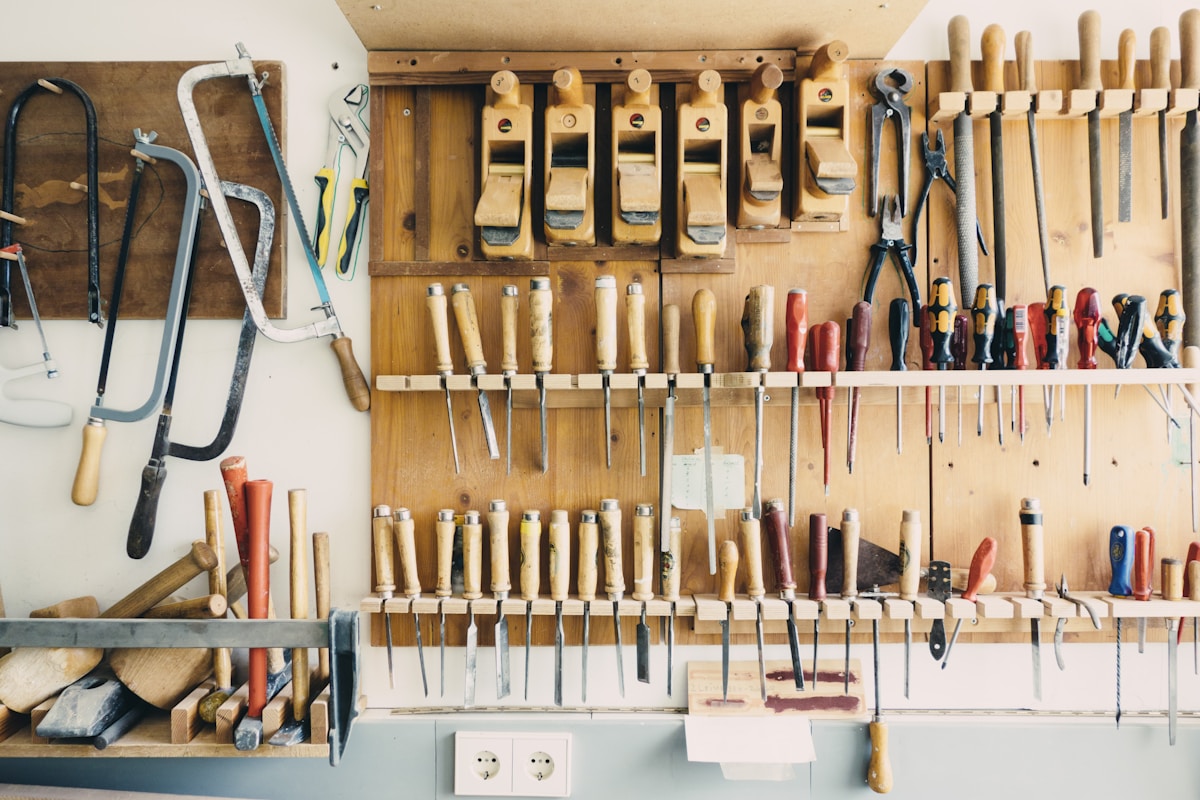
Recommended Woodworking Tools
HURRICANE 4-Piece Wood Chisel Set – $13.99
CR-V steel beveled edge blades for precision carving.
GREBSTK 4-Piece Wood Chisel Set – $13.98
Sharp bevel edge bench chisels for woodworking.
As an Amazon Associate, we earn from qualifying purchases.
After choosing overlay and hinge geometry, plan knob and pull locations with our cabinet hardware jig guide; test one door before repeating the layout.




Stay in the loop
Get the latest crafted wood creations updates delivered to your inbox.