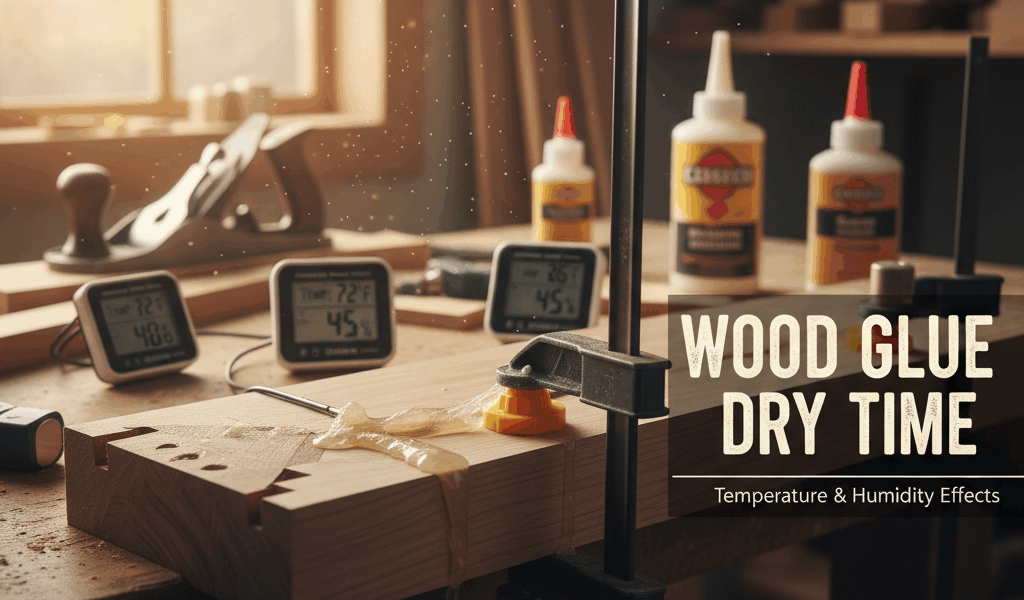
Wood glue drying times have become harder to navigate with all the temperature charts and humidity variables flying around. As someone who’s blown more than one glue-up by pulling clamps too early in a cold shop, I’ve learned to actually pay attention to this stuff. Today, I’ll share everything I know.
Wood glue drying time varies with temperature and humidity. Understanding these effects helps you plan clamp schedules and avoid releasing joints before they’ve developed adequate strength.
Temperature Impact on PVA Glues
At 70°F room temperature, standard yellow glue (PVA) develops enough strength for clamp removal in 30-45 minutes. The joint can be handled carefully at this point, though full strength takes 24 hours.
At 50-55°F, the same glue requires 60-90 minutes before clamp removal. The cold slows water evaporation and extends the cure time significantly. Below 50°F, PVA glue may not cure properly at all — the bond remains weak even after extended time.
At 80-85°F, clamp time drops to 20-30 minutes. The warmth accelerates water evaporation and speeds the initial set. However, the glue’s open time also shortens — you have less working time for assembly before the glue begins to set.
I’m apparently a 70°F shop person — it works for me with predictable 45-minute clamp times while working in a cold shop always leaves me guessing. A cheap thermometer and heater in the shop paid for themselves in avoided failed glue-ups within the first winter.
Humidity Effects
In low humidity (20-30% relative humidity), glue dries faster through rapid water evaporation. Clamp times decrease by approximately 25% compared to moderate humidity conditions. The downside is shorter open time and potential for the glue to skin over before you complete assembly on complex projects.
In high humidity (70-80% relative humidity), glue dries slower as water evaporates reluctantly into the already-moist air. Clamp times increase by 40-60% compared to moderate conditions. Summer shop conditions in humid climates can double the clamp time needed for adequate initial strength.
Extreme humidity above 80% may prevent proper curing. The glue remains soft and never develops full strength. Air conditioning or dehumidification becomes necessary for reliable glue joints in these conditions.
Combined Temperature and Humidity
Cold and humid combinations create the longest clamp times. At 55°F and 70% humidity, PVA glue may need 2-3 hours before safe clamp removal. Plan your glue-ups accordingly in unheated shops during winter.
Warm and dry combinations offer the fastest curing. At 80°F and 30% humidity, clamps can come off in 20 minutes. But watch your assembly time — the glue will begin to set within 5-7 minutes rather than the typical 10-15 minutes at moderate conditions.
Polyurethane Glue Differences
Polyurethane glue cures through moisture activation rather than water evaporation. It actually needs humidity to cure properly. At 70°F and 40-50% humidity, polyurethane glue requires 1-2 hours clamp time before careful handling.
Higher humidity speeds polyurethane cure slightly. At 60-70% humidity, the same joint may be ready in 1-1.5 hours. The difference is less dramatic than with PVA glues since humidity aids rather than hinders curing.
Temperature still affects polyurethane glue significantly. Below 50°F, cure times extend to 3-4 hours or more. Above 80°F, times drop to 45-60 minutes. The usable temperature range is narrower than PVA glue — polyurethane performs poorly below 40°F.
Hide Glue Behavior
Liquid hide glue dries similarly to PVA glue since both are water-based. At 70°F, expect 45-60 minute clamp times. Temperature and humidity affect it as they affect PVA, though hide glue is slightly more sensitive to cold.
Hot hide glue gels rapidly as it cools — within 2-5 minutes depending on starting temperature and room conditions. The initial gel isn’t full cure, but it holds the joint together. The glue then dries over several hours as remaining moisture evaporates. This two-stage process makes it less affected by humidity than liquid glues.
Hot hide glue in the cold shop. Epoxy when you need to fill gaps and moisture resistance. Yellow glue for almost everything else at room temperature.
Epoxy Cure Times
Epoxy cures through chemical reaction, not evaporation. Humidity has minimal effect. Temperature is the primary variable — every 10°F increase approximately doubles cure speed within the working range.
At 70°F, 5-minute epoxy sets in 5-7 minutes and cures to handling strength in 60-90 minutes. At 85-90°F, the same epoxy sets in 3-4 minutes and cures in 30-45 minutes. At 50-55°F, set time extends to 10-12 minutes and cure time to 3-4 hours.
The packaging “5-minute” or “30-minute” designation refers to working time at approximately 70°F, not total cure time. Actual cure to full strength takes much longer than the labeled time suggests.
Testing for Adequate Cure
Don’t rely on specified times alone — test the joint before removing clamps. Try gently flexing the joint. If it moves at all, it needs more time. Squeeze-out should be firm to the touch, not tacky or soft.
For PVA glues, the squeeze-out changes from translucent when wet to opaque when dry. Full opacity indicates sufficient cure for careful handling. Complete cure to full strength takes 24 hours regardless of how quickly the initial set occurs.
Extending Clamp Time
When conditions aren’t ideal, extend clamp time rather than gambling on early release. Leaving clamps on an extra 30-60 minutes costs nothing compared to a failed joint that requires disassembly and re-gluing.
In cold shops, warm the wood before gluing if possible. Even bringing lumber inside to room temperature for a few hours before gluing improves results. Some woodworkers use heat lamps or space heaters near glue-ups to maintain adequate temperature during cure.
Accelerating Cure
Raising temperature safely speeds PVA glue cure. A shop heater maintaining 75-80°F cuts clamp time significantly compared to a 60°F shop. Don’t use direct heat on the joint — excessive temperature (above 100°F) can cause PVA glue to fail.
For polyurethane glue, misting the joint surfaces lightly before applying glue speeds cure. The added moisture activates the curing agent more quickly. Don’t oversaturate — a light mist is sufficient.
Epoxy responds to higher temperatures. Some woodworkers place epoxy glue-ups in warming boxes at 90-100°F to speed cure. This technique works well with slower-setting epoxies that need full overnight cure at room temperature.
Shop Monitoring
Keep a thermometer and hygrometer in your shop to know actual conditions. Your feel for “comfortable” room temperature may be 65°F or 75°F, and this difference affects glue performance significantly. Knowing exact conditions helps you adjust clamp times accurately rather than guessing. It’s a small investment that eliminates a lot of uncertainty from every glue-up you do.
Recommended Woodworking Tools
HURRICANE 4-Piece Wood Chisel Set – $13.99
CR-V steel beveled edge blades for precision carving.
GREBSTK 4-Piece Wood Chisel Set – $13.98
Sharp bevel edge bench chisels for woodworking.
As an Amazon Associate, we earn from qualifying purchases.
Drying time is only one selection factor. Match the chemistry and exposure first with our best wood glue by project guide.



Stay in the loop
Get the latest crafted wood creations updates delivered to your inbox.