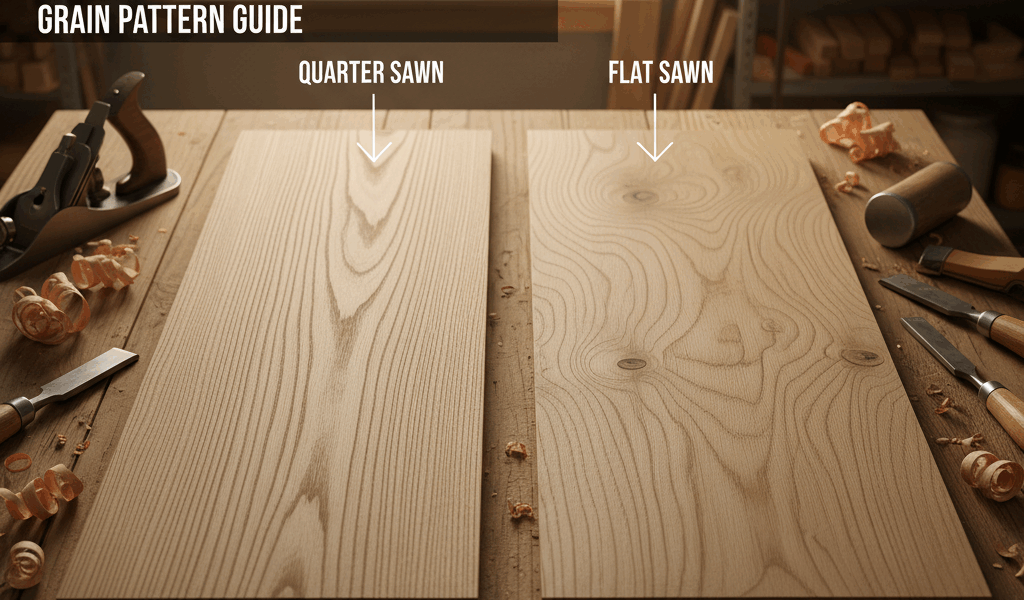
Quarter sawn and flat sawn oak show different grain patterns and stability characteristics. Understanding these differences helps you select the right sawing method for your project and budget.
Sawing Method Differences
Flat sawn boards come from cutting the log parallel to its length with the saw blade passing through the log tangent to the growth rings. This produces boards where growth rings run roughly parallel to the face—typically at angles less than 45 degrees. This is the most economical sawing method, yielding the most board feet per log.
Quarter sawn boards are cut perpendicular to the growth rings. The log is first quartered lengthwise, then boards are cut from each quarter at angles approaching perpendicular to the rings. This produces boards where growth rings run nearly vertical—at 45-90 degree angles to the face. The method yields less lumber per log, increasing cost.
Visual Appearance

Flat sawn oak displays cathedral or arched grain patterns across the face. These dramatic figures result from the saw cutting through growth rings at shallow angles. The pattern varies across the board width and between boards, creating visual interest but less uniformity.
Quarter sawn oak shows straight, parallel grain lines running the length of the board. Oak also displays distinctive ray fleck figure—small perpendicular flecks and ribbons across the grain. These rays exist in all oak but only show when cut perpendicular to the growth rings. The ray fleck is prized for its decorative appearance in Arts and Crafts and Mission-style furniture.
Dimensional Stability
Flat sawn oak moves significantly with seasonal humidity changes—approximately 8-10% across the width in white oak from dry winter to humid summer conditions. This expansion and contraction causes problems in wide panels unless you design joints to accommodate movement.
Quarter sawn oak moves about half as much—roughly 4-5% across the width in similar conditions. The perpendicular ring orientation minimizes the expansion effect that causes cupping and warping. This increased stability makes quarter sawn preferred for wide table tops, door panels, and other applications where movement causes problems.
Cupping Tendency
Flat sawn boards cup toward the bark side (outside of the tree). The cupping follows the growth ring curve—boards with rings curving upward cup with the bark side becoming convex. This cupping worsens as board width increases. Boards wider than 8 inches show noticeable cupping even when properly dried.
Quarter sawn boards resist cupping due to their vertical ring orientation. They may develop slight twist or bow but rarely cup significantly. This characteristic allows wider boards without the cupping problems that flat sawn wide boards exhibit.
Cost Difference
Flat sawn oak costs $4-7 per board foot for common grades like FAS (Firsts and Seconds). The efficient sawing method and high yield keep prices moderate. Availability is excellent—any hardwood supplier stocks flat sawn oak in multiple grades and thicknesses.
Quarter sawn oak runs $8-14 per board foot for comparable grades. The specialized sawing method, lower yield, and higher demand from furniture makers drive the premium pricing. Availability is limited—smaller suppliers may not stock it, requiring special orders.
Strength Considerations
Both sawing methods produce wood with equal strength in bending and compression when measured parallel to the grain. The sawing orientation doesn’t change the wood’s fundamental strength properties.
The difference appears in wear resistance. Quarter sawn oak wears more evenly because the vertical grain orientation presents end grain across the surface. This makes quarter sawn preferred for flooring and tabletops where wear matters. Flat sawn surfaces show wear patterns more readily as the soft early wood wears faster than the harder late wood.
Finishing Characteristics
Flat sawn oak absorbs stain evenly across the dramatic grain pattern, highlighting the cathedral figures. The contrast between early wood and late wood becomes more pronounced with staining. This creates the characteristic “oak look” most people recognize.
Quarter sawn oak shows more subtle stain color variation. The ray fleck often absorbs stain differently than the surrounding wood, creating additional visual interest. Some finishers prefer the more uniform appearance while others miss the dramatic grain of flat sawn material.
Milling Considerations
Flat sawn boards plane and joint easily since the cutter primarily engages long grain. Tear-out is minimal unless you encounter particularly wild grain at knots or defects.
Quarter sawn boards can show more tear-out during planing because the cutter partially engages the ray fleck, which doesn’t always plane cleanly. Taking lighter passes and ensuring sharp knives reduces this issue. The vertical grain orientation also makes quarter sawn boards slightly more prone to splintering at edges during routing and shaping.
Historical Context
Quarter sawn oak dominated furniture production in the late 1800s and early 1900s during the Arts and Crafts movement. Makers like Gustav Stickley specified quarter sawn oak for its straight grain and ray fleck figure. This historical association gives quarter sawn oak a traditional appearance that suits period reproductions and Mission-style furniture.
Flat sawn oak works for any period or style. The dramatic grain suits modern designs where you want visual impact, while the lower cost makes it practical for projects where the quarter sawn premium isn’t justified.
Project Selection Guide
Use quarter sawn oak for:
- Wide table tops and panels
- Arts and Crafts furniture reproductions
- Applications where stability is critical
- Projects where you want ray fleck figure
- Tabletops and surfaces subject to heavy wear
Use flat sawn oak for:
- Budget-conscious projects
- Narrow components under 6 inches wide
- Projects where dramatic grain enhances appearance
- Applications where quarter sawn isn’t available locally
- Face frames and trim where stability matters less




Stay in the loop
Get the latest crafted wood creations updates delivered to your inbox.