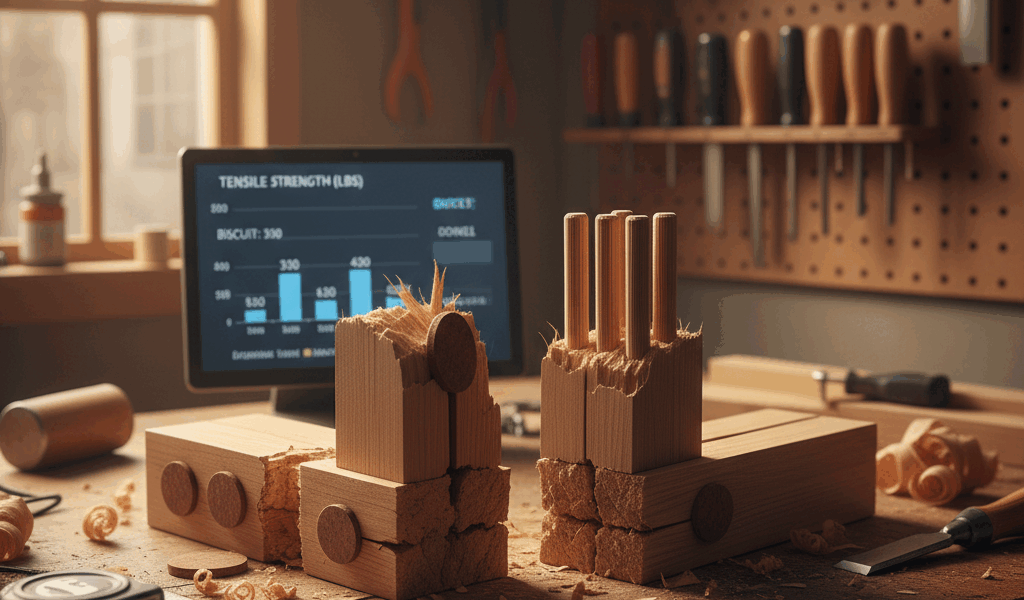
Biscuit joints and dowel joints both align and strengthen edge-to-edge and corner connections. Tests show measurable differences in strength, but practical considerations often matter more than raw numbers.

Biscuit Joint Strength
A properly made biscuit joint with three #20 biscuits in a 24-inch edge-to-edge panel glue-up holds approximately 550-650 pounds before failure in tension. The compressed beech biscuits swell when glue activates them, creating a tight fit in the slots.
Failure typically occurs by the biscuit pulling through the thin wood between the slot and the board edge, not by the biscuit itself failing. This means edge distance matters—keeping the slot at least 1/4 inch from edges prevents premature failure.
Dowel Joint Strength
Three 3/8-inch dowels in the same 24-inch joint hold approximately 700-850 pounds before failure. The solid wood dowels provide more material in the joint and more glue surface area than comparable-size biscuits.
Dowel joints fail either by the dowel shearing or pulling out of the hole. When holes are drilled accurately and dowels fit snugly, shear failure is more common, indicating the joint performed to its full potential.
Alignment Capability
Biscuits allow slight adjustment during assembly. The oval biscuit slots provide roughly 1/8 inch of play lengthwise along the joint. This lets you shift boards slightly to perfect alignment before the glue sets. The cross-grain dimension holds boards flush without play.
Dowels provide minimal adjustment—perhaps 1/32 inch of play if the holes are slightly oversized. Once you insert the dowels, the boards are essentially locked in position. Any alignment errors become permanent unless you disassemble and redrill.
Setup Time
Cutting biscuit slots takes approximately 30-45 seconds per slot including fence setup and cut. A three-biscuit joint requires less than two minutes of machining. The biscuit joiner references off the board face, so setup is quick and consistent.
Drilling dowel holes takes approximately one minute per hole pair when using a doweling jig for accuracy. The same three-dowel joint requires six minutes or more of drilling. You must set up the jig carefully for each hole to maintain alignment.
Equipment Cost
A quality biscuit joiner runs $150-400. The tool is dedicated to this single purpose but performs it quickly and accurately. Biscuits cost approximately $0.05-0.10 each.
A doweling jig costs $30-100 depending on quality and features. You’ll also need an electric drill and appropriate bit sizes. Dowels cost approximately $0.10-0.15 each depending on diameter and wood species. The total system cost is lower, but doweling requires more operator skill for consistent results.
Accuracy Requirements
Biscuits tolerate slight depth variations. Being off by 1/16 inch in slot depth rarely causes problems since the biscuit compresses slightly during assembly. The wide slot opening makes it nearly impossible to miss the biscuit during dry-fitting.
Dowels demand precise hole depth and spacing. Holes that are too shallow prevent full joint closure. Holes that don’t align perfectly make assembly difficult or impossible. Hole spacing errors compound across multiple dowels, potentially preventing the joint from coming together at all.
Edge-to-Edge Panels
For typical edge-glued panels like table tops, both methods provide strength well beyond what the glue alone delivers. The primary value is alignment during glue-up, not the strength increase.
Long-grain glue joints are stronger than the surrounding wood when properly made. Breaking a glued joint typically fractures the wood beside the joint, not the glue line itself. Adding biscuits or dowels helps keep the boards aligned while clamping but doesn’t increase the joint’s structural capacity significantly.
Right-Angle Joints
In corner joints like face frames or carcass construction, the strength difference matters more. The mechanical connection of biscuits or dowels carries the load rather than relying on problematic end-grain to long-grain glue bonds.
Both methods perform adequately for cabinet face frames. The higher strength of dowel joints becomes relevant in applications like chair construction where the joints face impact loads and racking forces.
Best Applications
Choose biscuits for:
- Production work requiring speed
- Edge-to-edge panel glue-ups
- Face frame construction
- Situations where slight adjustment during assembly helps
Choose dowels for:
- Maximum joint strength requirements
- Projects where you want traditional joinery methods
- Situations where biscuit visibility matters (thin stock)
- When you don’t own a biscuit joiner
Recommended Woodworking Tools
HURRICANE 4-Piece Wood Chisel Set – $13.99
CR-V steel beveled edge blades for precision carving.
GREBSTK 4-Piece Wood Chisel Set – $13.98
Sharp bevel edge bench chisels for woodworking.
As an Amazon Associate, we earn from qualifying purchases.




Stay in the loop
Get the latest crafted wood creations updates delivered to your inbox.