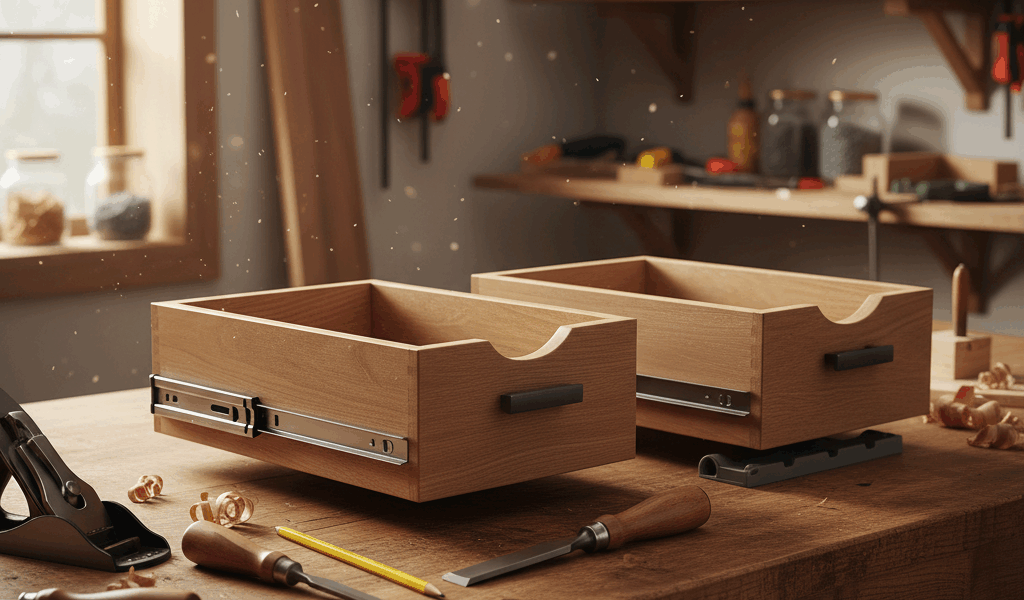
As a woodworker who has built a lot of cabinets and drawers over the years, I’ve installed enough drawer slides to have strong opinions about when each type earns its place. Today, I’ll share everything I know about side-mount versus under-mount drawer slides.
Drawer slides come in two main mounting styles: side mount and under mount. Each has real advantages for specific applications. The choice affects load capacity, drawer access, installation complexity, and what you spend — so it’s worth understanding both before you commit.

Side Mount Characteristics
Side-mounted slides attach to the drawer sides and the cabinet sides, sitting in the gap between them. They’re visible when the drawer is open — which isn’t a problem in shop cabinets or utility storage, but matters in finished furniture. Standard European-style side mounts are the most common type in ready-to-assemble furniture and older cabinetry.
These slides typically support 75-100 pounds depending on quality and length. Heavy-duty versions handle up to 150 pounds. The load rating applies when the drawer is fully extended — the condition that actually matters when you’re reaching for something at the back.
Under Mount Benefits
Under-mount slides attach to the drawer bottom and the cabinet floor, hiding completely from view. That invisibility creates a cleaner appearance and gives you the full interior width of the drawer without the slides intruding into the storage space. I’m apparently an “under-mount for finished work” person and that clean look always reads better in kitchen and bathroom cabinetry while visible slides always bother me in high-end interiors.
Load capacity ranges from 75 pounds for basic models up to 150 pounds for heavy-duty versions — matching side-mount capacity at equivalent quality levels.
Installation Complexity
Side mounts install faster and more forgivingly. Mark the height, attach the cabinet member, attach the drawer member, check the fit. Height adjustment typically allows 1/8 inch of play to correct minor errors. That forgiveness is valuable when you’re retrofitting an existing cabinet or working through a long run of drawers quickly.
Under mounts require more precision. The drawer must sit at exactly the right height relative to the cabinet, and the slides must be perfectly parallel. Most under-mount systems include adjustment screws for fine-tuning after installation, but you need to start reasonably close to the target position. That’s what makes under-mount installation slower — the precision requirement from the start. The result justifies the extra time for finished work.
Access and Extension
Both styles come in partial-extension and full-extension versions. Partial extension gives access to about 75% of drawer depth — fine for shallow drawers where everything is within easy reach. Full extension pulls the drawer completely out, exposing the entire interior. For deep drawers or tall cabinets, full extension isn’t a luxury, it’s a functional requirement.
Under-mount slides include full extension as a standard feature more often than side mounts. Side mounts typically require a price step up for full-extension models.
Cost Comparison
Basic side-mount slides cost $3-8 per pair. Quality European-style side mounts run $12-20 per pair. Under-mount slides start at $15-25 per pair and reach $40-60 for quality versions with soft-close. The price difference narrows considerably when you’re comparing equivalent quality levels with similar features — heavy-duty side mounts with soft-close cost nearly as much as comparable under-mount slides.
Soft-Close
Soft-close mechanisms slow the drawer in the last few inches of travel, preventing the slam that damages drawer boxes over time and grates on everyone in the house. Both slide types offer this feature at higher price points. Under-mount soft-close integrates more cleanly since the mechanism hides beneath the drawer. Side-mount soft-close adds visible components to the drawer sides — rarely a problem functionally, but worth noting for finished cabinetry.
When to Use Each
Use side mounts for:
- Budget-conscious projects
- Retrofitting existing furniture
- Shop cabinets and utility storage
- Situations where installation speed matters more than appearance
Use under mounts for:
- Kitchen and bathroom cabinetry
- Furniture where hardware visibility matters
- Face-frame cabinets where you want full-width drawers
- Any project where the absence of visible hardware is part of the design
Longevity
Quality matters more than mounting style for how long slides last. Ball-bearing slides outlast roller slides regardless of which way they mount. Steel construction on load-bearing components outlasts plastic components — especially in high-use applications where cheap slides fail within years while good ones last decades.
Recommended Woodworking Tools
HURRICANE 4-Piece Wood Chisel Set – $13.99
CR-V steel beveled edge blades for precision carving.
GREBSTK 4-Piece Wood Chisel Set – $13.98
Sharp bevel edge bench chisels for woodworking.
As an Amazon Associate, we earn from qualifying purchases.
Once the drawer system is selected, use a cabinet hardware jig comparison and drilling workflow to place pulls consistently without confusing overall handle length with center-to-center spacing.




Stay in the loop
Get the latest crafted wood creations updates delivered to your inbox.