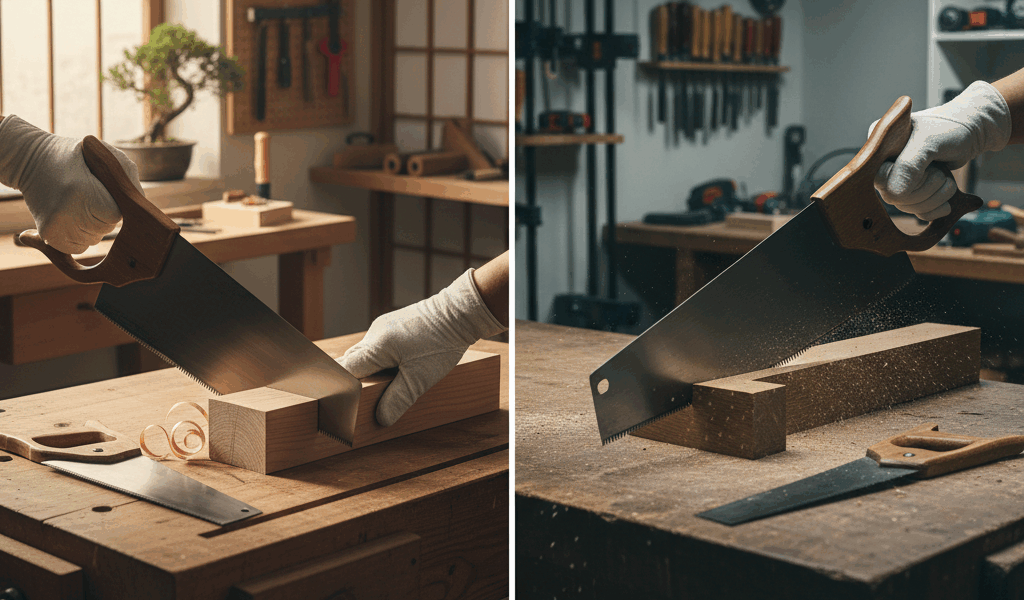
Woodworkers choosing their first hand saw face a fundamental decision: Japanese pull saws or traditional Western push saws. These tools operate on opposite principles, each offering distinct advantages for different cutting situations.
Cutting Direction Differences
The primary distinction lies in cutting direction. Western saws cut on the push stroke, while Japanese saws cut on the pull stroke. This seemingly simple difference affects blade design, cutting feel, and accuracy.
Pull strokes keep blades in tension, allowing thinner blade construction. Push strokes require thicker blades to resist buckling under compression forces.
Blade Thickness and Kerf Width
Japanese saws: Blades measure 0.3-0.5mm thick, creating narrow kerfs that remove less material. This reduces cutting effort and produces minimal sawdust.
Western saws: Blades range 0.8-1.2mm thick to handle push-stroke compression. Wider kerfs require more effort but provide blade stability.
The thinner Japanese blade cuts faster through hardwoods with less physical exertion. However, blade flexibility demands careful tracking to maintain straight cuts.
Tooth Configuration
Japanese saw teeth point backward toward the handle, cutting during the pull stroke. Teeth feature three-sided geometry creating extremely sharp cutting edges. Most Japanese saws use impulse-hardened teeth that stay sharp longer but can’t be resharpened.
Western saw teeth point forward, cutting on the push stroke. Traditional tooth patterns include rip (for cutting with grain) and crosscut (for cutting across grain). These teeth can be resharpened with files, extending saw life indefinitely.
Control and Accuracy
Pull saws offer natural accuracy advantages. Pulling toward your body provides better control and alignment than pushing away. The tension in pull strokes helps track straight lines without wandering.
New woodworkers often find pull saws easier to control. The pulling motion feels more intuitive and requires less muscle coordination than pushing.
Western saws demand more practice to develop accurate cutting technique. However, experienced users appreciate the power available from push strokes, especially in thick stock.
Cutting Speed and Effort
Japanese saws typically cut faster in hardwoods due to thin kerfs and aggressive tooth geometry. Less material removal means less physical effort per cut. Three-point teeth slice rather than tear wood fibers.
Western saws excel in softwoods where their robust construction handles aggressive cutting without deflection. The thicker blade resists binding in resinous woods like pine.
Versatility and Specialization
Japanese saw types:
- Dozuki: Thin blade with back reinforcement for precise joinery
- Ryoba: Double-edged blade with rip and crosscut teeth
- Kataba: Single-edged blade for flush cutting
Western saw types:
- Dovetail saw: Fine teeth for precise joinery
- Tenon saw: Medium teeth for general joinery work
- Panel saw: Large format for sheet goods
Japanese saws often combine multiple functions in one tool. Ryoba saws handle both rip and crosscut operations by switching blade edges. Western tradition favors specialized saws for specific tasks.
Maintenance and Longevity
Western saws with traditional teeth can be resharpened indefinitely. Files restore dull teeth to sharp condition. Vintage saws from decades ago still perform excellently when properly maintained.
Japanese saws feature impulse-hardened teeth that resist dulling but cannot be resharpened. When dull, replace the blade. Replacement blades cost $15-40 depending on saw type. Quality Japanese saws remain sharp through years of regular use before requiring replacement.
Price Considerations
Entry-level Japanese pull saws start around $20-30 for quality options. Premium versions reach $100-200. Replacement blades cost less than new complete saws.
Quality Western saws range $40-150 for new tools. Vintage saws from flea markets or estate sales often cost $10-30 and perform excellently after cleaning and sharpening.
Which Should You Choose?
Choose Japanese pull saws if you:
- Primarily work with hardwoods
- Value effortless cutting
- Prefer intuitive tool control
- Don’t want to learn saw sharpening
Choose Western push saws if you:
- Work extensively with softwoods
- Want tools you can maintain and sharpen
- Appreciate traditional woodworking techniques
- Already own quality vintage saws
Many woodworkers keep both styles in their shops. Japanese saws handle precision crosscuts and joinery in hardwoods. Western saws tackle rough dimensioning and softwood projects. The $30 investment in a quality Japanese saw provides an excellent introduction to pull-saw advantages without abandoning your existing Western saws.
Recommended Woodworking Tools
HURRICANE 4-Piece Wood Chisel Set – $13.99
CR-V steel beveled edge blades for precision carving.
GREBSTK 4-Piece Wood Chisel Set – $13.98
Sharp bevel edge bench chisels for woodworking.
As an Amazon Associate, we earn from qualifying purchases.

Stay in the loop
Get the latest crafted wood creations updates delivered to your inbox.