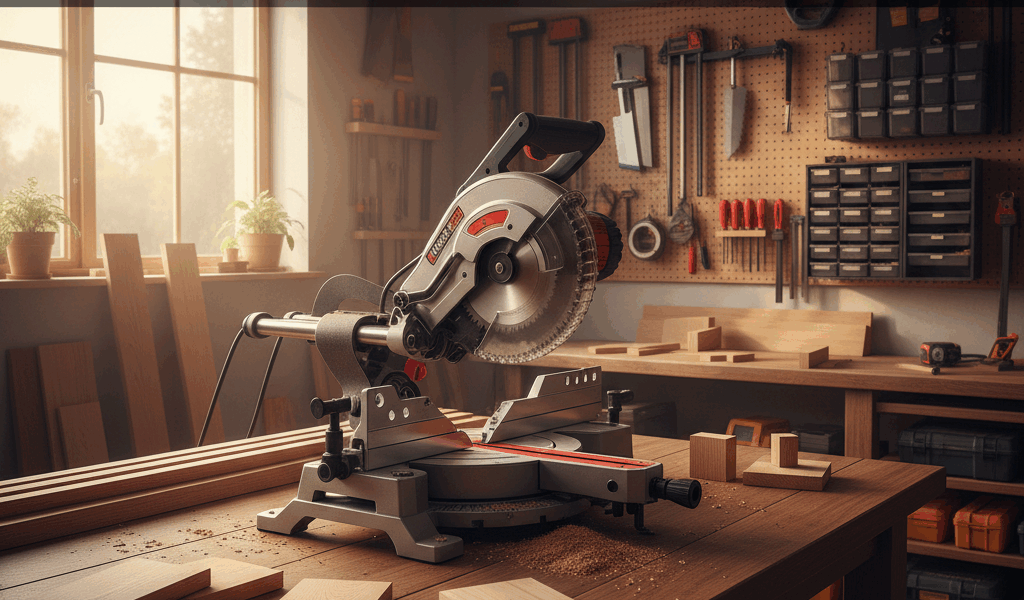
The best sliding compound miter saw is determined first by required cut capacity, available bench depth, portability, power source, and dust-control setup. For a fixed high-capacity station, compare the DEWALT DWS780 and Bosch GCM12SD. For a smaller wall-adjacent footprint, consider the 10-inch Makita LS1019L or Bosch CM10GD. For cordless 12-inch capacity, compare the DEWALT DCS781 with the cost and weight of its battery system.
This comparison uses current manufacturer specifications and safety documentation. We did not personally perform standardized accuracy, dust-capture, noise, or runtime tests on every saw. Availability, packages, components, and prices change; verify the exact model, date code, manual, included blade, battery, charger, clamp, and warranty before purchase.
Best sliding compound miter saws at a glance
| Saw | Best for | Officially stated advantage | Important tradeoff |
|---|---|---|---|
| DEWALT DWS780 | Corded capacity and trim work | 12-inch blade, dual bevel, cutline system, broad miter range | Large sliding footprint; check affected recall date codes |
| Bosch GCM12SD | High capacity near a wall | 12-inch Axial-Glide mechanism and front controls | Heavy for frequent transport |
| Makita LS1019L | Compact 10-inch station | Forward rail layout, dual bevel, 12-inch crosscut rating at 90 degrees | Less blade diameter than a 12-inch platform |
| Bosch CM10GD | 10-inch wall-adjacent shop use | Axial-Glide design, front bevel controls, broad stated capacity | Still substantial; verify stand and dust setup |
| DEWALT DCS781 | Cordless 12-inch jobsite work | Single 60V battery, cutline system, 50.9-pound bare-tool weight | Battery and charger cost; runtime depends on the cut and pack |
“Best” does not mean largest. A 12-inch saw may provide capacity you never use while demanding more room, heavier blades, and more effort to transport. Test your widest board, tallest base, nested crown, and expected bevel cuts against the manufacturer’s capacity chart.
1. DEWALT DWS780: best corded all-around capacity
The current DEWALT DWS780 is a corded 12-inch dual-bevel slider with a 15-amp motor, XPS cutline system, left and right beveling, and a miter range extending farther right than left. DEWALT lists up to 2×14 dimensional-lumber crosscut capacity at 90 degrees under its stated setup.
It is a practical candidate for a stationary trim, remodeling, or general crosscut station where wide boards and tall molding matter. The cutline shadow references the actual blade kerf, but calibration, blade condition, material support, technique, and test cuts still determine finished accuracy.
Critical recall check: DEWALT issued a recall for certain DWS780, DWS779, and DHS790 saws with date codes from 2019 04 through 2022 04 because the rear guard assembly could break or shatter. Check the official DEWALT miter-saw recall page and complete the required remedy before using an affected saw. This matters especially when buying used.
Choose it when: high corded capacity, tall-fence support, a familiar rail design, and the cutline system matter more than compact depth.
2. Bosch GCM12SD: best high-capacity wall-adjacent design
The Bosch GCM12SD replaces long rear-projecting slide rails with an articulated Axial-Glide mechanism. Bosch lists a 12-inch blade, dual bevel, front-access controls, integrated material extensions, and a 65-pound tool weight.
The hinge system can be easier to place against a wall than a traditional rear-rail slider. That does not mean the complete station is shallow: allow room for handles, dust hose, stock, fences, operator position, and full motion. Measure the real setup before building cabinetry around it.
Choose it when: 12-inch capacity and reduced rear clearance are valuable in a permanent shop.
Look elsewhere when: the saw must be carried frequently. Tool weight is only part of transport; include the stand, extensions, blades, hose, and power setup.
3. Makita LS1019L: best compact 10-inch rail layout
The official Makita LS1019L uses a forward two-rail system intended to operate flush against a wall. Makita lists a 10-inch blade, dual bevel, front bevel lock, laser, up to 12-inch crosscuts at 90 degrees, and specified nested-crown and vertical-base capacities.
A 10-inch blade can be easier to source and may reduce tool bulk while still covering common furniture and trim work. Compare actual cut charts, not blade diameter alone: carriage travel, fence geometry, bevel position, and material orientation all affect capacity.
Choose it when: wall-adjacent placement and 10-inch tooling fit your work, but wide crosscuts remain necessary.
4. Bosch CM10GD: best 10-inch articulated-glide option
The Bosch CM10GD applies an articulated Axial-Glide design to a 10-inch dual-bevel saw. Bosch lists a 12-inch horizontal cut capacity, front bevel controls, tall sliding fences, and common miter and bevel detents.
It is worth comparing directly with the Makita when rear clearance is constrained. Evaluate handle position, control access, glide feel, dust connection, table height, service support, and the exact cuts you make. A specification table cannot determine which control layout feels safer and more intuitive to you.
5. DEWALT DCS781: best cordless 12-inch candidate
The current DEWALT DCS781 is a 60V cordless 12-inch dual-bevel slider. DEWALT lists a 50.9-pound bare-tool weight, cutline system, regenerative braking, dust-port adapters, and stated runtime figures produced under specific materials and test conditions.
Use manufacturer runtime numbers as comparison conditions, not a promise for every job. Blade, material, dimensions, moisture, battery size and condition, temperature, cut rate, and dust system affect real results.
Choose it when: grid power is inconvenient and you already value the compatible battery platform.
Calculate first: saw, battery, charger, spare packs, stand, extractor or vacuum, and replacement batteries. A tool-only listing does not include a complete operating system.
Sliding, compound, and dual-bevel explained
- Sliding: the head travels horizontally to crosscut wider stock.
- Compound: the saw combines a miter angle with a bevel angle.
- Dual bevel: the head tilts both left and right, reducing the need to flip some workpieces.
A non-sliding saw can be lighter, less expensive, and easier to fit on a shallow bench. If your stock fits its capacity, sliding travel is not automatically an upgrade. For tool-category differences, see our chop saw versus miter saw guide.
How to choose the right saw
Start with actual cut capacity
List your widest flat crosscut, tallest vertical baseboard, nested crown size and spring angle, common bevel cuts, and any dimensional lumber. Check the manufacturer chart at the exact miter and bevel setting. Capacity at zero degrees does not prove capacity at 45 degrees.
Measure the full station
Measure front-to-back travel, handle clearance, dust hose, fence wings, stock support, and operator space. A wall-adjacent mechanism can save rear depth while still requiring a wide station.
Compare blade and arbor requirements
Use only blade diameters, arbor sizes, kerf ranges, maximum speeds, and materials allowed by the saw manual. A fine-tooth blade may improve trim cuts but is not correct for every material or operation. Disconnect power before blade changes and follow the manual’s direction and hardware sequence.
Evaluate dust at the source
Dust-collection percentages are meaningful only under the manufacturer’s stated test configuration. Check port diameter, required extractor, hose interference, shroud design, and whether the system still works through the full slide and bevel range. Wood dust is a health hazard; collection does not replace appropriate ventilation, housekeeping, or required respiratory protection.
Plan support and portability
Long stock requires stable support at the saw-table height. Never substitute another person for a proper extension or support. For transport, consider the saw’s locked balance, lift points, stand connection, stairs, and vehicle loading—not just listed tool weight.
Safety checks before every purchase and use
OSHA’s miter-saw guidance emphasizes automatic blade guarding, keeping hands safely away from the blade, sharp blades, and eye and face protection. The exact manufacturer manual controls setup and operation for a given saw.
- Check the model, type number, date code, recalls, guard, cord or battery, fence, table, and controls.
- Secure the saw to a stable stand or bench as directed.
- Use the correct undamaged blade and verify its direction and rated speed.
- Support and clamp material when required; never hold a short or irregular offcut near the blade.
- Make an unplugged or battery-removed dry run to check blade, fence, clamp, and guard clearance.
- Keep hands outside the marked hazard area and never reach under a moving blade.
- Allow the blade to reach speed before entering the work and stop fully before raising it or removing material, as directed by the manual.
- Disconnect power before adjustment, cleaning, blade changes, or clearing jams.
Do not defeat a guard, hold a workpiece freehand against unstable support, or use the saw for materials excluded by its manual. Seek qualified training if the safe setup is unclear.
Accuracy checks after setup
- Confirm the table, fence, blade, and detent calibration using the manufacturer procedure.
- Inspect the blade for damage, buildup, and suitability.
- Make test cuts in scrap and check both faces with reliable measuring tools.
- Support stock so it remains flat through the complete cut.
- Use stop blocks only in configurations that cannot trap the offcut against the blade.
- Recheck after transport, blade changes, impacts, or unexplained cut errors.
A saw’s laser or shadow line is a positioning aid, not proof that the fence and blade are square or that a compound angle is calibrated.
Frequently asked questions
Is a 10-inch or 12-inch sliding miter saw better?
A 12-inch saw generally offers greater vertical or crosscut capacity, while a 10-inch saw may be smaller and use less expensive blades. Compare the exact capacity chart and your work.
Do you need a dual-bevel saw?
Dual bevel saves flipping some molding and compound work. It is useful for trim production but unnecessary when bevel cuts are rare and the work is easy to reorient safely.
Can a sliding miter saw replace a table saw?
No. A miter saw excels at crosscuts, miters, and bevels in stock it can support. It does not perform the controlled lengthwise ripping and sheet processing associated with an appropriately guarded table-saw workflow.
Should you buy a used DWS780?
Only after checking the exact model and date code against the official recall, confirming any required repair, inspecting the saw, and testing calibration and safety functions under the manual.
Bottom line
Choose capacity and safe support first. The DEWALT DWS780 and Bosch GCM12SD are high-capacity corded candidates; the Makita LS1019L and Bosch CM10GD reduce rear-clearance demands in 10-inch formats; and the DEWALT DCS781 provides a current cordless 12-inch route. Verify the exact cut chart, recall status, footprint, dust setup, blade requirements, and manual before buying.




Stay in the loop
Get the latest crafted wood creations updates delivered to your inbox.