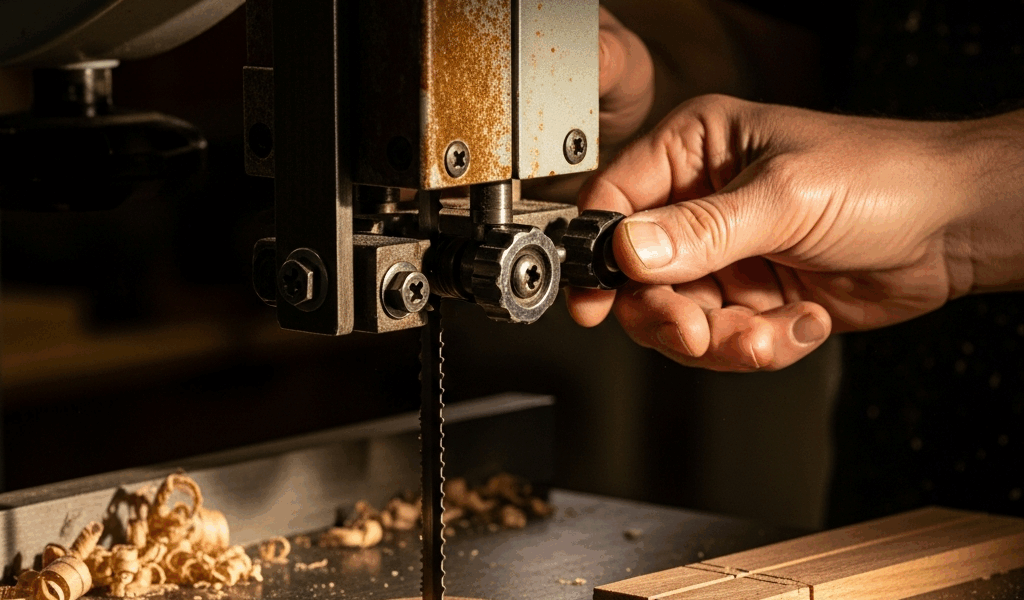
How Bad Tension Shows Up in Your Cuts
Bandsaw tension has turned into a moving target with all the conflicting advice flying around. As someone who’s run a one-man shop for fifteen years, I figured out how to handle reading a bandsaw’s problems the way a mechanic hears an engine knock. Today, I will share it all with you.
A loose blade announces itself fast. Your resawn boards come out tapered — thicker on one edge, thinner on the other. The kerf drifts sideways while you’re pushing stock through, so you’re constantly correcting your angle. Look up through the dust and you’ll actually see the blade oscillating side to side in the guides. It genuinely looks like it’s waving at you. The sound goes soft, almost mushy. Worst part? The blade pops off the wheels under heavy load. Suddenly it’s 2 p.m. on a Friday and you’re re-threading and swearing at nobody in particular.
Too much tension produces entirely different carnage. Blade breakage. Not immediately — sometimes not for weeks. Carbon steel blades go first, snapping without warning because the metal fatigues under that constant stress. Bimetal lasts longer but still fails. You’ll also catch a high-pitched whine coming off the upper wheel. Cuts look clean and straight, so everything seems fine tension-wise, but the blade is running hot. Touch the wheel covers carefully and you feel heat radiating off them. On lighter saws — WEN, Rikon, the smaller Jet models — over-tension actually warps the frame or cracks the tire on the drive wheel. I learned that the expensive way on a Rikon 10-inch I bought used off Craigslist for $180.
There’s also the frustrating middle ground where tension is almost right but the blade still drifts or cuts come out curve-heavy. That’s where most shop owners spend their time, chasing the dial and second-guessing themselves constantly.
Why the Built-In Tension Scale Lies to You
Worth saying out loud. It would’ve saved you weeks of adjusting.
Stop looking at that dial on the side of your saw. The tension indicator on most benchtop and mid-range bandsaws — Rikon, WEN, Jet 14-inch, even some Grizzlys — gets calibrated at the factory for one specific blade width. Usually half-inch. But what is the actual problem? In essence, it’s that different blade widths need different tensions entirely. But it’s much more than that — the scale is just flatly wrong the moment you install a quarter-inch or three-quarter-inch blade. The manufacturer knows this. They ship it anyway because the dial costs thirty cents and a better system costs five dollars.
I’m apparently hard on tension mechanisms and no brand works perfectly for me while the factory calibration never survives more than a year. Over time, the knob mechanism wears. Springs lose tension. The calibration drifts into meaninglessness. I’ve owned five bandsaws. Not one had an accurate tension indicator past year one. Save yourself the trouble I had of trusting the dial for longer than you should.
The Deflection Test and Flutter Test — Do These First
Real tensioning uses your hands and eyes. Both tests take sixty seconds combined. So, without further ado, let’s dive in.
The deflection test: Power off the saw. Find the blade at the midpoint between the upper and lower guides — exactly halfway down that span. Press the blade sideways with your thumb, toward the frame. You want roughly one-quarter inch of movement before the blade resists hard. That’s the target for a half-inch blade on a standard 14-inch saw.
Adjust for blade width. A quarter-inch blade should deflect slightly more — maybe three-eighths inch. A three-quarter-inch blade deflects a bit less, closer to three-sixteenths. Wider blades are stiffer, so they need less tension to hold position. That’s exactly why the dial fails — it can’t account for blade width at all. If deflection is almost nothing, the blade is over-tensioned. If it flexes a half-inch or more, it’s under-tensioned. Adjust in quarter-turns, retest, repeat. Don’t crank hard.
The flutter test: Turn on the saw. Watch the blade through the upper wheel cover — the translucent section, not the guard itself. Run the saw unloaded for ten seconds. A properly tensioned blade sits stable, moving smoothly with the tire. An under-tensioned blade oscillates visibly side to side. An over-tensioned blade won’t flutter, but you’ll hear that whine and feel heat coming off the upper wheel.
The flutter test confirms the deflection test. If deflection looked right but oscillation persists, there’s another problem entirely. That’s what makes the two-test approach endearing to us shop owners — one catches what the other misses.
Adjusting Tension Without Wrecking Your Blade or Tires
Loosen the tension knob half a turn first. This removes initial bearing pressure before you start. Then tighten in quarter-turn increments, running the deflection test between each turn. Three or four quarter-turns usually lands you in the zone.
Small saws require real caution here. A WEN or Rikon benchtop model has a light cast-iron frame — over-tension warps it. The frame bends slightly, throws off the wheel geometry, and suddenly nothing tracks correctly. The drive wheel tire can crack under sustained over-tension. It’s a $40 replacement part, annoying enough that I mention it now rather than after you’ve cracked one.
Carbon steel blades might be the best budget option, but bandsaw work requires blade longevity above almost everything else. That is because carbon blades running at full tension for eight hours daily fatigue faster than bimetal alternatives — sometimes dramatically faster. Dial back tension by about ten percent from what you’d use with bimetal when running carbon. You sacrifice some cut quality but gain meaningful blade life.
One more thing — release tension at the end of the day if the saw will sit unused for more than a week. Constant pressure on the tires causes flat spots. Won’t notice immediately. But after a month of storage under full tension, the tire develops a visible bump that creates vibration on every pass. Takes a few days of running to work itself out. Just loosen the knob all the way and tighten it fresh when you return.
When Tension Is Not the Real Problem
Here’s where troubleshooting actually saves you time. Not every bad cut traces back to tension.
Blade drift on straight cuts could be under-tension. Or it could simply be a dull blade. A dull blade wanders because the teeth aren’t cutting cleanly — they push wood instead of slicing through it. Test this fast: cut through a piece of scrap pine. If the blade tracks straight but moves slowly, the blade is dull, full stop. Sharp blades cut fast and true. Tension won’t fix dull teeth.
Visible flutter through the wheel covers might mean a blade with a kink or internal crack. Run the deflection test. If deflection reads correctly but flutter persists anyway, the blade is damaged. Replace it. That’s a $12–$25 blade, not a saw problem.
Cuts going off-square usually mean the table is tilted. Check it with a reliable square before touching the tension knob. A Starrett combination square runs about $45 and eliminates this guesswork permanently. Tensioning the blade won’t save a misaligned table.
Blade popping off under moderate load could be under-tension — or it could be a tracking problem. The blade may not be sitting centered on the wheels. Run the unloaded saw and watch blade position on the tire. It should ride centered, not drifting toward the front or back edge.
Quick elimination checklist before you touch tension: dull blade? Damaged blade? Table out of square? Tracking off? Address those first. Every time. The deflection test and flutter test are your foundation — learn those two things and you’ll tension any bandsaw correctly on the first real attempt.



Stay in the loop
Get the latest crafted wood creations updates delivered to your inbox.