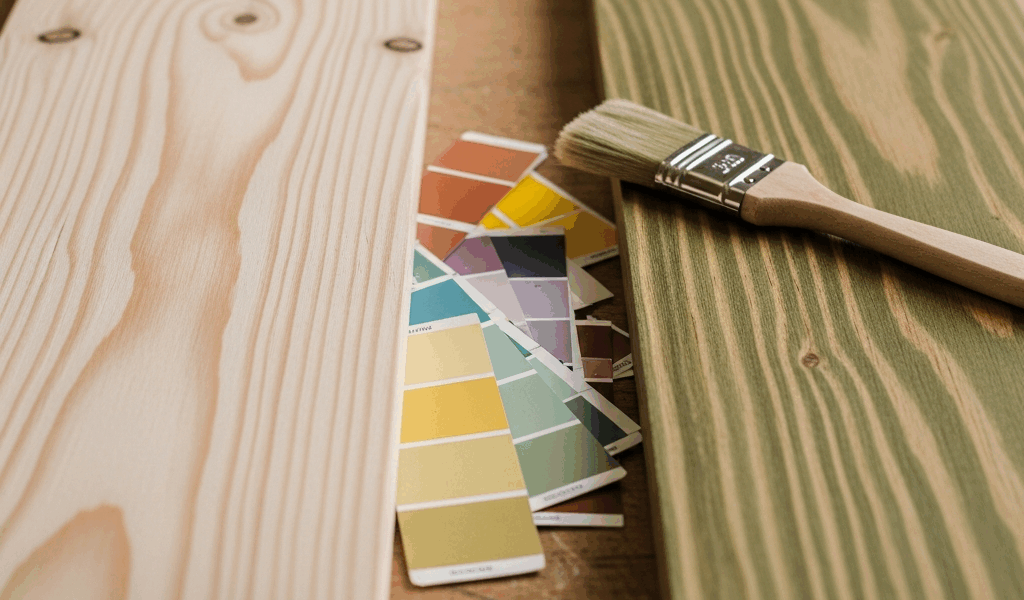
Birch vs Poplar for Painted Furniture — Which Is Better?
The birch vs poplar debate has grown more complex with the “just use whatever’s cheapest, it’s getting painted anyway” noise flying around. I’ve been building painted furniture pieces — cabinets, tables, toy boxes, shelving units — out of my garage workshop for going on eleven years now, and I’ve stood in the lumber aisle at Menards more times than I can count, cart half-full, budget already bleeding, trying to make this exact call. The honest answer — and I mean this — is that these two woods are not interchangeable. They look similar raw. They both take paint. But building a kitchen table out of poplar versus birch are two completely different decisions with two completely different outcomes five years later.
Let me walk you through what I’ve figured out. Some of it the hard way.
Hardness and Durability Under Paint
Birch sits at around 1,260 on the Janka hardness scale. Poplar lands at roughly 540. That’s not a rounding error — birch is more than twice as hard. And when you’re laying paint over a furniture piece, that gap matters more than most people want to admit.
Paint hides a lot. Grain variation, color inconsistency, minor surface flaws. What it absolutely does not hide is a dent that showed up after the finish cured. A chair painted in Sherwin-Williams Emerald Urethane — gorgeous, tough finish — will still show every gouge in soft wood underneath. I learned this personally with a set of poplar dining chairs I built for my sister-in-law back in 2019. Eight months in, the legs looked like they’d been through something. Chair legs take real abuse. Poplar doesn’t shrug it off.
Birch does. Dropped cast iron pan, dragged across tile, a kid’s backpack swinging into the corner — birch handles it. For high-contact pieces like dining tables, chairs, cabinet doors that get slammed daily, and entryway benches, birch is the right call. Full stop.
Poplar isn’t weak, exactly. It’s just not built for punishment. A shelf holding books in a guest room that never gets touched? Poplar is completely fine. A coffee table in a house with three kids under ten? Get the birch.
Real-World Impact Resistance
Frustrated by how fast a poplar tabletop I’d built started showing wear, I started running my own rough impact tests — nothing with lab equipment, just dropping a steel rule from counter height onto scrap pieces I had lying around the shop. Birch left a barely visible mark. Poplar left a dent you could catch with your fingernail. Same primer, same paint, same surface prep on both boards. The wood itself was the only variable.
That changed how I spec projects. Now birch is my default for anything living below waist height or taking regular human contact. Poplar earns a spot only when I know the piece will have an easy life.
Cost and Availability
Here’s the part worth saying first — because for most people building painted furniture on an actual budget, cost is the first filter, not the last one.
Poplar is significantly cheaper. At my local Home Depot this past spring, 1×4 poplar was running around $1.89 per linear foot. Birch boards — when they had them, which wasn’t always — ran closer to $2.70 to $2.90. On a bigger project like a built-in bookcase or a mudroom locker unit, that gap compounds fast. We’re talking $80 to $120 more in materials on a medium-sized build. That’s real money.
Availability is its own issue. Poplar is everywhere — Home Depot, Lowe’s, Menards, all of them carry it consistently in multiple widths. Solid birch boards in the dimensional lumber section? Hit or miss depending on where you live. I’ve driven to two different stores on the same morning looking for enough matching birch stock to finish a single project. That’s a cost too — just measured in time instead of dollars.
A hardwood dealer or specialty lumber yard is a different story. Those places stock birch reliably in 4/4 and 5/4 thicknesses, sometimes up to 8-inch and 10-inch widths. Worth building that relationship if painted furniture is a regular part of your work.
Budget Projects Where Poplar Wins
Trim work, built-in shelving, small decorative boxes, furniture that genuinely won’t take any abuse — poplar is a smart, practical choice in those situations. Prime it right and nobody can tell the difference from the outside. The savings are real. The finished piece looks just as good on day one. The question is always day 365 and beyond.
Paint Adhesion and Finish Quality
Both woods take paint. Neither one fights you. But they don’t behave identically, and there’s one specific poplar problem that catches people completely off guard the first time.
Poplar has a notorious tendency toward green and purple mineral streaks running through the boards. Totally natural, extremely common — you’ll see them on almost every piece you pull off the rack at a home center. Under paint, those streaks can bleed through. White is the worst situation. I’ve had poplar pieces where I laid down two coats of standard latex primer, painted them white, and within a few weeks noticed a faint greenish cast coming through certain boards. Subtle. But visible once you’ve seen it.
Shellac-based primer is the fix. Zinsser BIN — aerosol for smaller pieces, quart can for bigger ones — seals those streaks completely. Extra step, extra cost (the aerosol runs about $14 to $16), but it solves the problem reliably. Skip it and you’re gambling, especially with whites, creams, and light grays.
Birch doesn’t have this problem. Tighter grain, consistent cream-to-light-tan color throughout, no mineral streaks to worry about. Standard water-based primer — I use Sherwin-Williams Extreme Bond Primer on most of my painted work — and you go straight to topcoat. No shellac step. That saves real time and money across every single project.
Surface Prep for Both Woods
Sanding matters for both. I start at 120 grit for initial surfacing, move to 150 between primer coats, finish at 180 or 220 before the final paint coat. Birch sands cleanly and consistently. Poplar can get slightly fuzzy if your sandpaper is worn — the fibers lift a bit rather than cutting clean. Fresh sandpaper fixes it, but worth knowing before you’re halfway through a panel wondering what’s happening.
Grain raising is something to watch with poplar specifically. Wipe it down with a damp cloth before priming, let it dry completely, sand lightly — this raises the grain in a controlled way so the primer coat goes on smoother. Five-minute step. Makes a noticeable difference in final finish quality. Learn from what tripped me up of skipping it on a rush job.
The Verdict
Here’s how I actually make this call on every painted furniture project.
Poplar goes on my list when the piece is low-wear, when the budget is genuinely tight, and when long-term durability isn’t the primary concern. Interior shelving. Trim and millwork. A decorative side table that sits in a corner holding a lamp and never gets touched. Situations where appearance matters more than toughness — poplar’s lower cost and easy availability make it the practical choice, and finished properly with the right primer, it looks excellent.
Birch goes on my list when the piece needs to actually last. Kitchen and dining furniture. Chairs. Cabinets getting opened and closed several hundred times a year. Entry furniture taking daily abuse. Any painted piece where I’m promising a client quality and durability — birch is what backs that promise up. The extra cost is real. So is the difference five years out.
- Painted shelves, trim, low-use decorative furniture — poplar is the right call
- Painted tables, chairs, cabinets, and high-use pieces — birch is worth the premium
- Light paint colors on poplar — always use a shellac-based primer like Zinsser BIN
- Birch at big box stores — call ahead, it’s not always in stock
- Either wood sanded to 180 before final coat — non-negotiable for a clean painted finish
The mistake I see constantly is people choosing poplar for everything painted because it’s cheap, available, and “it’s all getting painted anyway.” I made that exact mistake early on. The paint covers the wood, yes. It does not cover the dent from a toy truck, or the gouge from a chair leg dragging across hardwood, or the slow breakdown of soft wood in a high-use spot. That’s what makes choosing correctly so endearing to us woodworkers — it’s the difference between a piece that gets handed down and one that gets replaced.
Both woods belong in a painted furniture workflow. Knowing which one fits which job — that’s the thing that separates furniture that lasts from furniture that disappoints.


Stay in the loop
Get the latest crafted wood creations updates delivered to your inbox.