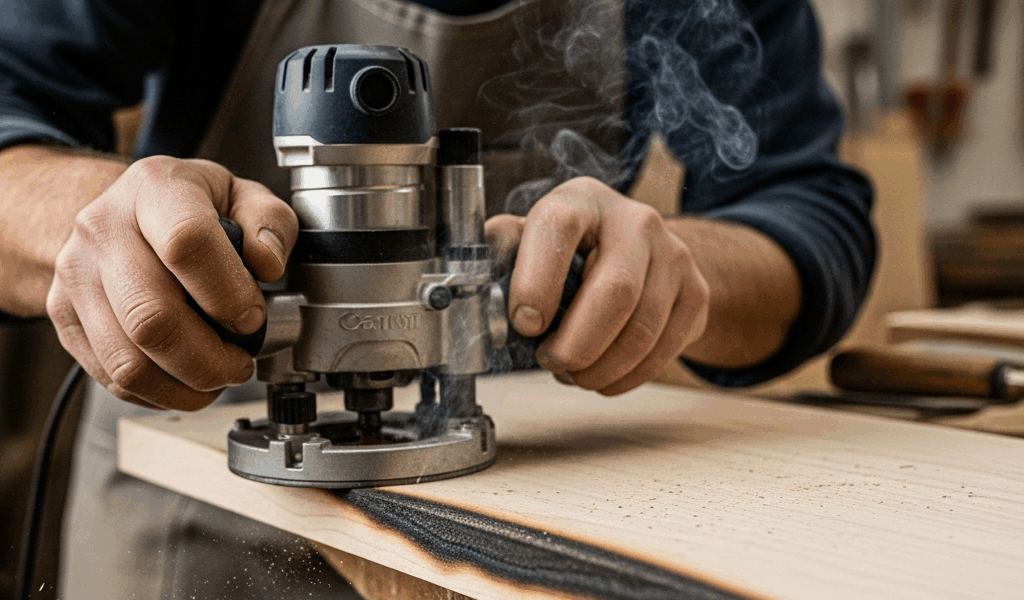
Router Bit Burning Wood — What Causes It and How to Fix It
Router bit burning has changed quite a bit thanks to the half-baked advice flying around. Everyone’s got a tip. Move slower. Move faster. Buy better bits (like Whiteside carbide router bits). Spray wax on everything. As someone who burned through two years of expensive hardwood before anything clicked, I put in the hours studying what actually causes those scorched brown stripes — and more importantly, how to stop making them. Most sources zero in on one variable when the real issue is several things colliding at once. Let me save you some ruined cherry.
This article includes affiliate links. We may earn a commission at no extra cost to you.
Feed Rate Is Almost Always the Cause
Here’s what nobody says plainly enough: moving too slowly is the single biggest reason your router bit is burning wood. When the bit spins at 18,000 RPM and you’re barely creeping along a board edge, the carbide grinds against the same fibers repeatedly. Friction stacks up. Heat follows. The wood scorches before the cut even finishes.
Burned by my own obsession with “clean, controlled cuts,” I started pushing faster — and the burn marks vanished almost entirely. Going slow feels careful. Precise. With a router, it mostly works against you.
Too fast has its own consequences, though. Tearout. Chipping on exit cuts, especially through figured grain. The sweet spot is real, and it shifts depending on what you’re cutting. Here’s how I think about it:
- Softwoods like pine: Moderate feed, roughly 3–4 feet per minute by hand. Forgiving stuff.
- Hardwoods like oak or walnut: Push a bit faster than feels comfortable. Smooth, continuous movement — zero pauses.
- Dense hardwoods like cherry or maple: Faster still. These two species are their own separate conversation, and we’ll get there.
The rule that matters most: never stop mid-cut with the bit still spinning. Even half a second produces a burn. If you need to stop — kill the bit first, then stop moving. I learned this on a maple handrail I was profiling for a client. Stopped to reposition my grip. Ruined 36 inches of $90 maple stock in about the time it takes to blink. That lesson cost more than my first router did. Steer clear of where I went wrong.
Bit diameter feeds into this too. A larger bit sweeps more material per revolution — trying to push a 2-inch roundover at the same pace as a ½-inch straight bit is asking for burns. Ease up slightly on feed rate for bigger profiles, but don’t compensate so hard that you’re crawling again.
RPM Adjustment by Bit Diameter
This is the piece to know up front — because wrong RPM can be causing burns before you even start moving the router.
Most routers ship with a variable speed (a Rockler Router Speed Control helps here) dial. Most woodworkers leave it maxed out. I ran my Bosch 1617EVSPK at full speed for the entire first year I owned it — full speed, every cut, every bit. Seemed logical. More speed, cleaner results. That’s not how physics works. A larger bit has more surface area contacting the wood. At identical RPM, the outer edge of a 2-inch bit is traveling significantly faster than the outer edge of a ½-inch bit. Too much surface speed means too much friction. Burns follow.
Here’s the speed chart I’ve settled on through trial, error, and cross-referencing a handful of manufacturer guidelines:
- Bits up to ¾ inch diameter: 22,000–24,000 RPM
- Bits ¾ inch to 1 inch: 18,000–22,000 RPM
- Bits 1 inch to 1½ inch: 14,000–18,000 RPM
- Bits 1½ inch to 2 inch: 12,000–14,000 RPM
- Bits over 2 inches — raised panel bits, large coves: 10,000–12,000 RPM maximum
If your router doesn’t go that low, that’s worth knowing. Budget routers often bottom out around 16,000 RPM — fine for small bits, but that means large panel-raising bits have no business going in them. Not safely, anyway, and definitely not without burning. The DeWalt DWP611 and Makita RT0701C both drop to around 10,000 RPM. That range matters more than most beginners realize.
Set your RPM before the cut. Match it to the bit. Then focus on keeping your feed rate moving. Those two variables together solve probably 80% of burning problems — no exaggeration.
Dull Bits Create More Friction
But what is a dull router bit, really? In essence, it’s a bit that rubs instead of cuts. But it’s much more than that — it’s a source of burning you might be blaming on your feed rate or RPM when the actual culprit is hanging in your bit storage right now.
Carbide-tipped bits last. A decent set from Freud or CMT handles hundreds of linear feet before needing attention. But they do dull — gradually, invisibly. There’s no moment it stops working. It just starts burning wood that used to come out clean. Cheap bits — the 15-piece sets for $29.99 — dull fast. Sometimes after a few cuts in dense hardwood. I’ve had bargain bits arrive from the factory already too soft for maple. Apparently quality control isn’t a priority at every price point.
Signs your bit is the problem:
- Burns show up even at correct feed rate and RPM
- The cut demands noticeably more pushing force than before
- Tearout has gotten worse on exit cuts
- The bit feels warm after a short run — router off and unplugged before you check, always
Carbide bits can be sharpened with a diamond hone — a small flat diamond file, around $15 at most woodworking stores. You sharpen only the flat face of each carbide insert, not the curved profile edge. Light passes. It extends bit life considerably and it’s worth learning. If the bit is chipped, or has already been sharpened several times, replacement is the smarter call. A quality ½-inch straight bit from Freud runs $25–$35. Cheap compared to ruined stock.
Store bits with some intention. Foam-lined cases or individual sleeves keep edges from contacting each other. A drawer full of loose router bits is a drawer full of bits quietly going dull.
Wood Species That Burn Easily
Not all wood burns equally — and that’s what makes routing such a specific skill for us woodworkers. Pine forgives a lot. Oak is relatively tolerant. Cherry and hard maple are notorious, though, and they require a different approach entirely.
Cherry is deceptive. It’s not particularly hard — Janka hardness around 950 lbf, softer than oak — but it scorches at lower temperatures than most species. The resins react to heat quickly. A brief hesitation in feed rate leaves a brown mark. Worse, light sanding on cherry often makes burns more visible rather than less, because cherry darkens unevenly under abrasion. You can sand your way into a bigger problem.
Hard maple sits around 1,450 lbf on the Janka scale. Dense enough that heat builds fast. Routing figured maple — curly or quilted — is genuinely difficult. The grain reverses constantly, and you’re always fighting tearout somewhere regardless of which direction you move.
One technique that helps significantly with both species is climb cutting. In a standard router pass, you move the router so bit rotation pushes against your direction of travel. In a climb cut, you reverse direction — moving with the rotation instead of against it. This reduces friction on the surface and dramatically cuts down on burning along cherry and maple edges.
The catch: climb cutting is less stable. The router can pull itself along the edge, which takes adjustment. Take light passes — no more than 1/16 inch at a time — and keep a firm grip. Never climb cut freehand on the interior of a workpiece. Use it on exterior profiles where you have full control, ideally with a router table fence as backup.
For cherry specifically, I’ve had good results making a light conventional pass first to establish the profile, then a very fast climb cut as a finishing pass. The finishing pass cleans up minor burning from the first without dwelling long enough to create new marks. Takes practice. Worth developing.
One more thing on species — pre-raising the grain with a damp cloth before routing does nothing for burn prevention, despite what some sources claim. Save that for sanding prep. What actually helps is making sure your stock is fully acclimated to shop humidity. Wet wood burns more readily than dry wood — moisture turns to steam under friction heat. Fresh lumber sits in my shop for at least a week before it goes near a router bit.
Router bit burning is a solvable problem. Match RPM to bit diameter, keep your feed rate moving and consistent, keep your bits sharp, and give cherry and maple the specific respect they require. Get those variables right and the burning stops. Simple as that — just not always easy.


Stay in the loop
Get the latest crafted wood creations updates delivered to your inbox.