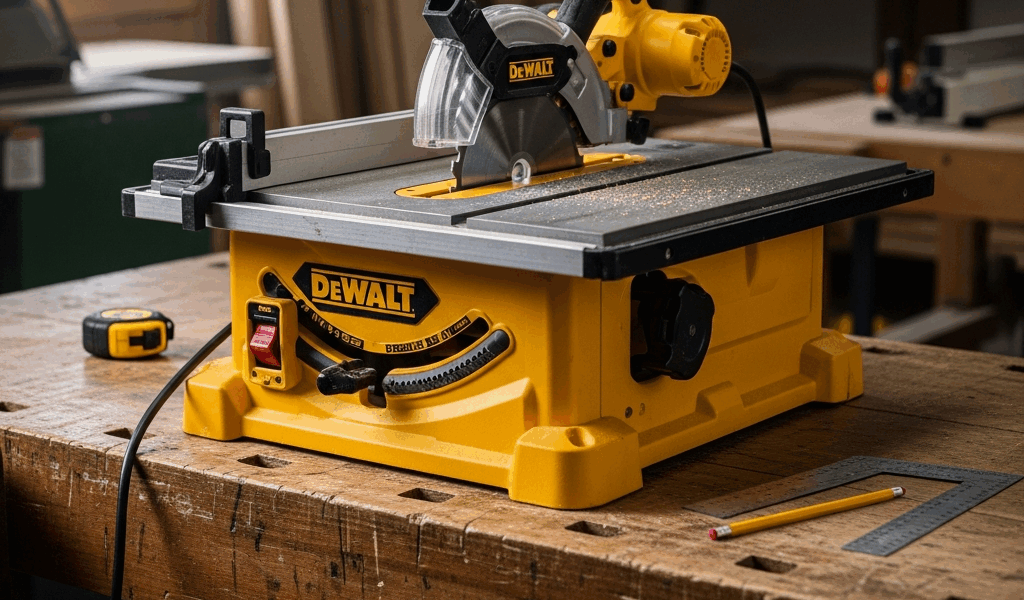
If a newly installed blade visibly moves side to side, do not test it in wood. Use the table-saw blade wobble checklist to verify compatibility, mounting faces, and runout with power disconnected.
\n\nYou bought a new blade for your DeWalt DW745 and it doesn’t sit right with the riving knife. Or worse, the cut quality is terrible even though the blade is brand new. The DW745 has a specific kerf requirement that most blade shopping guides ignore, and getting it wrong means the saw either won’t work safely or won’t cut cleanly.
The DW745 Kerf Requirement
The DW745 uses a 10-inch blade with a 5/8-inch arbor — standard so far. But the riving knife on this saw is 2.3mm thick, which means you need a thin-kerf blade. A standard (full kerf) blade cuts a 3.2mm slot. The riving knife sits in that slot behind the blade to prevent kickback. If the riving knife is wider than the blade’s kerf, it jams against the workpiece. If it’s much narrower, it doesn’t prevent the wood from closing on the blade.
The sweet spot: thin-kerf blades with a kerf width of 2.3mm to 2.5mm. These match the DW745’s riving knife perfectly. Standard kerf blades work too (the knife is thinner than the kerf), but the DW745’s 15-amp motor is a portable jobsite saw — it doesn’t have the horsepower to drive a full-kerf blade through hardwood as smoothly as a cabinet saw does. Thin kerf requires less power and produces better results on this machine.
This article includes affiliate links. We may earn a commission at no extra cost to you.
Best Overall — Freud LU87R010 40T
The Freud LU87R010 is a 10-inch, 40-tooth thin-kerf combination blade that handles ripping and crosscutting in a single blade. The 40-tooth count is the ideal all-purpose configuration — enough teeth for clean crosscuts, few enough for efficient ripping. The thin kerf matches the DW745’s riving knife and reduces the load on the motor.
This is the blade to buy if you only want one blade for your DW745. It rips 3/4-inch plywood cleanly, crosscuts hardwood without significant tear-out, and handles sheet goods without bogging down. The TiCo hi-density carbide tips hold an edge longer than most competitors at this price point (~$40-50).
Best for Ripping — Freud LM72R010 24T
If you do a lot of ripping — breaking down lumber along the grain — a dedicated 24-tooth rip blade makes a noticeable difference. Fewer teeth means more aggressive chip removal, less heat, and faster cuts. The Freud LM72R010 is a thin-kerf 24-tooth blade designed specifically for ripping solid lumber.
The trade-off is crosscut quality — 24 teeth leaves a rougher edge on crosscuts than 40 teeth. If you’re ripping lumber to rough dimension and then cleaning up on a jointer or with a hand plane, this blade is ideal. If you need finished-quality edges straight off the saw, stick with the 40-tooth combination blade.
Best for Fine Finish — Diablo D1060X 60T
When you need glass-smooth crosscuts on hardwood or tear-free cuts on veneered plywood, a 60-tooth thin-kerf blade is the right tool. The Diablo D1060X produces finish-ready edges that need minimal sanding. It’s particularly good on plywood and melamine where tear-out on the veneer face is the primary concern.
Don’t use this blade for ripping — 60 teeth creates too much friction on long rip cuts, especially in hardwood. The DW745’s motor will bog down and the blade will overheat. Save the 60-tooth for crosscuts and sheet goods, and swap to the 24T or 40T for ripping.
Best Budget — Irwin Marples 60T
The Irwin Marples 60-tooth thin-kerf blade runs about $25-30 — roughly half the price of the Freud and Diablo options. Cut quality is good but not exceptional. The carbide tips dull faster than Freud’s TiCo tips, so you’ll replace or sharpen sooner. But for a hobbyist working primarily in softwood and plywood, the Marples delivers clean cuts at a price that’s easy to justify.
It’s also a reasonable choice as a “shop beater” blade — the blade you leave on the saw for rough work so you don’t dull your good blade on construction lumber with embedded nails.
Blades to Avoid on the DW745
Standard (full) kerf blades from Forrest, CMT, or others: They’ll physically fit the arbor, but the 3.2mm kerf demands more motor power than the DW745 delivers comfortably. You’ll notice slower feed rates, more motor strain, and a higher risk of kickback when the motor bogs mid-cut.
Blades with the wrong arbor size: The DW745 uses a 5/8-inch arbor. Some 10-inch blades have a 1-inch arbor with a reducer bushing. These work mechanically but the bushing can introduce wobble, which affects cut quality and safety.
Cheap 100+ tooth blades: Too many teeth on a 15-amp saw means excessive friction, slow feed rates, and burn marks on hardwood. Save the high-tooth-count blades for cabinet saws with 3+ HP motors.
How Often to Change the Blade
A quality thin-kerf blade on the DW745 should last 6-12 months of regular hobbyist use before needing sharpening. Signs it’s time: burn marks on clean-cutting wood species (especially poplar and pine, which shouldn’t burn), increased resistance during feed, and visible rounding on the carbide tips under magnification.
Professional sharpening costs $15-25 per blade and restores the edge to near-new quality. Most blades can be resharpened 3-5 times before the carbide tips are too thin. At $40-50 per blade with 3-5 sharpenings, the per-cut cost of a quality blade is remarkably low compared to burning through cheap blades every few months.


Stay in the loop
Get the latest crafted wood creations updates delivered to your inbox.