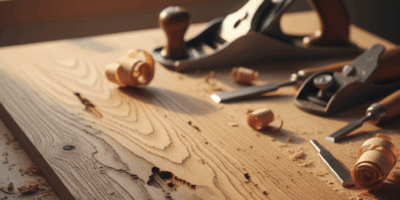
Wood grain has gotten talked about in woodworking circles for decades without always being explained clearly. As a woodworker who has spent a lot of time learning to read wood before cutting it, I can tell you that understanding grain structure changes how you approach every tool and every finish. Today, I’ll share everything I know about wood grain patterns and what they mean in practice.
How Trees Create Grain
Wood grain results from the tree’s annual growth pattern. Each year, the tree adds a new layer of cells between the bark and the previous year’s growth — the familiar rings visible on end grain. Those rings are the foundation of everything that follows about how wood behaves.
Early Wood and Late Wood
Spring growth produces large, thin-walled cells (early wood or spring wood) when water flows freely. These light-colored cells conduct water well but provide less structural strength. Summer growth slows as water becomes scarcer, producing late wood cells with thick walls and small openings that appear darker and carry most of the wood’s structural strength.
The contrast between early and late wood creates visible grain patterns. Dramatic-contrast species like oak and ash show pronounced grain. Maple and birch have subtle patterns because their growth rates stay more consistent throughout the season.
Rays and Cell Structure
Rays run perpendicular to the growth rings, carrying nutrients horizontally through the trunk. In oak especially, these rays create the ray fleck figure that quartersawn oak is known for. Wood cells align vertically in the trunk, creating the fiber structure we call grain — and the angle and uniformity of that alignment determines how the wood behaves under tools.
Reading Grain Direction
Knowing which way grain runs keeps you from tearing out fibers with a plane, lets you split wood cleanly along the grain, and tells you how a board will move with seasonal moisture changes. I spend more time reading boards at the lumber yard than most people do, and it’s paid back every time a figured piece planes out clean on the first pass instead of the fifth.
The Hand Test
Run your hand along a board’s face. One direction feels smooth; the other catches. The smooth direction shows you the grain slope. Plane in the direction your hand slides smoothly — planing against it lifts fibers and creates tearout that has to be scraped or sanded out afterward. On expensive figured wood, this distinction is not minor.
Visual Indicators
Look at the board’s edge and find where grain lines meet the surface. Lines should slope downward in your planing direction — like shingles on a roof, not against them. Cathedral patterns on flat-sawn boards point toward the planing direction. Knots reveal local grain direction too — fibers wrap around knots, and routing or planing into a knot rather than away from it always ends badly.
Reversing Grain
Figured wood reverses grain direction multiple times across the same board. Curly maple alternates bands of opposing fiber direction. These boards need very sharp tools, genuinely light cuts, and a higher cutting angle — 55 to 60 degrees versus the standard 45. A Lie-Nielsen No. 4 in bevel-up configuration, or a good scraper plane, handles reversing grain far better than a standard bench plane. Trying to muscle through curly maple with a coarsely set plane is how you learn this lesson in about two minutes.
Plain Sawn vs. Quarter Sawn
How a log gets broken down into boards dramatically affects grain appearance and dimensional stability.
Plain Sawing
Plain sawing cuts boards tangent to the growth rings — efficient, wide boards, minimal waste. Plain-sawn boards show cathedral or flame patterns on the face grain. They move more across their width as humidity changes and cup toward the bark side as they dry. Furniture construction needs to account for that movement explicitly. Ignore it and joints open, panels crack, drawer sides bind.
Quarter Sawing
Quarter sawing cuts radially, so growth rings meet the face at 45 to 90 degrees. In white oak this reveals the ray fleck — the shimmering horizontal bands that make quartersawn white oak distinctive and unmistakable. Quartersawn boards move less across their width and are significantly more stable than plain-sawn stock. Drawer sides, tabletops, musical instrument tops, and period furniture reproductions benefit from that stability. Quartersawn lumber is more expensive and produces narrower boards, which is why it costs more and gets specified intentionally rather than by default.
Rift Sawing
Rift sawing cuts at angles between plain and quarter, producing straight grain without ray fleck. Table legs and chair parts often use rift-sawn stock precisely because it shows consistent, clean grain on all four faces rather than the figure-on-two-sides look of plain-sawn stock.
Common Grain Figures
Curly Grain
Curly figure — also called tiger stripe — appears when fibers grow in alternating waves, creating bands that seem to shift as you move around the piece. Curly maple is the most common. The phenomenon occurs randomly in a small percentage of trees, which is why the boards command premium prices at the lumber yard. Finding a truly spectacular piece of curly maple on the rack is still satisfying every time.
Bird’s Eye
Small circular patterns scattered across the face, most common in hard maple. The eyes are stunted buds the tree grew around. The random distribution makes matching difficult across large surfaces — book-matching bird’s eye maple is a puzzle that can take longer than the actual woodworking.
Quilted Figure
Quilted wood shows a three-dimensional pillow or bubble effect even though the surface is flat. Big-leaf maple from the Pacific Northwest produces spectacular quilted figure. The chatoyance — the light-shift effect as you move around the piece — on a finished quilted panel is hard to describe to someone who hasn’t seen it in person.
Burl
Burls develop when trees experience stress from insects, disease, or injury. The grain swirls chaotically in every direction. Beautiful to finish, genuinely difficult to machine. Hand work and abrasives give better results than edge tools on burls. Small cracks and voids often need stabilization with thin cyanoacrylate before finishing — otherwise the finish pulls them open slightly as it cures.
Crotch Figure
Where a trunk divides into branches, grain swirls in complex feather-like patterns. Walnut and mahogany crotches have been prized for veneer work for centuries. Working crotch figure solid rather than as veneer is a challenge — the grain runs in too many directions at once for any single tool approach to handle cleanly.
Spalting
Fungal colonization creates black zone lines and color variations in partially decayed wood. Spalted maple and beech can be striking. The process requires timing — not enough colonization gives faint lines, too much gives punky wood that won’t hold an edge or take a finish cleanly. I’ve attempted to deliberately spalt maple blanks twice with inconsistent results. The controlled version is harder than the accidental version.
Grain and Tool Performance
Planing
Straight grain planes cleanly at standard cutting angles. Interlocked or figured grain requires higher cutting angles to prevent tearout. Sharp tools matter more on difficult grain than on any other condition in woodworking — a dull iron that gets through straight-grained pine without drama creates disasters on figured stock. Multiple light passes beat one aggressive cut on any grain that resists the tool.
Sawing
Crosscut teeth slice fibers for cuts across the grain. Rip teeth chip away material for cuts along the grain. Score cut lines with a marking knife before sawing figured grain to prevent splintering at the surface where the blade exits.
Routing
Routers produce clean surfaces on most grain. Problems occur when grain runs out of the cut direction. Climb cutting — feeding against normal direction — can help on difficult grain but requires firm grip, light passes, and the understanding that the bit wants to pull the router rather than resist it.
Scraping
A properly tuned and burnished card scraper handles figured wood that defeats planes. The nearly perpendicular cutting angle eliminates tearout regardless of grain direction. A Lie-Nielsen or Veritas scraper with a well-turned burr leaves surfaces ready for finish without additional sanding on even the most challenging figured wood.
Grain and Wood Movement
Wood constantly exchanges moisture with its environment, and grain orientation determines how and where movement occurs. Wood moves dramatically across the grain but barely along it — a 12-inch-wide board might move 1/4 inch across its width over the seasons while barely changing in length. This differential movement is what causes warping, cracking, and joint failure when designs don’t accommodate it. Frame and panel construction, breadboard ends, and tabletop buttons that float the top over the base are traditional design solutions to a fundamental material reality.
Grain and Finishing
Open-grain species like oak and ash have visible pores that absorb finish unevenly. Fill them for a glassy smooth surface or leave them open for a textured natural look — both are intentional choices. Closed-grain species like maple and cherry have tiny invisible pores and finish smooth without filling.
Blotching is the real enemy on pine, cherry, and soft maple. Wood conditioner before staining helps but doesn’t eliminate it. Gel stains sit on the surface rather than penetrating and provide more even color. Dye stains absorb more evenly than pigmented stains and actually enhance chatoyance in figured wood rather than filling it with color and obscuring the depth.
Before You Go
Reading grain becomes instinctive with practice. Study boards before cutting — look at the edge, run your hand along the face, identify the cut from the growth ring angle on the end. Handle different species at the lumber yard. Examine finished furniture for the grain decisions behind it. The wood tells you how it wants to be worked. The better you read that, the less you fight it, and the better everything you build becomes.


Stay in the loop
Get the latest crafted wood creations updates delivered to your inbox.