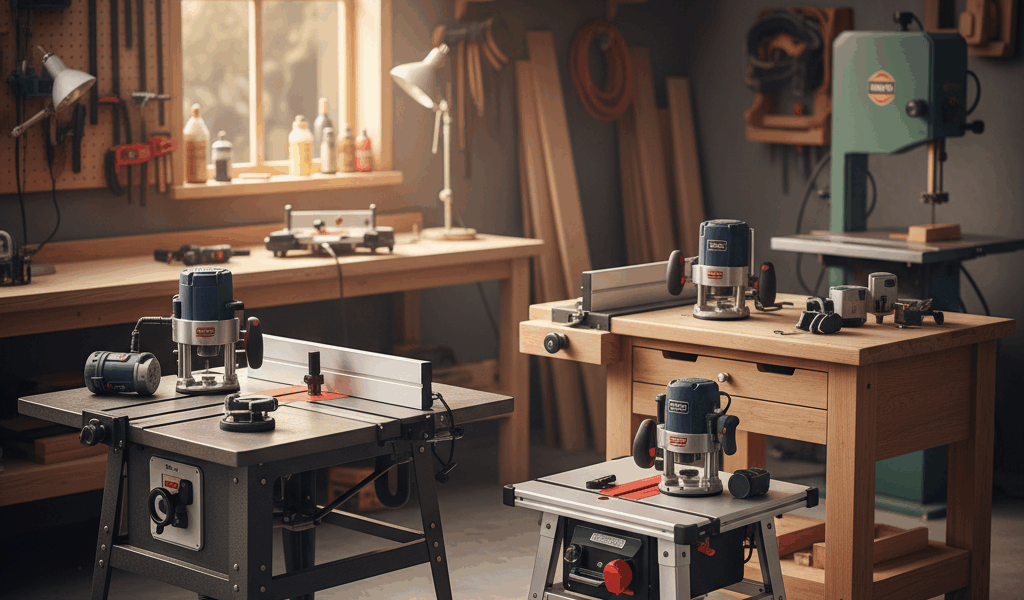
The Bosch RA1181 is the best router table for a small shop or first setup because it is portable, has an aluminum top and plate, includes a tall fence and featherboards, and works with many common fixed-base routers. For a full-size freestanding system, the Kreg PRS1045 provides a larger 24-by-32-inch top, adjustable stand, T-square-style fence, and micro-adjustment. Serious furniture and cabinet shops should compare the JessEm Mast-R-Lift Excel II and Rockler ProMax cast-iron systems, while a Bench Dog ProMAX extension is the space-saving choice for a compatible table saw.
Compatibility comes before ranking. A table, insert plate, router lift, and motor must fit each other mechanically, and the opening must safely support the intended bit. Confirm every model number and dimension with the manufacturer before ordering.
Best router tables at a glance
| Best for | Router table | Work surface | Important limitation |
|---|---|---|---|
| Benchtop and first shop | Bosch RA1181 | Aluminum | No integrated router lift; confirm router mounting |
| Full-size general woodworking | Kreg PRS1045 | 24 × 32-inch laminate top | Router and power switch are separate |
| Premium lift-based system | JessEm Mast-R-Lift Excel II | Phenolic | Verify motor diameter and included stand/package |
| Heavy production-style setup | Rockler ProMax Ultra with integrated lift | Cast iron | Heavy and requires compatible router motor |
| Space-saving table-saw extension | Bench Dog ProMAX | Cast iron | Table-saw dimensions and motor clearance must match |
1. Bosch RA1181: best benchtop router table
The Bosch RA1181 is the most practical entry point for a garage or shared workbench. Bosch specifies a 27-inch-wide aluminum work surface, rigid aluminum mounting plate, tall adjustable fence, two featherboards, starter pin and guard, and a 2-1/2-inch dust port. At roughly 30 pounds, it can be moved without behaving like a lightweight plastic accessory during a cut.
The mounting plate is drilled for a published list of Bosch, DeWalt, Makita, Milwaukee, Porter-Cable, Ryobi, and other routers, but compatibility is model-specific. Some plunge routers work only through a fixed base. Above-table height access also depends on the router and may require a correctly placed access hole.
Choose it if: you need a capable portable table and already own a compatible router. Skip it if: you want integrated lift adjustment, a cabinet, or a large surface for long stock.
2. Kreg PRS1045: best full-size router table system
The Kreg PRS1045 Precision Router Table System combines a 24-by-32-inch, one-inch-thick reinforced laminate top with an adjustable steel stand and Kreg’s T-square-style aluminum fence. The fence locks at both ends and includes micro-adjustment, independent faces, dust collection, and jointing rods.
The stand adjusts from 31 to 39 inches, which is useful when matching an existing outfeed surface or setting a comfortable working height. The package includes an insert plate and levelers, but buyers still need to verify router mounting and decide whether a separate lift, safety switch, casters, or cabinet is required.
Choose it if: you want an expandable freestanding system with a strong fence. Skip it if: portability or an integrated lift matters more than surface area and modularity.
3. JessEm Mast-R-Lift Excel II: best premium phenolic system
The JessEm Mast-R-Lift Excel II combines a phenolic table with an integrated lift mechanism. Its value is precise above-table bit-height adjustment and a rigid, moisture-resistant surface without a separate lift plate seam. This is aimed at furniture makers, cabinet shops, and advanced users who change bits and setups frequently.
The name describes the core table system, not necessarily every component shown in a retailer’s package. Confirm the current contents, fence, stand, switch, insert rings, and router-motor compatibility. Lift clamping ranges are based on motor diameter; a plunge base is not mounted into the lift as a complete unit.
Choose it if: repeatable height adjustment and a premium integrated lift justify the cost. Skip it if: you need a complete low-cost package or want to reuse an incompatible router base.
4. Rockler ProMax Ultra: best cast-iron router table with integrated lift
The Rockler ProMax Ultra uses a 24-by-32-inch cast-iron surface with the lift built into the casting. Rockler specifies a 1-3/4-inch-thick top, side-mounted coarse and fine height controls, snap-in insert rings, and machined miter and accessory tracks. The mass damps vibration and resists the sag that can develop around a separate plate in a softer top.
That mass is also the main practical drawback. The top alone is extremely heavy and needs a properly rated stand or cabinet. The integrated lift accepts specific cylindrical router motors, sometimes with an adapter; verify diameter and clearance before purchase. Fence, stand, cabinet, dust enclosure, and switch may be separate.
Choose it if: flatness, vibration damping, and lift convenience matter in a stationary shop. Skip it if: you move tools often or need a ready-to-run package at a modest cost.
5. Bench Dog ProMAX: best router-table extension for a table saw
The Bench Dog ProMAX cast-iron extension replaces or extends a compatible table-saw wing, using the saw’s footprint and support structure instead of consuming floor space for another stand. It includes a cast-iron surface, fence, and miter slot but requires a compatible plate or lift.
This is not a universal bolt-on part. Rockler specifies a 27-inch-deep, 1-1/2-inch-thick table-saw surface, and some installations require drilling or additional rails and legs. Motor protrusion on left- or right-tilt cabinet saws can rule out a position. Compare the mounting-hole diagram, saw-fence rail, tilt direction, motor clearance, and support requirements before buying.
Choose it if: floor space is scarce and the saw is dimensionally compatible. Skip it if: installation would compromise the table-saw fence, motor access, outfeed path, or stability.
Router table comparison: what matters
Flatness and plate leveling
The workpiece must pass across the table, insert, and ring without catching or changing height. A plate that sits proud can tip the stock; one below the surface can create a dip near the cutter. Look for multiple leveling points and a way to lock the plate. Check flatness with a known straightedge across several directions.
Fence rigidity and face alignment
A router-table fence does not need to be parallel to a miter slot for ordinary bearingless edge routing, but its two faces must be coplanar unless intentionally offset for jointing. Deflection changes cut depth. Independent faces should close near the bit without contacting it, and the dust port should not force the fence out of alignment.
Insert plate and lift compatibility
Plate openings vary. Common dimensions are not interchangeable simply because they look similar. Check length, width, corner radius, thickness, leveling method, ring system, mounting pattern, lift model, router-motor diameter, and maximum bit opening. Do not modify a structural plate or lift unless its manufacturer permits it.
Router power and speed
A compact trim router is useful for light profiles but is not a substitute for a mid-size or full-size motor when swinging large panel-raising bits. Large-diameter bits require lower speeds and a table and opening rated for them. Use the bit maker’s maximum RPM as a limit, not a target, and make multiple shallow passes.
Dust collection
Fence collection captures chips thrown behind a straight cut. A below-table enclosure can capture debris that falls around the motor, but it must preserve motor cooling and adjustment access. Match port sizes to the extractor and avoid starving a router’s cooling airflow.
Power switch and emergency access
A front-mounted, no-voltage-release or paddle-style switch lets the operator stop the router without reaching beneath the table. Confirm the switch’s electrical rating matches the router. Unplug the system before installing a bit, changing an insert ring, adjusting the plate, or reaching near the cutter.
Benchtop vs freestanding vs table-saw extension
- Benchtop: lowest space commitment and easiest storage; smaller work surface and usually under-table adjustment.
- Freestanding: best balance of surface, fence, storage, dust collection, and upgrade options; consumes dedicated floor space.
- Table-saw extension: conserves floor space and can add cast-iron mass; demands exact saw compatibility and careful support.
- Cabinet or cast-iron production system: excellent stability, lift access, and dust-control potential; expensive and difficult to move.
Router-table safety essentials
- Read the router, table, lift, fence, and bit instructions before assembly.
- Disconnect power before touching the bit or opening.
- Use the smallest insert-ring opening that safely clears the cutter.
- Verify the bit is fully secured with adequate shank engagement; do not bottom the shank against the collet.
- Set speed at or below the bit manufacturer’s maximum for that diameter.
- Use a fence, guard, featherboards, push blocks, and hold-downs appropriate to the cut.
- With a fence and the bit viewed from above, feed stock from right to left so the cutter resists the feed. Never make a climb cut unless a documented procedure and tooling specifically require it.
- Start with the workpiece clear of the bit and wait for full speed.
- Take shallow passes; do not trap stock between the bit and fence.
- Wear eye and hearing protection and connect suitable dust collection.
Freehand routing with a starter pin, template, or bearing-guided bit follows different workpiece-direction rules around the cutter. Follow the table and bit instructions rather than applying the fence rule blindly.
Frequently asked questions
What is the best router table for beginners?
The Bosch RA1181 is the most straightforward benchtop choice when the router appears on Bosch’s compatibility list. It includes a usable fence, plate, featherboards, guard, starter pin, and dust port without requiring a custom cabinet.
Do I need a router lift?
No. A lift is valuable when bit height changes and above-table bit access are frequent. A router with built-in above-table adjustment may meet occasional needs for less money. Compatibility and minimal backlash matter more than owning a lift.
Can any router go in a router table?
No. The base or cylindrical motor must match the plate or lift, and the router must be appropriate for inverted use. Verify mounting, adjustment access, switch behavior, speed control, bit capacity, cooling, and manufacturer guidance.
Is MDF, phenolic, aluminum, or cast iron best?
Reinforced laminate MDF offers mass and value; phenolic resists moisture and stays slick; aluminum is durable and portable; cast iron provides maximum mass and vibration damping. Construction and flatness matter more than material alone.
After choosing a system, use our guides to diagnose a router-table fence that is not square, compare 1/4-inch and 1/2-inch router collets, and set router-bit RPM by diameter.




Stay in the loop
Get the latest crafted wood creations updates delivered to your inbox.